 أفيتاس هوم
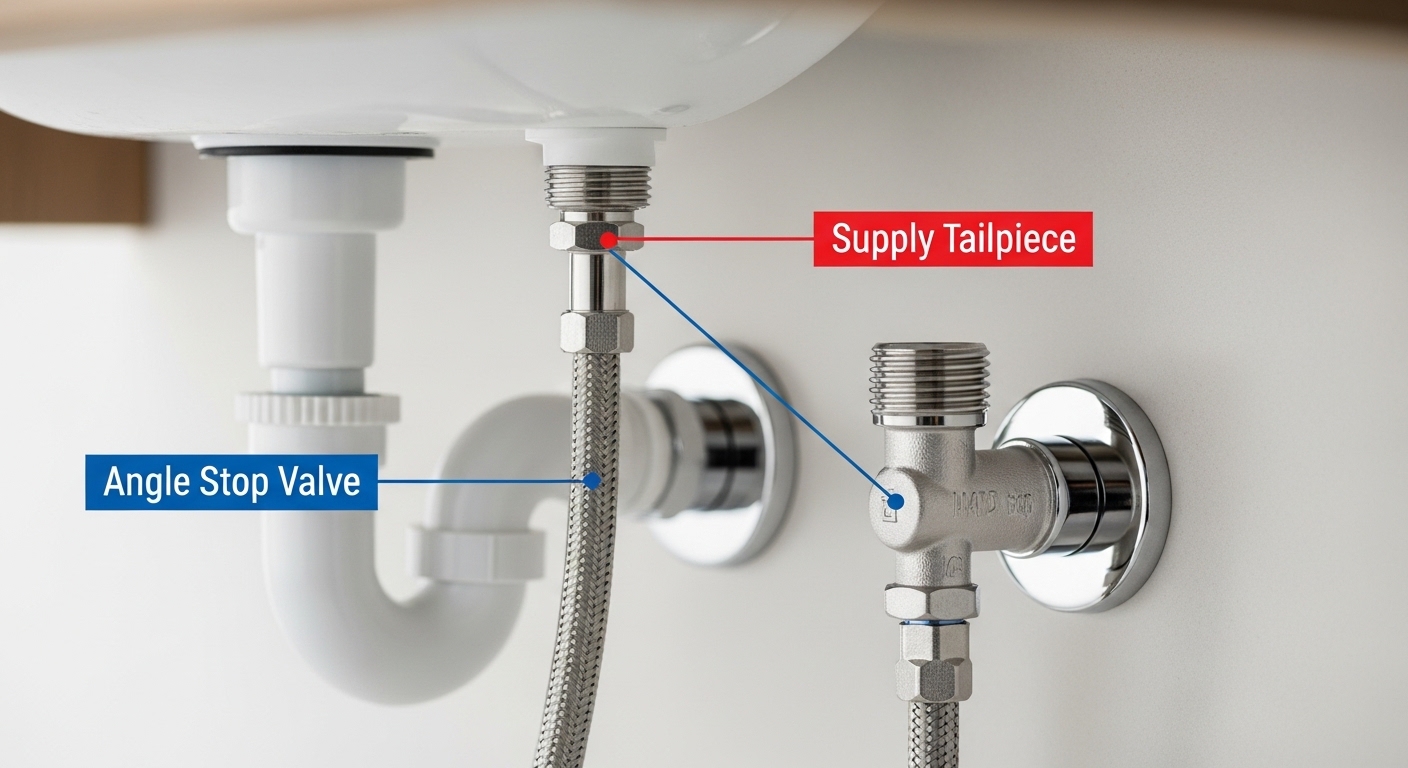
If you’re staring at the tangle of tubes under your sink wondering about the most common faucet supply line size, here’s the short version: the connections almost always come as a pair — a 3/8-inch compression fitting that threads onto the angle stop (shutoff valve) coming out of the wall, and a 1/2-inch IPS (iron pipe size) female fitting that threads onto the faucet’s tailpiece. The tube itself is usually 3/8″ nominal. That combo covers the overwhelming majority of kitchen and bathroom faucets sold in the United States, which is exactly why hardware stores stack it by the hundreds.
But “most common” isn’t the same as “guaranteed to fit yours.” Faucet threads, valve outlets, and even the measuring system (inches vs. millimeters) vary just enough to leave you standing in the plumbing aisle second-guessing yourself. So let’s walk through what these numbers actually mean, how to measure what you have, and how to pick a line that seals on the first try — no midnight leaks.
So What Size Is a Standard Faucet Supply Line, Really?
A standard faucet supply line is a 3/8″ compression connection on the valve side and a 1/2″ IPS connection on the faucet side. Those two numbers describe the ends, not the width of the water passage, and that’s where most of the confusion starts.
Here’s the thing people miss: the size printed on the package describes the threads and fittings, not how much water flows through. A “3/8-inch” compression fitting actually mates to a tube with a 3/8″ outer diameter, and the real opening inside is closer to 1/4″. Meanwhile the “1/2-inch IPS” end refers to an old iron-pipe thread standard — the thread is roughly 13/16″ across if you actually put calipers on it, which is why measuring the visible thread never matches the label. Don’t fight it; just learn the pairings.
Three fitting types cover almost everything you’ll meet under a sink:
- 3/8″ compression (comp) — a smooth, threaded fitting with a captive nut. This is what screws onto most modern quarter-turn shutoff valves.
- 1/2″ IPS (also called 1/2″ FIP for the female version) — a tapered pipe thread. This is what most faucet supply tailpieces use, and it’s the faucet-end standard on the majority of braided lines.
- 7/16″ and 1/2″ faucet-specific slip/coupling nuts — used by some faucet brands (Delta, Moen, American Standard) whose tailpiece takes a specific coupling nut rather than raw IPS threads.
The single most-sold flexible line in America is labeled something like “3/8″ Comp × 1/2″ F.I.P.” — and if your faucet and valve are both standard, that’s your part.
What’s the Difference Between 3/8″, 1/2″, and 7/16″ Supply Line Fittings?
They’re different connection standards, and mixing them up is the #1 reason a “new” supply line leaks. The valve end is usually 3/8″ compression; the faucet end is usually 1/2″ IPS or a brand-specific coupling that measures around 7/16″ or 1/2″ across the threads.
Think of a supply line as a translator between two things that were made separately: the shutoff valve (installed by whoever plumbed the house) and the faucet (chosen by you). The line’s whole job is to bridge those two threads and seal at both ends. So you need to identify each end independently.
| Fitting label | Where it’s used | Actual measurement clue | Common on |
|---|---|---|---|
| 3/8″ Compression | Shutoff valve / angle stop end | Nut ~9/16″ across flats; tube OD 3/8″ | ~90% of modern U.S. shutoff valves |
| 1/2″ IPS / FIP | Faucet tailpiece end | Female thread bore ~5/8″–13/16″ | Most standard bathroom & kitchen faucets |
| 7/16″ Slip / coupling | Certain faucet tailpieces | Smaller coupling nut, no tapered thread | Some Delta, Moen, Peerless faucets |
| 1/2″ Compression | Older or dishwasher/valve outlets | Larger nut, tube OD 1/2″ | Some older homes, some toilets |
| M10 / M8 / 15mm (metric) | Imported / European faucets | Fine metric thread | Many import brands & bidet faucets |
Notice the pattern: the valve end is boringly consistent (3/8″ comp), while the faucet end is where variety lives. That’s why many faucets ship with their own pre-attached supply hoses — the manufacturer already solved the faucet-side thread for you, and you only have to deal with the valve end. If yours has captive hoses, you’re often just matching them to a 3/8″ comp valve.
How Do I Measure My Faucet Supply Line Before Buying a New One?
Measure the tube’s outer diameter and identify the thread type at each end — don’t guess from the printed label on the old line, because it may have been the wrong part all along. Five minutes with a tape measure and a phone camera saves a second trip to the store.
Here’s a reliable order to do it:
- Shut off the water at the angle stop under the sink (turn the small oval or football-shaped handle clockwise until it stops). Open the faucet to release pressure.
- Measure the tube’s outer diameter with a caliper or by wrapping a strip of paper around it. A 3/8″ line is about 1/2″ around the outside once you include the wall thickness; the printed “3/8” refers to the OD of the rigid tube standard.
- Look at the valve end. If the nut is smooth-sided and about 9/16″ across the flats, it’s 3/8″ compression. This is your answer 9 times out of 10.
- Look at the faucet end. Is it a tapered pipe thread (IPS) or a straight coupling nut? Tapered + about 5/8″ bore = 1/2″ IPS. A shorter, straight coupling nut usually means a brand-specific size.
- Measure the length you need — from the valve outlet to the faucet tailpiece, then add 2–3 inches of slack so the line curves gently instead of kinking.
One more tip: take a clear photo of both fittings and bring your old line to the store. If you’re also confused about the little screen on the faucet spout, that’s a separate spec — our guide on faucet aerator thread size and how to measure it walks through that thread the same careful way.
Are Faucet Supply Lines Universal, or Do I Need an Exact Match?
Supply lines are nearly universal because 3/8″ comp × 1/2″ IPS fits the vast majority of setups — but “nearly” is doing real work in that sentence, and the exceptions bite. You still need to confirm both ends before you buy.
The reason they feel universal is that U.S. residential plumbing standardized on the 3/8″ compression angle stop decades ago, and faucet makers standardized on 1/2″ IPS tailpieces to match. So one part number genuinely does cover most kitchens and bathrooms. The catch is the outliers: imported faucets with metric threads, older homes with 1/2″ compression valves, dishwasher and pot-filler branches, and some brand-specific coupling nuts. We dug into exactly where “universal” holds up and where it breaks in our companion piece, are kitchen faucet supply lines universal, or do I need a specific size? — worth a read if your setup looks unusual.
Bottom line: buy the standard 3/8″ comp × 1/2″ IPS braided line as your default, but verify. And if either end doesn’t match, don’t force it — use a proper brass adapter rather than an over-tightened, half-threaded connection that will weep for months.
Braided Stainless vs. Rigid vs. PEX Supply Lines — Which Length and Material Should I Get?
For almost everyone, a braided stainless-steel line 16–20 inches long is the best choice — it’s flexible, burst-resistant, and forgiving of imperfect angles. Rigid chrome tubes look cleaner in exposed installs but are unforgiving; PEX and poly lines are cheap but better suited to specific applications.
Material matters more than people think, because a supply line is one of the few parts in your home under constant water pressure 24/7. When one fails, it doesn’t drip — it sprays. Here’s how the common options compare:
| Type | Best for | Pros | Watch out for |
|---|---|---|---|
| Braided stainless steel | Most kitchen & bath faucets | Flexible, burst-resistant, easy install | Cheap ones use plastic nuts — pick metal |
| Rigid chrome / copper | Exposed, visible connections | Clean look, durable | Must be bent precisely; kinks ruin it |
| PEX / poly flexible | Budget or DIY runs | Very cheap, no corrosion | Softer fittings; not for high heat near tailpiece |
| Vinyl / plastic braid | Light-duty, low pressure | Lowest cost | Shorter lifespan; avoid for main faucets |
On length: measure the real distance and add a couple inches. Too short and you’ll strain the fittings into a leak; too long and the line coils and kinks. Common stock lengths are 12″, 16″, 20″, and 24″ — a 16″ or 20″ line covers most under-sink situations. For sizing, the standard 3/8″ comp × 1/2″ IPS remains the most common faucet supply line size across all of these materials, so the material choice doesn’t change your thread math.
Also worth knowing: replace both hot and cold lines at the same time. They’re the same age and the same price, and a fresh pair eliminates the “which one is leaking?” guessing game. If your under-sink drama is actually a slow drip rather than a burst line, our step-by-step on how to fix a leaky bathroom sink faucet yourself covers diagnosing the source before you swap parts.
How Do I Install a New Supply Line Without It Leaking?
Hand-tighten the nut, then turn it only about a quarter- to half-turn more with a wrench — supply-line fittings seal with a rubber cone gasket, not brute force, so overtightening is the leading cause of leaks. Turn the water back on slowly and watch both ends for a full minute.
Here’s a clean, repeatable procedure:
- Confirm the water is off and the faucet is open to drain pressure.
- Thread the faucet end on first by hand — start it straight to avoid cross-threading, which is easy to do on brass tailpieces.
- Thread the valve end onto the shutoff, again by hand until snug.
- Snug both with a wrench — a quarter to half turn past hand-tight. For a 3/8″ comp connection you usually don’t need Teflon tape because it seals on a ferrule or cone; for tapered IPS threads a few wraps of tape or pipe dope help.
- Open the shutoff slowly and inspect. Run your finger under each nut after 60 seconds. Dry? You’re done. A drop? Snug it another eighth-turn — don’t crank.
If the valve itself is the problem — weeping from the stem, or the handle won’t turn — that’s a valve job, not a supply-line job. And if your issue is upstream in the wall behind the faucet, the fix is a different animal entirely; see our guide on shower rough-in valve replacement for how much deeper that kind of work goes.
Quick Reference: Which Supply Line Should You Grab?
If you want the no-thinking answer: grab a 16″–20″ braided stainless line, 3/8″ compression × 1/2″ IPS, in a two-pack for hot and cold. That’s the most common faucet supply line size and it fits standard U.S. kitchen and bathroom faucets. Only deviate if you’ve confirmed a metric thread, a brand coupling, or a 1/2″ comp valve.
- Standard bathroom/kitchen faucet + modern valve: 3/8″ comp × 1/2″ IPS braided.
- Faucet with captive/pre-attached hoses: match only the valve end — usually 3/8″ comp.
- Imported or bidet-style faucet: check for metric (M8/M10/15mm) threads before buying.
- Older home, larger tube: you may have 1/2″ comp valves — bring the old line in.
FAQ
What is the most common faucet supply line size in U.S. homes?
The most common is a 3/8-inch compression fitting on the shutoff-valve end paired with a 1/2-inch IPS (iron pipe size) fitting on the faucet end, using a 3/8″ outer-diameter tube. Packaged lines label this as “3/8″ Comp × 1/2″ F.I.P.” and it fits the majority of standard kitchen and bathroom faucets.
Is a 3/8″ supply line the same as a 1/2″ supply line?
No — they refer to different fitting standards, and they don’t interchange without an adapter. A 3/8″ compression line fits most modern angle-stop valves, while a 1/2″ IPS end fits most faucet tailpieces. Many standard lines actually have both: 3/8″ comp on one end, 1/2″ IPS on the other. Measure each end separately rather than assuming one number covers the whole line.
Do I need plumber’s tape (Teflon tape) on a faucet supply line?
Usually not on the compression end, which seals with a brass ferrule or a rubber cone gasket rather than the threads. On tapered IPS/FIP threads, a few wraps of Teflon tape or a dab of pipe dope help ensure a clean seal. Never rely on tape to fix a mismatched fitting — get the right size instead.
How long should a faucet supply line be?
Measure from the shutoff valve outlet to the faucet tailpiece and add 2–3 inches of slack so the line curves gently without kinking or straining the fittings. Common stock lengths are 12″, 16″, 20″, and 24″; a 16″ or 20″ line handles most under-sink installs. Too short is worse than slightly too long.
Can I reuse an old supply line when I install a new faucet?
It’s not recommended. Braided lines have rubber gaskets and internal liners that harden and crack with age, and reusing a line that’s been compressed for years is a common source of new leaks. Supply lines are inexpensive — replace both hot and cold whenever you change a faucet or valve, and check the fittings match your new faucet’s tailpiece.
Why does my new supply line still leak after tightening?
The three usual culprits are overtightening (which deforms the gasket), cross-threaded fittings, or a size mismatch you forced together. Loosen it, check that the threads engage straight and cleanly, confirm the cone gasket is seated, then hand-tighten plus only a quarter- to half-turn with a wrench. If it still weeps, the fitting sizes likely don’t truly match — use a proper adapter.
A Note From the Avitashome Team
This guide was written and reviewed by the product and installation team at Avitashome, where we spec, test, and sell faucets and bathroom fixtures every day. We handle real customer returns and installation questions, so the fittings and failure points described here come from actual under-sink experience — not a spec sheet copied from a catalog. Supply lines that carry U.S. faucets should meet ANSI/NSF-61 and IAPMO/cUPC standards for potable-water contact and burst pressure; when you buy, look for those markings and check the manufacturer’s warranty on the hose (quality braided lines are often warranted for 5+ years). When a job goes past a simple line swap — a corroded valve, in-wall plumbing, or backflow concerns — bring in a licensed plumber. Getting the size right is the easy, high-impact part, and now you know exactly what to grab.