
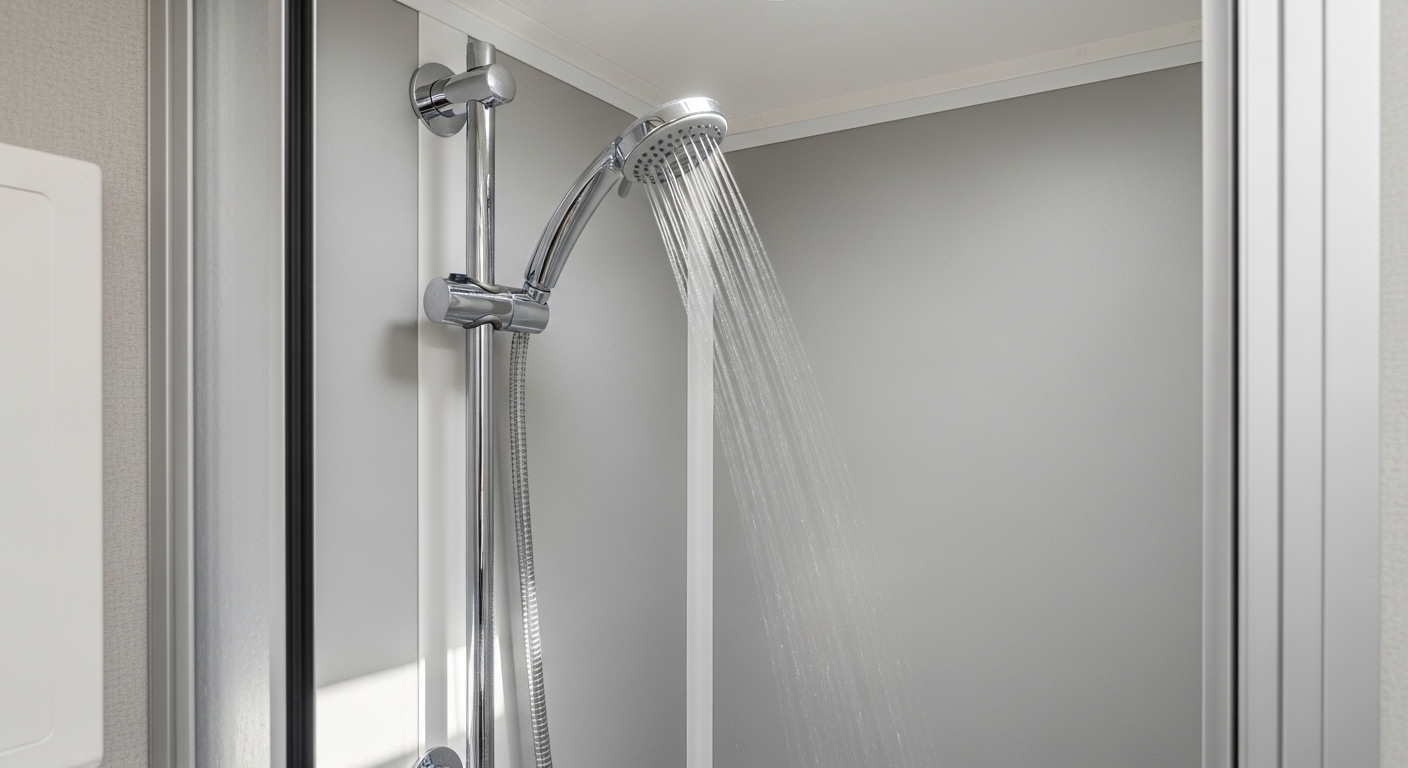
If you’re dealing with RV shower head low pressure, you’re not imagining it — RV plumbing runs on smaller lines, a modest 12-volt water pump, and low-flow fixtures designed to save your fresh-water tank, so a trickle is common but almost always fixable. The good news: nine times out of ten this is a repair you do yourself with a wrench, some white vinegar, and 20 minutes, not a service-center bill. Let’s walk through exactly why the pressure drops and how to get a strong, satisfying shower back — whether you’re boondocking off the pump or hooked up to city water at a campground.
Why does my RV shower head have such low pressure in the first place?
RV shower heads run at low pressure by design, and then real-world gunk makes it worse. Factory RV fixtures are flow-restricted to sip water so your 30–40 gallon fresh tank lasts, and the whole system is fed by a 12V diaphragm pump that typically maxes out around 45–55 PSI — versus 60–80 PSI in a house. So you’re starting from a lower baseline, and any added restriction (scale, a kinked hose, a tired pump) turns “gentle” into “barely there.”
Here are the usual culprits, roughly in the order you should check them:
- Flow restrictor washer: a small plastic disc with a tiny center hole, seated where the head screws onto the hose. This is the #1 cause of weak RV showers.
- Mineral scale / clogged nozzles: hard water leaves calcium and lime deposits inside the spray face and screen.
- Weak or air-locked water pump: a pump losing prime, running on a low battery, or with a clogged inlet strainer.
- Low battery voltage: a 12V pump on a battery sagging to 11.5V pushes noticeably less water.
- Kinked or crushed shower hose: the flexible braided hose loves to twist behind the head.
- Sediment in the filter/strainer: the pump inlet screen and any inline filter catch tank debris.
- Water-saver / on-off valve: many RV heads have a trickle-mode toggle that people forget is engaged.
How do I fix low water pressure in my RV shower head myself?
Start by pulling the shower head off the hose and clearing the two most common blockers: the flow restrictor and the scale. This single step solves the majority of low-pressure complaints. Here’s the full DIY sequence.
- Turn on the pump and listen. If it cycles rapidly (rapid on-off “burping”), you likely have air in the lines or a low tank — prime it first (below).
- Unscrew the shower head from the hose by hand or with a wrench and a rag to protect the finish. Look inside the female threaded collar.
- Find the flow restrictor — a small colored plastic ring (often white, red, or green) with a pinhole center, sometimes under a rubber washer or a metal screen. Pry it out gently with a flathead or a paperclip.
- Clean or enlarge the opening. If you’re on a well-supplied campground and want more flow, some RVers remove the restrictor entirely; if you’re conserving tank water, just clean it. (Note the trade-off — more flow drains your tank faster.)
- Soak the head in white vinegar for 30–60 minutes (a full night for heavy scale) to dissolve calcium. A 50/50 vinegar-water mix works too.
- Scrub the spray face. Rub the rubber nozzle nubs with your thumb — flexible silicone nozzles release scale when massaged — and brush the inlet screen with an old toothbrush.
- Flush the head under a faucet to blow out loosened debris, then reassemble with the washer/screen back in place.
Reinstall, run the pump, and you should feel an immediate difference. If the head itself now flows strong when held off the hose but the shower is still weak, the problem is upstream — the hose, pump, or supply.
What if my RV shower head still has low pressure after cleaning?
If cleaning didn’t help, move upstream to the hose and pump. Straighten and inspect the braided shower hose for kinks or an internal collapse — cheap hoses can delaminate inside where you can’t see it, so swap in a new one to rule it out. Then check the pump: confirm your house battery reads 12.4V or higher, clean the pump’s inlet strainer (a clear canister near the pump with a screen inside), and make sure the fresh tank isn’t near empty. A pump straining against a clogged strainer or dying battery will never deliver full pressure no matter how clean the head is.
Is it the flow restrictor, the pump, or hard-water scale? A quick diagnosis
Match your symptom to the likely cause before you start swapping parts. This table saves you from replacing a perfectly good shower head.
| Symptom | Most likely cause | Fix | Time / cost |
|---|---|---|---|
| Weak flow from a brand-new or clean head | Flow restrictor washer | Clean or remove the restrictor disc | 10 min / $0 |
| Some nozzles spray, others dead or sideways | Mineral/hard-water scale | Vinegar soak + scrub nozzles | 30–60 min / $0 |
| Pump cycles rapidly, pressure pulses | Air lock / low tank / bad pump | Re-prime, top tank, check pump | 15 min / $0 |
| Pressure drops only when battery is low | Low 12V voltage | Charge/replace house battery | Varies |
| Fine at head, weak at wall | Kinked or collapsed hose | Replace braided shower hose | 10 min / $12–20 |
| Weak even on city-water hookup | Clogged inlet filter or pressure regulator | Clean filter / check regulator | 15 min / $0–15 |
Does removing the flow restrictor actually help — and is it legal?
Yes, removing the flow restrictor noticeably boosts flow, but it comes with two real trade-offs. Federal law (the U.S. EPA) caps residential shower heads at 2.5 GPM, and many RV heads restrict further to 1.5–2.0 GPM to protect your tank. Pulling the restrictor is legal for your own personal use, but it means: (1) your fresh-water tank empties faster when boondocking, and (2) your gray tank fills faster. If you’re always on full hookups it’s a reasonable upgrade; if you dry-camp, you may want to keep it and just clean it instead. A good middle ground is a quality low-flow RV head with a trickle-mode button, which lets you wet down, shut the flow, soap up, then rinse.
My RV shower has low pressure only on city water — what’s wrong?
If pressure is fine on the pump but weak (or the reverse) on a campground hookup, the issue is your pressure regulator or inlet filter, not the shower head. Nearly every RV should use a pressure regulator to protect the plumbing from high campground pressure — but a cheap fixed regulator can over-restrict down to 40 PSI, and a clogged inline water filter chokes flow further. Swap to an adjustable regulator (set it around 50–55 PSI, safely under your RV’s rated limit) and replace a saturated inline filter cartridge. Conversely, if the shower is only weak on the pump, focus on the pump, strainer, and battery covered above.
Could hard water be permanently ruining my RV shower head?
Hard water won’t instantly ruin the head, but repeated scale buildup will clog nozzles and shorten its life if you never descale. RVers move between water sources constantly — some with very high mineral content — so calcium and lime accumulate faster than in a fixed home. A monthly vinegar soak keeps nozzles clear, and choosing corrosion- and scale-resistant fixture materials matters over the long haul. If you’re upgrading, it’s worth understanding which finishes and materials shrug off hard water best; our guide to the best bathroom faucet material for hard water applies directly to shower fixtures too. Some RVers also add an inline filter or a water softener specifically to protect fixtures.
When should I just replace the RV shower head instead of repairing it?
Replace the head when the plastic body is cracked, the internal threads are stripped, or the nozzle face is so scaled it won’t clear after two vinegar soaks — otherwise, repair is faster and cheaper. A quality RV shower head runs $20–45 and typically includes a longer braided hose, a trickle/pause button, and a more aggressive spray pattern that feels stronger even at low GPM. Look for these when you shop:
- A pause/trickle valve — the single most useful RV shower feature for tank conservation.
- Aerating or high-velocity spray — mixes air into the stream so it feels powerful at low flow.
- A 60-inch or longer hose — short hoses kink; longer ones reach and coil without collapsing.
- Silicone/rubber nozzle nubs — you can rub scale off them by hand.
- Standard ½-inch NPT threads — so it fits your existing RV hose fitting.
Because the connection is standardized, most RV heads are a direct screw-on swap — the same idea as choosing the right supply and fittings on any fixture. If you’ve ever wondered whether these connections interchange, our explainer on whether kitchen faucet supply lines are universal covers the thread-size logic that also applies to RV shower hoses. And if your weak pressure turns out to be a leak or a faulty diverter behind the wall rather than the head, the fundamentals in our shower rough-in valve replacement guide will help you diagnose it.
What tools and parts do I need to fix RV shower head low pressure?
You need almost nothing — this is a low-cost repair. Here’s the kit:
- Adjustable wrench or channel-lock pliers (with a rag to protect the finish)
- White vinegar and a bowl or zip bag
- An old toothbrush and a paperclip or safety pin (for the restrictor pinhole)
- Plumber’s tape (PTFE tape) to reseal threads
- Optional: a replacement braided hose and a spare flow restrictor/washer
How do I re-prime my RV water pump if the pressure just died?
If pressure vanished suddenly and the pump won’t build up, it’s air-locked and needs re-priming. Fill the fresh tank at least a quarter full, open the shower or a nearby faucet to the cold side, and switch on the pump. Let it run and sputter until a steady, air-free stream comes out — this can take 30–60 seconds. If it keeps burping air, check for a loose fitting on the pump’s suction side, a low tank, or a clogged inlet strainer. A pump that runs but never stops cycling usually has an air leak on the intake or a worn internal check valve, which is a cheap rebuild-kit or pump replacement.
Author note & why you can trust this guide
Written by the avitashome fixtures team. At avitashome (www.avitashome.com) we specialize in faucets, shower heads, and bathroom fixtures, and we bench-test flow rates and connection standards on the products we recommend. The GPM figures here reflect U.S. EPA WaterSense and federal 2.5-GPM standards, and the PSI ranges reflect typical 12V RV diaphragm-pump specs. Always confirm your specific RV’s rated pressure limit and check that any shower head or hose you buy carries a manufacturer warranty — reputable RV fixtures typically come with a 1–5 year warranty against defects. When in doubt about your plumbing, or if you find water where it shouldn’t be, call a certified RV technician.
FAQ
Why is my RV shower head low pressure even with a full water tank?
A full tank rules out the supply, so the restriction is downstream: a clogged flow restrictor, mineral scale in the nozzles, a kinked hose, or a pump running on low battery voltage. Remove and clean the head first, then check the hose and confirm your house battery reads at least 12.4V.
Can I remove the flow restrictor from my RV shower head safely?
Yes — it’s safe and legal for personal use, and it boosts flow. The trade-off is that your fresh-water and gray tanks fill and empty faster, which matters when boondocking. If you dry-camp often, clean the restrictor instead of removing it, or use a head with a trickle-pause button.
How often should I descale my RV shower head?
Descale with a vinegar soak about once a month, or any time flow weakens or nozzles start spraying sideways. RVs draw from many different water sources, so hard-water scale builds up faster than in a home with one consistent supply.
What PSI should my RV water pump put out for a good shower?
Most RV 12V pumps are rated for roughly 45–55 PSI, and that’s enough for a comfortable low-flow shower. If yours feels weak, verify the pump isn’t cycling on air, the inlet strainer is clean, and the battery voltage is healthy — a sagging battery is a common hidden cause of weak pressure.
Will a new shower head fix RV low pressure, or is it the plumbing?
A new head helps if the old one is cracked, stripped, or permanently scaled — and many RV heads with aerating spray and a pause valve feel stronger at the same GPM. But if cleaning the head off the hose gives strong flow, the real problem is upstream (hose, pump, strainer, or regulator), and a new head alone won’t fix it.