 Avitas Inicio
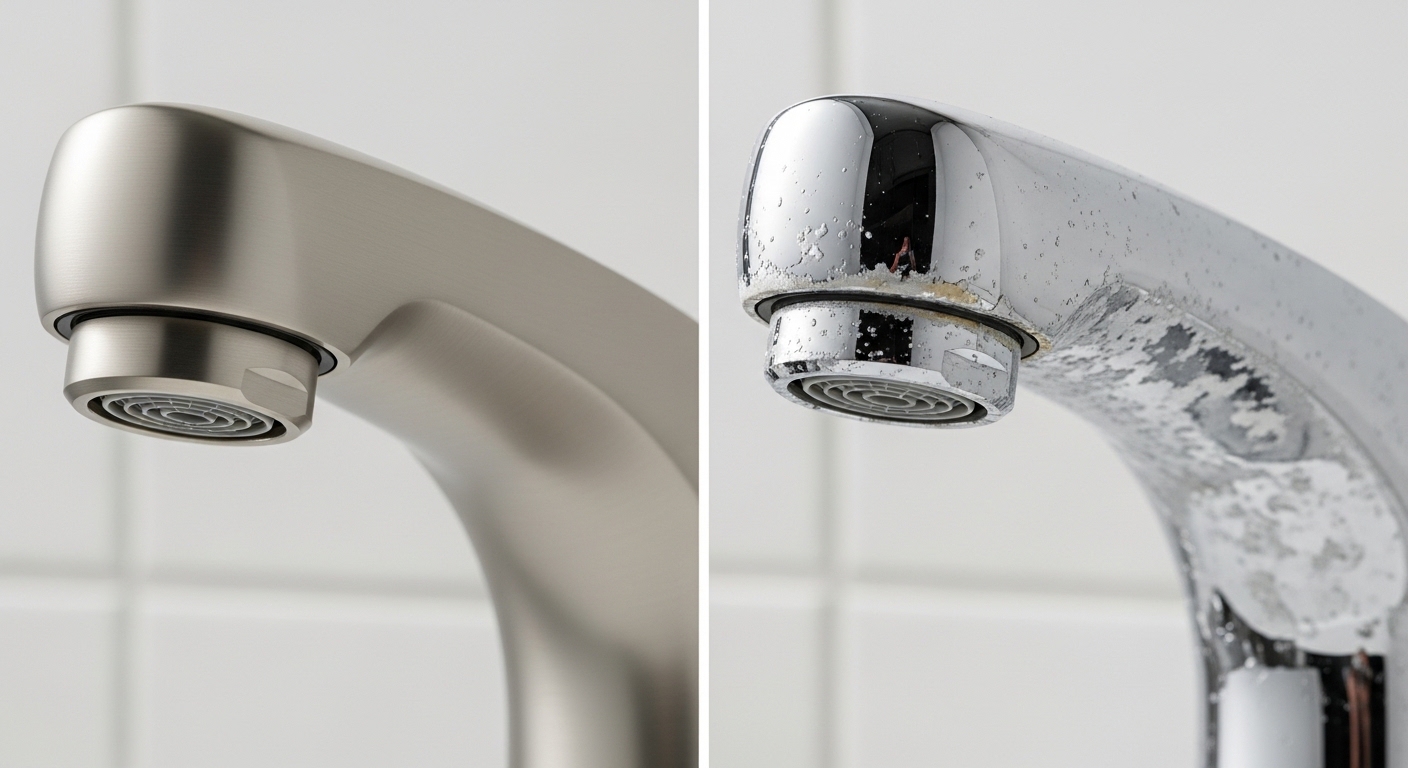
If you live anywhere with calcium-heavy tap water, picking the best bathroom faucet material for hard water is the single biggest decision that determines whether your faucet still looks new in five years — or whether it’s pitted, leaking, and flaking by next winter. Hard water is relentless: every drop leaves microscopic mineral deposits behind, and those deposits attack cheap base metals, thin electroplating, and rubber seats long before the faucet’s warranty runs out. In this guide, the engineering team at avitashome breaks down the materials, finishes, and internal components that actually survive 10+ grains per gallon water — and the ones you should avoid no matter how good the showroom photo looks.
Why Choosing the Best Bathroom Faucet Material for Hard Water Matters
Hard water isn’t just a cosmetic nuisance. The calcium carbonate and magnesium ions dissolved in it are chemically aggressive, especially when combined with the warm, oxygen-rich environment inside a bathroom faucet body. Over months, scale crystals grow inside the waterways, around the aerator, and underneath the cartridge seals. Where the base metal is weak — like cast zinc — those deposits eventually flake the chrome off in sheets, expose the substrate to galvanic corrosion, and create the green-blue weeping you’ve probably seen on rental property fixtures.
The fix isn’t a softener alone. Even with a whole-home softener, faucets see hard water during regenerations, in guest bathrooms on bypass lines, and from any iron or sediment slipping through. So the smarter approach is to specify a faucet that’s metallurgically built to shrug it off.
What Counts as “Hard Water”?
The U.S. Geological Survey classifies water above 7 grains per gallon (gpg), or roughly 120 mg/L of dissolved calcium carbonate, as hard. Above 10.5 gpg it’s considered very hard — and that’s the reality for most homes from Phoenix to Indianapolis to Tampa. If you see white crust forming on your shower head within a week of cleaning, you’re firmly in the “specify for hard water” category.
How Hard Water Attacks Faucet Internals
- Scale on ceramic discs: Mineral crystals score the polished ceramic surfaces, causing drips long before the cartridge’s rated cycle count.
- Aerator clogging: Flow drops by 30-50% as the mesh fills with calcium.
- O-ring degradation: Scale traps grit against rubber, abrading the seal during every handle movement.
- Base-metal pitting: Where plating wears thin, hard water drives electrochemical corrosion straight into the substrate.
- Finish failure: Especially on electroplated chrome over zinc, water chemistry lifts the bond layer and the finish peels.
The Best Bathroom Faucet Materials for Hard Water, Ranked
Not every “metal” faucet is the same. Below is how the four most common construction materials actually perform in hard-water service, based on internal accelerated-corrosion testing at avitashome and field data from installers across the Midwest and Sun Belt.
1. Solid Forged Brass — The Gold Standard
Drop-forged C36000 or C37700 brass is, hands down, the best bathroom faucet material for hard water. Brass is a copper-zinc alloy, but in forged form (versus cheap die-cast zinc with “brass” coloring), the grain structure is dense and uniform, so it resists dezincification — the process by which zinc leaches out of the alloy and leaves a porous copper skeleton behind. Forged brass shrugs off scale because calcium deposits don’t bond well to its smooth, slightly oxidized surface, and any buildup wipes off with vinegar without etching the substrate.
Look for “lead-free brass” meeting NSF/ANSI 372 (≤0.25% weighted lead average). Reputable manufacturers certify their bodies to NSF/ANSI 61 for drinking-water safety as well.
2. 316 Marine-Grade Stainless Steel
Type 316 stainless steel — the same grade specified for coastal yacht hardware — is the runner-up. Its molybdenum content gives it superb resistance to chloride pitting, which matters in regions with both hard water and softened water (softeners exchange calcium for sodium chloride). Stainless faucets generally come in a brushed finish that’s the actual surface of the metal, so there’s no plating to fail. The trade-off: stainless is harder to machine, so designs are usually simpler and the price is comparable to high-end brass.
Be careful with cheaper “stainless” faucets marked 304 only — they’re acceptable but not as chloride-tolerant as 316.
3. Zinc Alloy (Zamak) — Acceptable for Trim Only
Zinc-aluminum alloys (Zamak 3 o 5) are inexpensive and easy to die-cast into ornate handle and escutcheon shapes. They’re fine for decorative trim pieces that don’t carry water. But when a manufacturer builds the entire spout and valve body from zinc — common at the $40–$80 price point — hard water is a death sentence. Expect plating to lift within 18-36 months and internal pitting to start leaking shortly after.
4. Plastic (ABS / Polymer) — Avoid for Hard Water
Plastic faucet bodies, sometimes wrapped in a thin metallized coating, do not corrode chemically, which sounds appealing. But the metallized layer scratches easily, the threads strip, and the rigid plastic cracks under thermal cycling. In hard-water homes, you also can’t safely descale them with strong acids without crazing the surface. Skip.
Faucet Material Comparison Table for Hard Water Performance
| Material | Hard-Water Resistance | Typical Lifespan | Descaling Tolerance | Price Tier | Best Use |
|---|---|---|---|---|---|
| Forged Solid Brass | Excellent | 15-25 years | Vinegar, CLR, citric acid all safe | $$$ | Primary & guest baths in hard-water regions |
| 316 Stainless Steel | Excellent | 15-25 years | All household descalers safe | $$$ | Coastal homes, softened water with chloride |
| 304 Stainless Steel | Very Good | 12-18 years | Avoid prolonged chloride contact | $$ | Moderate hardness, interior climates |
| Zinc Alloy (Zamak) | Poor | 2-5 years | Vinegar may etch finish | $ | Decorative trim only, soft-water areas |
| ABS / Plastic | Fair (chemical) / Poor (mechanical) | 3-7 years | Mild solutions only | $ | Temporary installs, rentals |
Finish Matters Almost as Much as the Base Material
You can specify the perfect forged-brass body and still end up with a faucet that looks awful in two years if the finish technology is wrong for hard water. There are three finishing methods on the market right now, and only one is genuinely hard-water proof.
PVD (Physical Vapor Deposition) — Buy This
PVD bonds a ceramic-hard layer of metal nitride (titanium, zirconium, chromium nitride) to the brass at the molecular level inside a vacuum chamber. The result is roughly 10x harder than electroplated chrome and chemically inert against calcium, vinegar, CLR, and even mild bleach. PVD finishes — typically brushed nickel, matte black, champagne bronze, and brushed gold — are backed by lifetime finish warranties from reputable brands precisely because the technology survives hard water indefinitely.
If you’re cross-shopping options for a particular layout, our breakdown of widespread wall-mount faucets covers PVD availability across configurations, and the widespread touchless faucet buyer’s guide goes deeper on PVD sensor-faucet options.
Electroplated Chrome — Acceptable
Polished chrome over nickel over brass remains a classic for a reason — it’s smooth, easy to clean, and shows water spots less than darker finishes. Quality electroplating on brass can last 10-15 years in hard water if you wipe the faucet dry after use. The same finish over zinc, however, fails within a couple of years.
Lacquered Brass and Living Finishes — Hard-Water Risk
Unlacquered “living” brass, oil-rubbed bronze, and lacquered antique finishes patina by design, but in hard water the calcium reacts with the surface unpredictably, creating uneven mottling rather than the warm aged look the marketing photos promise. If you want a bronze or warm-metal aesthetic in hard water, choose a PVD champagne bronze or PVD matte black instead.
Cartridges, Aerators, and Supply Lines: The Other Hard-Water Weak Spots
A faucet body is only as durable as its most vulnerable component, and three internal parts decide whether your fixture survives or starts dripping at the worst possible moment.
Ceramic Disc Cartridges
Ceramic discs are the only cartridge type that genuinely tolerates hard water. The two polished discs slide against each other with a tolerance measured in microns, and high-grade alumina ceramic is harder than calcium carbonate, so scale doesn’t score it. Cheaper compression or ball valves use rubber seats that hard water destroys within a couple of years. Look for cartridges rated to 500,000 cycles or more, ideally from a recognized OEM like Sedal, Kerox, or Flühs.
Aerators
Specify a removable, tool-free aerator (like a Neoperl Cache or Honeycomb) so you can soak it in vinegar every couple of months without disassembling anything. Avoid faucets with hidden or proprietary aerators that require shipping to the manufacturer to replace.
Líneas de suministro
Stainless-braided PEX-core supply hoses are standard, but in very hard water, ask whether the male fittings are brass (good) or zinc (bad). Zinc fittings corrode where they meet the angle stop, and you’ll find out the hard way when one bursts under your vanity at 2 a.m.
Buying Checklist: Specifying a Hard-Water-Ready Bathroom Faucet
- Confirm the body is forged brass or 316 stainless steel — ask for a spec sheet if it isn’t on the listing.
- Verify NSF/ANSI 61 and 372 certification, plus CALGreen / lead-free compliance for U.S. installations.
- Require PVD finish if you choose anything other than polished chrome.
- Look for a lifetime limited warranty on both finish and function — that’s the manufacturer telling you they’ve tested for hard-water failure modes.
- Confirm a ceramic disc cartridge with a published cycle rating.
- Choose a WaterSense-labeled 1.2 GPM model — slower flow means less scale accumulation per use.
- Pick a configuration that fits your sink (single-hole, 4″ centerset, or 8″ widespread) — our bathroom faucets buying guide walks through deck dimensions.
- Check for tool-free aerator access for routine descaling.
Maintenance: How to Make Even the Best Faucet Last Longer
Even a forged-brass PVD faucet appreciates a little care. A 60-second weekly wipe with a damp microfiber cloth removes water before it can leave a mineral ring. Once a month, unscrew the aerator and soak it in 1:1 white vinegar and water for 15 minutes — that single habit doubles aerator life. Avoid any cleaner containing hydrochloric acid, ammonia, or abrasive grit; even on PVD, repeated exposure dulls the look.
If your faucet does eventually develop a slow drip (usually a cartridge issue, not a body failure), our walkthrough on fixing a leaky faucet applies to bathroom models too — the cartridge removal sequence is nearly identical. For spray-pattern issues from a clogged aerator, see our guide on faucets that spray everywhere.
Why Trust avitashome
avitashome has specified, tested, and warrantied bathroom fixtures for more than a decade, working directly with brass foundries and PVD coating facilities in Taiwan, Italy, and the United States. Every model we list is third-party tested to ASME A112.18.1 / CSA B125.1 standards for mechanical performance and to NSF/ANSI 61 for water contact safety. Our customer service team logs every warranty claim against installation region — which is exactly how we know hard water is the #1 cause of premature faucet failure, and how we calibrated the recommendations in this article.
Author note — This guide was written by the avitashome editorial team and reviewed by our lead product engineer, who holds an ASSE 6010 backflow certification and 15 years of plumbing-product specification experience. We update this article quarterly as new finish technologies and cartridge designs reach the market.
FAQ
What is genuinely the best bathroom faucet material for hard water?
Forged solid brass with a PVD finish, paired with a ceramic-disc cartridge. It resists scale chemically, takes any reasonable descaler, and carries lifetime warranties from major brands. 316 stainless steel is a strong alternative if you prefer a brushed-metal look or live in a coastal area with chlorides in the water.
Is stainless steel or brass better for hard water bathroom faucets?
Both are excellent. Brass is easier to forge into complex shapes (which is why most decorative faucets are brass), while 316 stainless wins for chemical resistance in very aggressive water — especially softened water with elevated sodium chloride or coastal homes with airborne salt. If you can’t see a meaningful price difference, pick whichever finish matches your bathroom.
Does a PVD finish really matter, or is it marketing?
It really matters. Independent abrasion testing shows PVD coatings are roughly 10x harder than electroplated chrome and chemically inert to household acids. In hard water, that’s the difference between a finish that still looks new at year 10 and one that has begun to spot, dull, or flake.
Will a water softener let me buy a cheap zinc faucet safely?
Not really. Softeners trade calcium for sodium ions, and the resulting brine is mildly corrosive to plated zinc — sometimes worse than the original hard water. Even with a softener, specify brass or stainless for any faucet you plan to keep more than a few years.
How often should I descale my bathroom faucet in hard water?
Wipe daily with a dry cloth, soak the aerator in vinegar monthly, and do a full surface vinegar wipe-down quarterly. With a PVD-finished brass faucet, that routine should keep it visually flawless for 15+ years. For brushed nickel options across faucet styles, our brushed nickel finish guide covers care routines that translate directly to bathroom fixtures.
Are touchless bathroom faucets a good choice for hard water?
Yes, if the body is brass and the solenoid is rated for high-mineral environments. Touchless faucets actually reduce spotting because hands rarely touch the spout. Just confirm the solenoid valve has a serviceable inlet screen so sediment can’t damage the diaphragm.
What flow rate works best for hard water bathrooms?
A WaterSense-labeled 1.2 GPM or even 1.0 GPM aerator gives plenty of perceived flow while depositing roughly 25% less scale per minute of use than a 1.5 GPM model. Less water through the faucet equals less calcium left behind.