 Avitas Home
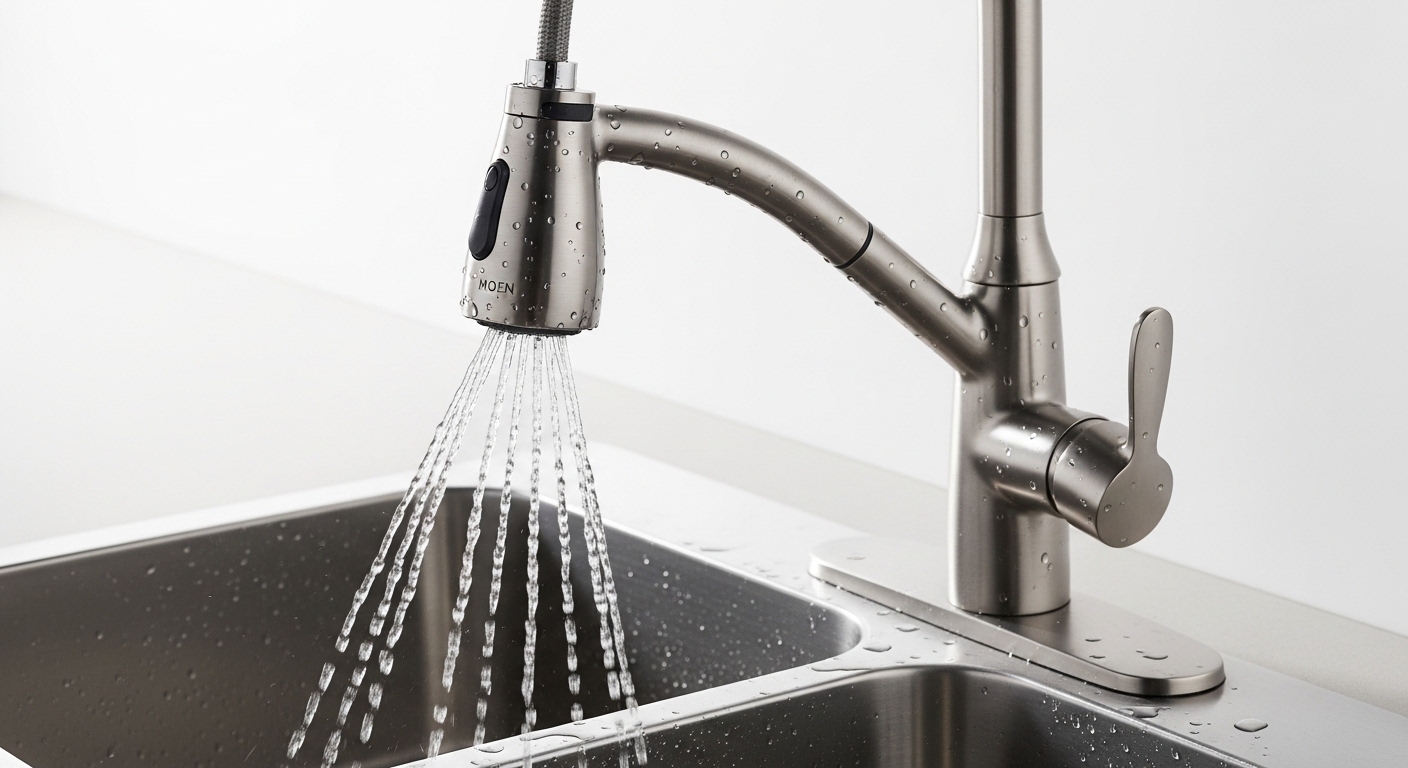
If you’re dealing with a low water flow Moen kitchen faucet, take a breath — you almost certainly don’t need a new faucet, a plumber, or a big repair bill. Moen builds solid fixtures, and a sudden drop in flow is nearly always mineral buildup or trapped debris choking one small part. Below, I’ll walk you through exactly what’s happening, how to diagnose it in the right order, and how to get your pressure back — plus when the flow was actually never “broken” to begin with (thanks to federal flow-rate rules).
This is a hands-on troubleshooting guide based on the way these faucets actually fail in real kitchens. I’ve pulled apart a lot of Moen pull-downs, and the pattern almost never changes. Let’s get your faucet ripping again.
Why did my Moen kitchen faucet suddenly lose water pressure?
A sudden loss of pressure in a Moen kitchen faucet is caused by a clog somewhere in the water’s path — most often the aerator at the tip of the spout, followed by the pull-down spray head, then the supply lines or shutoff valves under the sink. “Sudden” is the key word: if flow dropped over a day or two, it’s debris or minerals, not a design issue.
Here’s the logic. Water leaves your home’s supply lines at 40–80 PSI, travels up through the faucet body, and exits through the aerator — a tiny screen-and-screw assembly that mixes air into the stream. That aerator has the smallest openings in the entire system, so it’s the first place sediment, rust flakes, and hard-water scale collect. When those openings clog, flow drops fast even though your home’s water pressure hasn’t changed at all.
The common triggers I see:
- Hard-water scale (calcium/magnesium): chalky white crust that builds slowly, then suddenly crosses the threshold where flow tanks.
- Debris after plumbing work: if the city flushed a main or you had a repair done, rust and grit get pushed into your lines and land in the aerator.
- A partially closed shutoff valve: someone bumped the under-sink valve, or it was never fully reopened after a repair.
- A clogged pull-down spray head: on pull-down and pull-out models, the spray face has dozens of tiny nozzles that scale over.
- A collapsed or kinked hose: the flexible pull-down hose can pinch against the cabinet or its own weight/hook.
Diagnose in that order — cheapest and easiest first — and you’ll rarely need to go deep. If your water also sprays sideways or mists unevenly, that’s a classic clogged-aerator tell; our guide on how to fix a faucet that sprays water everywhere covers that exact symptom.
How do I clean the aerator on a Moen kitchen faucet?
To clean a Moen aerator, unscrew it from the spout tip by hand (or with tape-wrapped pliers), soak the parts in white vinegar for 20–30 minutes, scrub the screen with an old toothbrush, rinse, and reassemble. This single fix restores full flow on the majority of low-flow Moen faucets.
Step by step:
- Turn off the faucet and plug the drain so you don’t lose small parts.
- Unscrew the aerator. Many Moen models use a hidden/recessed aerator that needs the small plastic key that came with the faucet; if you don’t have it, Moen ships them cheap, or careful pliers with a cloth barrier work. Turn clockwise-to-loosen when viewed from below (it’s reversed because you’re looking up at it).
- Note the order of parts. Lay them out left to right exactly as they came off — screen, restrictor, washer, housing.
- Soak in white vinegar for 20–30 minutes to dissolve scale. For heavy buildup, go a full hour.
- Scrub and rinse with a toothbrush under running water. Hold the screen up to the light — you should see clean, open mesh.
- Reassemble in the same order and hand-tighten. Overtightening cracks the plastic threads.
- Test. Run hot and cold. Full flow back? Done.
If the aerator itself is corroded or cracked, replace it — Moen aerators are inexpensive and standardized by model. Not sure whether a generic one will fit? A universal aerator often does, and we break down exactly when it works in does a bathroom faucet universal aerator actually fit every faucet — the fit logic is identical for kitchen faucets.
What if cleaning the aerator didn’t fix the low flow?
If a clean aerator didn’t restore flow, the clog is upstream: check the pull-down spray head, then the supply valves and hoses under the sink. Work from the spout back toward the wall — the problem is always the last unchecked point in that chain.
Check the pull-down spray head
On pull-down and pull-out Moen faucets (Arbor, Adler, Doherty, Sleek, and similar), the spray face is a second aerator with dozens of rubber or plastic nozzles. Rub your thumb firmly across the wet nozzles with the water running — the flexible tips flex and pop off a lot of scale instantly. For deeper cleaning, unthread the spray head from the hose and soak it in vinegar the same way. If you’re comparing Moen pull-down models or troubleshooting a specific one, our Moen Doherty kitchen faucet reviews get into how these spray heads behave over time.
Check the shutoff valves
Look under the sink for two oval or football-shaped handles (hot and cold). Turn each one fully counterclockwise to make sure it’s 100% open. A valve that’s only half open silently throttles your flow. This is the single most overlooked cause — especially right after any under-sink work.
Check the supply lines
Follow the braided hoses from the valves up to the faucet. Look for kinks, tight bends, or a hose pinched against the cabinet wall. Kinks in the flexible pull-down hose inside the spout are common too — reach up and make sure it hangs free and isn’t caught on the counterweight or a hook. If a supply line is old, corroded at the fittings, or too short and straining, replace it; sizing is easier than people think, and we cover it in are kitchen faucet supply lines universal.
Check the cartridge (last resort)
If both hot and cold are weak everywhere and nothing above helped, the Moen 1225 or 1255 cartridge inside the handle may be scaled or worn. Moen’s cartridges are user-replaceable and often free under warranty. This is a 30-minute job, but only tackle it after ruling out everything else — it’s rarely the culprit for a flow problem (it’s more often the cause of leaks or temperature issues).
Is low flow just the flow restrictor — and can I remove it?
Sometimes your Moen faucet isn’t broken at all — it’s simply meeting federal flow limits. Since 1994, U.S. kitchen faucets are capped at 2.2 gallons per minute (GPM), and many newer or California/Colorado-compliant models ship at 1.8 or even 1.5 GPM via a built-in flow restrictor inside the aerator. If your “new” faucet feels weak straight out of the box, this is usually why.
You can sometimes remove or swap the restrictor for a higher-flow aerator, but understand the trade-offs before you do:
- It may violate local plumbing code and your area’s water-conservation rules.
- It raises your water and water-heating bills.
- It can void the faucet’s WaterSense certification.
- On well systems or low-pressure homes it genuinely helps; on city pressure the gain is often small.
My honest take: clean everything first. Nine times out of ten the faucet was designed to flow fine, and scale is the real thief. Removing a restrictor to “fix” a clog just masks the problem for a few weeks until the buildup returns.
Which is the real culprit? A quick comparison
Use this table to match your symptom to the most likely cause and the fastest fix.
| Cause | Tell-tale symptom | Fix difficulty | Time / cost |
|---|---|---|---|
| Clogged aerator | Sudden weak or split/spraying stream, worse over weeks | Very easy | 5–30 min / $0 |
| Clogged spray head | Weak or uneven spray only in spray mode | Easy | 15 min / $0 |
| Half-closed shutoff valve | Weak flow after recent under-sink work | Very easy | 1 min / $0 |
| Kinked supply line or hose | Weak flow, visible bend or pinch under sink | Easy | 10 min / $0–$20 |
| Flow restrictor | Weak from day one on a new faucet | Easy | 10 min / $0 |
| Scaled/worn cartridge | Weak hot+cold everywhere, maybe temp issues | Moderate | 30 min / $0 under warranty |
How do I stop low flow from coming back on hard water?
To prevent recurring low flow, tackle the hard water that causes the scale: clean the aerator every 2–3 months, wipe the spray-head nozzles weekly, and consider a whole-house or under-sink water softener/filter if your water is very hard. Prevention is far easier than repeated disassembly.
If you’re on hard water (chalky spots on glasses, white crust on fixtures), scale will keep clogging that aerator no matter how many times you clean it. A few durable habits:
- Wipe the spray face weekly — 10 seconds with your thumb clears nozzles before they harden.
- Quarterly vinegar soak of the aerator becomes a non-event once it’s routine.
- Bag-soak trick: fill a sandwich bag with vinegar, rubber-band it over the spout tip overnight — no disassembly needed for light maintenance.
- Consider softening/filtration if you’re replacing aerators constantly; it also protects your water heater and dishwasher.
Finish and material matter too — some faucet finishes shrug off hard-water spotting far better than others. If you’re shopping for a replacement and hard water is your reality, our breakdown of the best bathroom faucet material for hard water applies directly to kitchen fixtures and will save you future headaches.
When should I just replace the faucet or call Moen?
Replace or call Moen when the faucet body is cracked, leaking internally from the base, corroded through, or when a cartridge swap and full cleaning still leave you with poor flow. Moen’s Limited Lifetime Warranty covers the original homeowner for defects and drips — including free replacement cartridges and parts — so call them before you buy anything.
Moen’s warranty is genuinely one of the best in the business, and their customer line will ship you a cartridge, aerator, or spray head at no cost for most residential faucets. Have your model number ready (usually printed under the spout, on the escutcheon, or on your original paperwork). If the faucet is 15+ years old and you’re fighting flow, leaks, and a dated finish all at once, a new WaterSense pull-down is often the smarter money than chasing repairs.
FAQ
Why is only my hot water low on my Moen faucet?
If only the hot side is weak, the culprit is usually the hot-side shutoff valve being partially closed, sediment from the water heater collecting on the hot supply, or debris on one side of the cartridge. Start by fully opening the hot shutoff valve under the sink, then flush the line by disconnecting the hot supply into a bucket. Water-heater sediment is a common source of hot-only clogs.
Does Moen sell replacement aerators, and are they free?
Yes. Moen sells model-specific aerators and spray heads, and they’ll often send replacement aerators and cartridges free of charge under their Limited Lifetime Warranty to the original homeowner. Contact Moen with your model number. A generic universal aerator can also work in a pinch if you match the thread size and gender.
Can I remove the flow restrictor from my Moen kitchen faucet?
Usually yes — it sits inside the aerator assembly and can be popped out or swapped for a higher-GPM aerator. But it may conflict with local water-conservation code, raise your bills, and void WaterSense certification. Clean the aerator first; most “restrictor” complaints are actually scale clogs, not the restrictor itself.
How often should I clean my Moen aerator?
Every 2–3 months on hard water, or once or twice a year on soft/city water. If you find yourself cleaning it monthly, your water is hard enough to justify a softener or filter, which will also protect your dishwasher, water heater, and other fixtures.
My whole house has low pressure, not just the faucet — what now?
If every fixture is weak, the problem isn’t your Moen faucet — it’s your home’s supply: a partially closed main shutoff, a failing pressure regulator (PRV), a clogged whole-house filter, or a municipal issue. Check your main shutoff and pressure regulator, or call your water utility. Faucet-specific fixes won’t help a whole-house pressure drop.
Will a pull-down Moen clog faster than a standard spout?
Slightly, because it has two aerating points — the spray head and, on some designs, an internal screen — plus a flexible hose that can kink. But the maintenance is the same and just as easy. Wipe the spray face weekly and the difference disappears.
About the author: This guide was written by the Avitas Home fixtures team, which specializes in kitchen and bathroom faucets, and reviewed against Moen’s published installation and warranty documentation. We test and tear down pull-down faucets hands-on to see how aerators, spray heads, and cartridges hold up on real hard-water systems.
About Avitas Home: Avitas Home (www.avitashome.com) is a specialist retailer of faucets, shower heads, and bathroom fixtures. Our recommendations reference U.S. federal flow standards (2.2 GPM max), EPA WaterSense certification, and manufacturer warranty terms so you can fix or buy with confidence.