
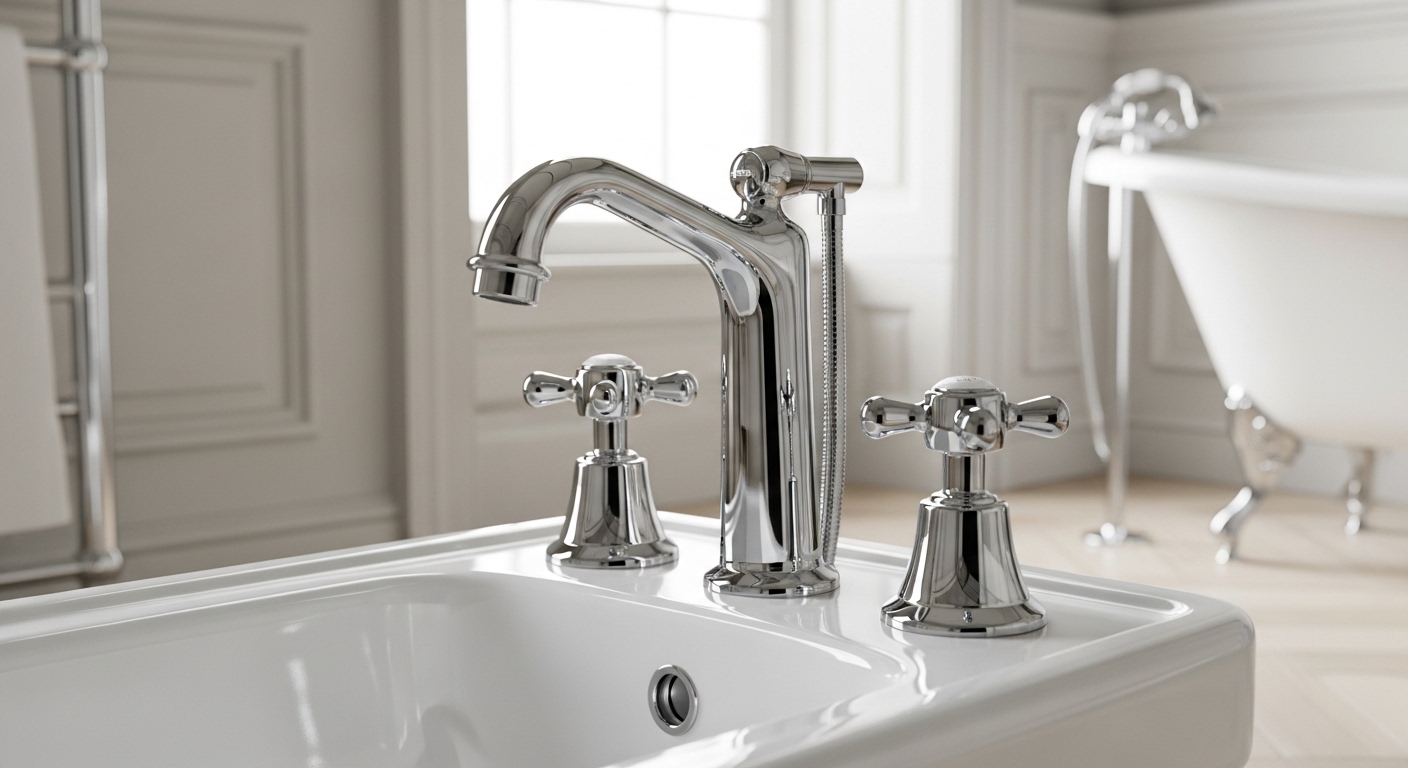
If you’re shopping for a jado bidet faucet, you’re almost always in one of two situations: you already own one and it’s dripping, running slow, or missing a part, or you saw the Jado name on a designer’s spec sheet and want to know whether it’s still a smart buy in 2026. This guide answers both, plainly, from the point of view of people who fix and sell bathroom fixtures every day. We’ll cover what makes a Jado bidet faucet different, whether you can still buy one, what to do when it breaks, and how to pick a modern replacement that looks and performs just as well.
Quick note before we dive in: a “bidet faucet” here means the mixer that mounts on a standalone bidet fixture — the porcelain bowl next to the toilet — usually a 3-hole widespread deck mount with a vertical or angled spray in the center of the bowl. It is not a bidet toilet seat sprayer, and it is not a handheld shower bidet. Getting that distinction right saves you from buying the wrong part.
What exactly is a Jado bidet faucet, and why do people still ask for it by name?
A Jado bidet faucet is a premium 3-piece bidet mixer built by Jado, a brand that spent decades known for heavy solid-brass construction, ceramic-disc cartridges, and European styling. People still ask for it by name because Jado had a reputation for lasting 20–30 years, so a lot of upscale bathrooms built in the 1990s and 2000s have Jado fixtures that are only now starting to need service.
Here’s the backstory that matters for your buying decision. Jado was a German brand that became widely distributed in the United States, later owned by American Standard, and eventually absorbed into LIXIL — the same corporate family behind American Standard, GROHE, and DXV. Over the last decade the standalone “Jado” catalog was retired. So when someone types “jado bidet faucet” into Google or asks an AI assistant for one, they’re usually chasing either a discontinued original or a functional equivalent.
What set the Jado bidet mixers apart:
- Solid forged brass bodies — not zinc alloy, not plastic — which is why they survive decades of hard water.
- Ceramic-disc cartridges that give a smooth quarter-turn and resist the mineral wear that kills cheaper rubber-washer valves.
- Pop-up drain assemblies with matching lift rods, so the whole bidet set looked cohesive.
- Deep, durable finishes — polished chrome, polished nickel, brushed nickel, and old-brass/bronze tones — plated over brass so they hold up.
That build quality is exactly why we tell people not to rip out a working Jado. If the finish is intact and the body is solid, the only wear parts are the cartridge, the aerator/spray outlet, and the pop-up seals — all serviceable.
Can you still buy a new Jado bidet faucet in 2026?
Mostly no — not new from the factory. The Jado brand line is discontinued, so any “new” Jado bidet faucet you find in 2026 is old-stock (new-old-stock, or NOS), a surplus unit, or occasionally a returned item. You can sometimes find them through plumbing-supply liquidators, estate sales, and marketplace listings, but supply is thin and prices swing hard.
Realistically, here are your three paths, ranked by how most of our customers actually solve it:
- Keep and repair the Jado you own. Cheapest and greenest. A cartridge, aerator, or pop-up rebuild is often under $40 in parts.
- Buy a Jado-family replacement. Because Jado moved into LIXIL, some cartridges and trim cross-reference to American Standard parts. A plumbing supplier can look up the cross-reference by your model number.
- Replace with a current equivalent bidet mixer. A modern solid-brass 3-hole widespread bidet faucet in a matching finish gives you the same look and function, with a fresh warranty and easy parts availability.
If you’re set on the Jado name for a period-correct restoration, expect to hunt and to pay a premium. If you just want a beautiful, reliable bidet faucet that will last, a modern solid-brass equivalent is the better value — and you won’t be stuck sourcing rare parts a decade from now.
My Jado bidet faucet is dripping or running slow — how do I fix it myself?
A dripping Jado bidet faucet almost always means a worn ceramic-disc cartridge, and slow or spitting flow almost always means a clogged aerator or spray outlet. Both are DIY jobs that take 20–30 minutes with basic tools, no plumber required. Fix the right part and the faucet performs like new.
Diagnose first, because the cure is different:
- Drips from the spout when handles are off → cartridge (the seal inside the valve is worn).
- Weak, sputtering, or misdirected spray → clogged aerator/spray tip full of mineral scale.
- Leak around the base of a handle → handle O-ring or cartridge seal.
- Water pools slowly / won’t drain → pop-up assembly, not the faucet valve.
The single most common fix is the aerator, and it’s the easiest. If your flow dropped off gradually, unscrew the aerator, soak it in white vinegar for an hour to dissolve the calcium, rinse, and reinstall — the same trick that revives most clogged fixtures. If you’ve dealt with this on other faucets, our guide on whether a bathroom faucet universal aerator actually fits every faucet explains the thread sizes so you can buy the right replacement if the old one is corroded. And if the drip is coming from the valve rather than the outlet, the step-by-step in how to fix a leaky bathroom sink faucet yourself walks through cartridge and O-ring replacement — the mechanics are the same on a bidet mixer as on a lavatory faucet.
Step-by-step: replacing the cartridge on a Jado-style bidet mixer
- Shut off the hot and cold angle stops under the bidet. Open the handles to release pressure and confirm the water is off.
- Plug the drain so no small screws disappear.
- Pop off the handle index cap, remove the handle screw, and pull the handle straight up.
- Unscrew the bonnet nut with a wrench (pad the jaws to protect the finish). Lift out the ceramic cartridge.
- Take the old cartridge to a plumbing supplier to match it exactly — Jado used specific cartridge profiles, and getting the right one is the whole game.
- Drop in the new cartridge, retighten the bonnet snug (not gorilla-tight — you’ll crack ceramic), reassemble the handle, and turn the water back on slowly.
- Run both temperatures for 30 seconds and check for drips.
A quick reality check on tools: if a handle feels loose after reassembly, it’s usually the handle screw or an adapter, not a broken faucet — the same fix we cover for a loose faucet handle on other brands applies here too.
Jado bidet faucet vs. a modern solid-brass replacement — which should you buy?
If your Jado is repairable, repair it; if it’s cracked, badly pitted, or missing parts you can’t source, buy a current solid-brass 3-hole bidet mixer in a matching finish. Below is how the two stack up on the factors that actually change your decision.
| Factor | Original Jado bidet faucet | Modern solid-brass 3-hole bidet mixer |
|---|---|---|
| Availability (2026) | Discontinued; new-old-stock only, hard to find | In stock in multiple finishes |
| Body material | Forged solid brass (excellent) | Solid brass on quality models (verify — avoid zinc) |
| Valve type | Ceramic-disc cartridge | Ceramic-disc cartridge |
| Parts & service | Cross-reference via LIXIL/American Standard; scarce | Current parts, easy to source |
| Warranty | Expired on originals | New manufacturer warranty (often limited lifetime) |
| Typical price | Wildly variable; premium for NOS | Predictable; strong mid-to-high value |
| Best for | Period-correct restoration, matching existing set | Reliability, availability, fresh warranty |
The headline: you are not sacrificing quality by moving to a good modern mixer, as long as you insist on solid brass and a ceramic-disc cartridge. Those two specs are what made Jado great, and they’re both still available today.
Which finish should you choose for a bidet faucet, and does it need to match the toilet?
Match your bidet faucet finish to the other metal fixtures in the room — the lavatory faucet, towel bars, and shower trim — not to the toilet, which is porcelain and reads as neutral white. A bidet sits right next to the toilet, so what you’re really coordinating with is the sink faucet and any visible plumbing hardware.
Jado bidet faucets showed up most often in polished chrome, polished nickel, brushed/satin nickel, and warmer old-brass tones. If you’re replacing one and want the room to stay cohesive, here’s the practical guidance:
- Polished chrome — the safest, most timeless match; hides water spots reasonably and pairs with almost anything.
- Polished or brushed nickel — softer and warmer than chrome, great in traditional and transitional bathrooms. If you’re leaning this way, our breakdown of a polished nickel faucet and shower finish covers how it wears and cleans over time.
- Brushed/satin nickel — best at hiding fingerprints and hard-water spotting; ideal for a busy household.
- Bronze/old-brass tones — beautiful for period looks but harder to match exactly to a discontinued Jado; bring a part to compare in person.
One durability tip that matters more than the color: choose a finish that is plated over solid brass, and for living finishes (unlacquered brass), expect a patina over time. If low maintenance is your priority, brushed nickel over brass is the sweet spot for a bidet that gets daily use.
What should you check before installing any bidet faucet?
Before you buy or install, measure your bidet’s hole configuration and confirm the water and drain rough-in — a bidet faucet that doesn’t match the deck holes simply won’t fit. Most standalone bidets use a 3-hole widespread layout, but the hole spacing and the spray-outlet position vary, so measuring saves a return.
Run through this checklist:
- Count the holes. Most bidets are 3-hole (two handles + center spray). Some are single-hole. Buy to match.
- Measure hole spacing. Widespread sets are typically adjustable across a range; confirm your center-to-center distance falls inside it.
- Confirm the spray type. Vertical spray (aims up from the bowl center) vs. horizontal/over-the-rim. They’re not interchangeable.
- Check supply connections. Standard 3/8″ compression angle stops feed most bidet mixers; verify your supply lines reach and fit.
- Verify the pop-up. If your bidet has a drain, make sure the new faucet includes a compatible pop-up and lift rod, or plan to reuse the existing one.
- Look for certification. Choose a mixer certified to U.S. standards (ASME A112.18.1 / NSF/ANSI 372 low-lead “lead-free” compliance) so it’s code-legal and safe.
If you’re sourcing a replacement locally rather than restoring the original, it’s worth knowing where selection and support are strongest. Our overview of the best places to buy a bathroom faucet in the USA covers what to look for in a seller — return policy, parts availability, and finish selection — which all matter double when you’re matching a discontinued line.
How long does a quality bidet faucet last, and is it worth the money?
A quality solid-brass bidet faucet with a ceramic-disc cartridge lasts 15–30 years with only minor service — cartridge and aerator swaps along the way — which is exactly why Jado units are still in bathrooms decades later and why a good replacement is worth the investment. The faucet body outlives the cosmetic trends; you’ll likely redecorate around it more than once.
Value comes down to three things: material (solid brass, not zinc), valve (ceramic disc, not rubber washer), and serviceability (can you get parts). Hit all three and the cost-per-year is tiny. Miss any one — a bargain zinc-body mixer, for example — and you’ll be replacing the whole thing in a few years. That’s the real lesson of the Jado story: pay once for good brass and a good cartridge, and maintain the two cheap wear parts.
FAQ
Are Jado bidet faucets still being made?
No. The Jado brand line has been discontinued after the brand was absorbed into LIXIL (the parent of American Standard and GROHE). Any new Jado bidet faucet you find in 2026 is new-old-stock or surplus, not current production. For ongoing parts and warranty, a modern solid-brass equivalent is the more practical choice.
Where can I get replacement parts for a Jado bidet faucet?
Start with a plumbing-supply house that can cross-reference Jado model numbers to American Standard/LIXIL parts, since many cartridges and trim pieces carried over. Bring the old cartridge, aerator, or handle with you to match it exactly. For universal wear parts like aerators, an off-the-shelf replacement in the correct thread size often works fine.
Why is my Jado bidet faucet dripping even when it’s turned off?
A drip with the handles fully closed means the ceramic-disc cartridge has worn or a seal has failed. Replace the cartridge — it’s a 20–30 minute job. If instead the leak is at the base of a handle, it’s usually a handle O-ring. Neither problem means the faucet is beyond saving.
What’s the difference between a bidet faucet and a bidet sprayer?
A bidet faucet is the deck-mounted mixer on a standalone porcelain bidet, controlling hot and cold water to a spray in the bowl. A bidet sprayer (or bidet seat/attachment) is a handheld or seat-mounted device that attaches near a toilet. They are completely different products — make sure you’re buying for the fixture you actually have.
Can I replace a discontinued Jado bidet faucet with a different brand?
Yes. As long as the new mixer matches your bidet’s hole count and spacing, spray type, and supply connections, any quality 3-hole widespread bidet faucet will fit. Choose solid brass with a ceramic-disc cartridge and a finish that coordinates with your other bathroom fixtures, and you’ll match Jado’s performance with a fresh warranty.
Is a bidet faucet hard to install yourself?
For a confident DIYer, no — it’s on par with installing a widespread lavatory faucet. Shut off the water, drop the mixer into the deck holes, connect the supply lines to the angle stops, install the pop-up, and check for leaks. If your bidet has unusual rough-in or you’re unsure about the drain, a plumber can do it in under an hour.
A note on who wrote this and why you can trust it
This guide was written by the AvitasHome fixtures team — a group that sources, installs, and services faucets and bathroom fixtures full-time, and fields questions from homeowners and remodelers every week. We recommend repairs before replacements because that’s what we’d tell a friend, and we’ve serviced enough discontinued premium brands like Jado to know which parts wear out and which last for decades. When we point you toward a replacement, we hold it to the same standard the originals set: solid-brass construction, ceramic-disc cartridges, and certification to U.S. plumbing standards (ASME A112.18.1 / NSF-ANSI 372 lead-free), typically backed by a manufacturer’s limited lifetime warranty. Measure twice, buy the right part once, and a good bidet faucet will outlast the room around it.