
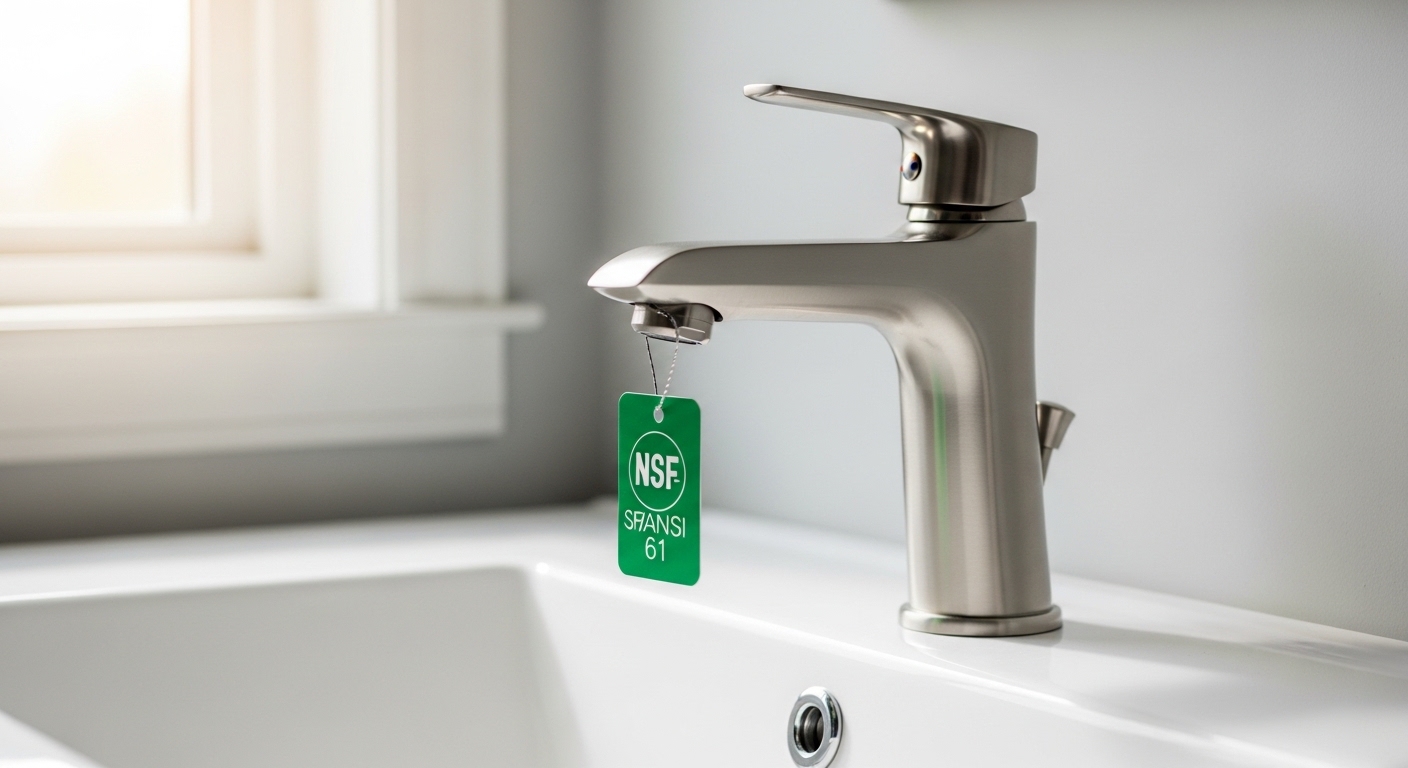
If you’ve been shopping for a lead free bathroom sink faucet and feeling confused about why some listings shout “lead free” while others say nothing at all, here’s the plain truth: since January 2014, every faucet legally sold in the United States for drinking or hand-washing water has to meet a strict lead limit. So “lead free” isn’t a premium upgrade — it’s the baseline. The confusion comes from marketing, murky import listings, and the difference between a faucet that claims to be lead free and one that’s actually third-party certified. This guide walks you through exactly what the term means, how to verify it, and how to shop smart.
What does “lead free” actually mean on a bathroom faucet?
“Lead free” is a legal definition, not a vibe. Under U.S. federal law, a faucet is “lead free” when the wetted surfaces — every part water touches on its way to your hands — contain a weighted average of no more than 0.25% lead. Older brass faucets could legally contain up to 8% lead, so the current standard is roughly 32 times stricter.
The reason this matters is simple chemistry. Traditional faucet bodies were made from leaded brass because lead makes the metal easier to machine. But when water — especially soft, acidic, or hot water — sits inside that brass overnight, tiny amounts of lead can leach into the first cup you draw in the morning. In a bathroom sink, people brush teeth, take medication, and fill cups for kids, so the “it’s just a bathroom faucet” argument doesn’t hold up.
Two standards do the heavy lifting here:
- NSF/ANSI 372 — verifies the 0.25% weighted-average lead-content requirement (this is the “lead free” certification).
- NSF/ANSI 61 — tests how much lead and other contaminants actually leach into the water over time, not just what the metal contains.
A faucet that carries both is the gold standard. If a product page only says “lead free” with no standard number, treat that as an unverified claim until you see the certification.
Is a lead free bathroom sink faucet actually required by law, or is it optional?
It’s required — full stop. The federal Reduce Lead in Drinking Water Act (an amendment to the Safe Drinking Water Act) makes it illegal to sell, or install for potable use, any faucet that exceeds the 0.25% lead limit. States like California and Vermont pushed this first with their own laws, and the federal rule caught up nationwide in 2014.
So why do you still see leaded faucets for sale? A few loopholes and gray areas:
- Non-potable exemptions. Faucets sold explicitly for irrigation, outdoor hose bibs, or other non-drinking uses don’t have to comply — and some of those slip into general marketplaces mislabeled.
- Unregulated imports. Cheap faucets shipped directly from overseas sellers sometimes skip U.S. certification entirely. The listing may say “lead free” with nothing to back it.
- Old stock. Clearance and salvage channels occasionally move pre-2014 inventory.
Bottom line: a reputable, U.S.-focused retailer selling a bathroom faucet is selling you a compliant one. The risk lives in the bargain-basement corners of open marketplaces, which is one reason it pays to know where the best place to buy a bathroom faucet in the USA really is rather than chasing the lowest possible price.
How do I actually verify a faucet is lead free before I buy?
Look for a stamped or printed certification, not just the words “lead free.” The fastest checks take under two minutes and save you from a bad purchase.
Here’s your verification checklist:
- Find the standard numbers. The listing, spec sheet, or box should reference NSF/ANSI 61 and/or 372, or say “meets Federal Safe Drinking Water Act / lead free requirements.”
- Look for a certifier mark. Common third-party marks include NSF, WQA (Water Quality Association gold seal), IAPMO, or CSA. These bodies independently test the product — the manufacturer doesn’t grade its own homework.
- Check the material line. “Lead-free brass,” “304/316 stainless steel,” or “brass with a weighted-average lead content ≤0.25%” are good signs. Vague terms like “premium metal” or “zinc alloy” with no certification are red flags.
- Match it to a plumbing code. Faucets certified to NSF 61 are typically also compliant with the Uniform Plumbing Code (UPC) and cUPC, which matters if you ever pull a permit.
What are lead free faucets made of — and does the material change the price?
Lead free faucets are made from one of three main materials, and yes, the material affects both price and longevity. The most common are lead-free brass, stainless steel, and — at the budget end — coated zinc alloy. Here’s how they stack up for a bathroom sink specifically.
| Material | Lead status | Typical price (bathroom faucet) | Best for | Watch-outs |
|---|---|---|---|---|
| Lead-free brass (low-lead / “eco brass”) | ≤0.25% lead, NSF 61/372 certified | $70–$300 | Everyday vanities; best all-round durability | Heavier; confirm the certification, not just “brass” |
| Stainless steel (304/316) | Inherently lead-free | $90–$350 | Hard-water areas, allergy-sensitive homes | Fewer finish options; premium models cost more |
| Coated zinc alloy | Usually lead-free but check leaching cert | $25–$70 | Tight budgets, low-use guest baths | Shorter lifespan; finish can chip; verify NSF 61 |
For most people, a certified lead-free brass faucet is the sweet spot: it machines into precise, durable valves, holds a finish like brushed nickel or matte black well, and lasts 15–20 years with basic care. Stainless is excellent if your water is hard or you simply want the reassurance of a material that never contained lead in the first place. If you like the warm, classic look of brass but want to understand the metal itself better, our breakdown of whether a brass gooseneck faucet is the right choice goes deeper on brass quality and finishes.
Does a lead free faucet reduce lead in my water on its own?
Partly — it removes the faucet as a source, but it can’t clean up lead that’s already in your incoming water. This is the single most important thing to understand. A lead free bathroom sink faucet guarantees the fixture itself isn’t adding lead. It does not filter lead coming from old service lines, lead solder in your home’s pipes, or a leaded fixture upstream.
So if you live in an older home (pre-1986 plumbing is the usual cutoff) and you’re worried about lead, do all three of these:
- Install a certified lead free faucet so the fixture isn’t contributing.
- Test your water — many local utilities offer free or low-cost lead test kits, and certified labs run them for $20–$50.
- Add point-of-use filtration certified to NSF/ANSI 53 for lead reduction if your test shows a problem.
A simple daily habit helps too: if a faucet hasn’t been used for several hours, run it for 30–60 seconds before drinking. That flushes out any water that’s been sitting in the pipes. A well-designed faucet with a healthy flow rate makes this painless — and if your existing faucet trickles, that could be a clogged aerator rather than a plumbing problem, which is an easy fix once you know your faucet aerator thread size.
How do I choose the right lead free bathroom faucet for my sink?
Start with your sink’s hole configuration, then pick a certified faucet in your finish and budget. The “lead free” part is table stakes; the fit is what determines whether installation is a 30-minute job or a frustrating return.
Walk through these four questions:
- How many mounting holes does your sink have? Single-hole, centerset (4 inches between handles), and widespread (8–16 inches) are the three main layouts. A single-hole vanity is the most common in modern bathrooms — see our guide to whether the Elate single hole faucet works for a small vanity for a real-world example.
- What’s your water quality? Hard water favors stainless or solid brass with a ceramic-disc cartridge that resists mineral wear.
- What finish survives your household? Brushed nickel hides water spots best; matte black looks striking but shows toothpaste; chrome is the easiest to wipe clean.
- Are you covering unused holes? Switching from a 3-hole to a single-hole faucet? You’ll want a matching escutcheon or a brushed nickel faucet hole cover to close the gaps cleanly.
Are cheap lead free faucets a bad idea, or can they be fine?
A cheap faucet can be perfectly safe on lead — the risk isn’t toxicity, it’s durability. A $30 certified faucet meets the same 0.25% lead limit as a $250 one. What you’re paying for at higher price points is the cartridge quality, the solidity of the valve body, the finish’s resistance to chipping, and the warranty behind it.
Here’s the honest trade-off: budget faucets often use a plastic or lower-grade cartridge that starts dripping in a few years, and a leaky bathroom faucet wastes water and gets annoying fast. If yours ever starts dripping from the base or handle, it’s usually a worn cartridge or O-ring — and it’s very fixable, as our walkthrough on fixing a leaky bathroom sink faucet yourself shows. For a low-use guest bath, a certified budget faucet is genuinely fine. For a primary bathroom you use every day, spending a bit more on a solid-brass body with a ceramic-disc cartridge pays off over a decade of use.
A note on expertise and how we test
This guide was written by the avitashome product team, which specializes exclusively in faucets and bathroom fixtures — not general home goods. We evaluate faucets the way a plumber and a chemist would together: we check third-party certification records (NSF, WQA, IAPMO listings are publicly searchable by model number), we look at cartridge type and valve-body material, and we weigh finish durability against real bathroom use. Every faucet avitashome sells for potable use meets the U.S. lead free standard, is certified to the relevant NSF/ANSI standards, and is backed by a manufacturer warranty — many carry limited lifetime coverage on the finish and cartridge. When we say a faucet is lead free, we mean it carries the certification to prove it, not just the marketing label.
FAQ
Is every new bathroom faucet sold in the U.S. automatically lead free?
Legally, any faucet sold for potable (drinking/hand-washing) water in the U.S. must meet the 0.25% lead limit, so a faucet from a reputable U.S. retailer will be lead free. The exceptions are faucets sold for non-potable uses and uncertified imports from open marketplaces. Always confirm you see NSF/ANSI 61 or 372 certification rather than assuming.
What’s the difference between “lead free” and “NSF certified”?
“Lead free” describes the legal lead limit (0.25% of wetted surfaces). “NSF certified” means an independent lab verified the claim — NSF/ANSI 372 confirms the lead content, and NSF/ANSI 61 confirms how little leaches into the water. A faucet can claim “lead free” without certification, so the NSF mark is the stronger proof.
Do lead free faucets cost more than regular faucets?
No. Because lead free is the legal standard, it’s built into the price of virtually every compliant faucet. You’ll find certified lead free bathroom faucets from around $25 to $300+. Price differences come from material, cartridge quality, finish, and warranty — not from the lead free feature itself.
Can an old faucet be “converted” to lead free?
Not really. Lead is in the metal of the faucet body, so you can’t strip it out. If you have a pre-2014 leaded faucet and want to eliminate that source, the fix is to replace the faucet with a certified lead free model. Adding an NSF 53–certified filter at the faucet helps with lead already in your water supply, but it doesn’t change the fixture itself.
Does hot water from a lead free faucet still need to be flushed?
The faucet won’t add lead, but you should still avoid using hot tap water for drinking or cooking regardless of the faucet, because hot water dissolves any lead in older pipes more readily. Use cold water for consumption, and flush the line 30–60 seconds after long periods of no use. A certified lead free faucet plus these habits gives you the safest result.
How long does a good lead free bathroom faucet last?
A quality solid-brass or stainless lead free faucet with a ceramic-disc cartridge typically lasts 15–20 years. Budget zinc-alloy models often last 3–7 years before the cartridge wears or the finish chips. Regular cleaning, avoiding abrasive cleaners on the finish, and replacing a worn cartridge early all extend its life.