
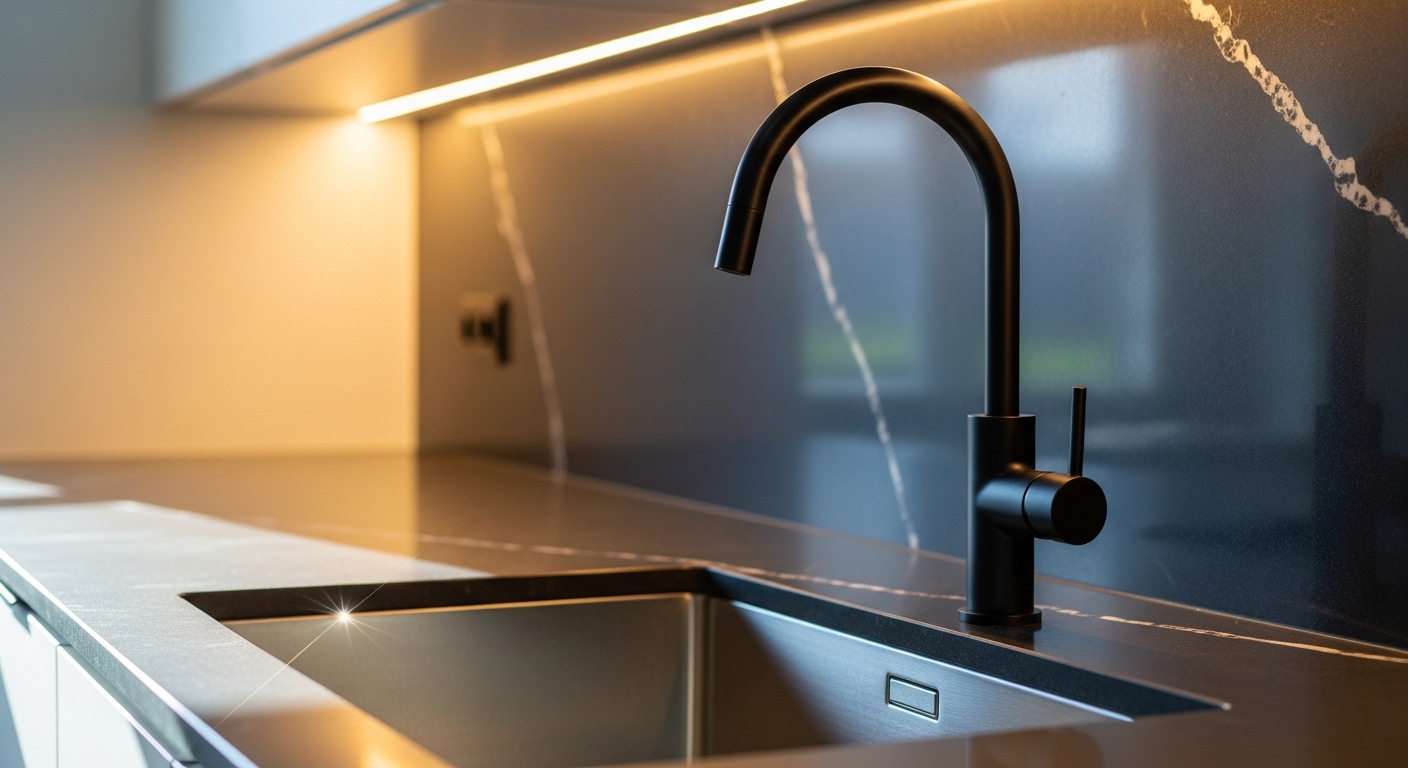
If you’ve been searching for a matte black RO tap, you’re almost certainly upgrading your drinking water setup and you don’t want a shiny chrome spout ruining the clean, modern look of your kitchen. Good news: matte black reverse-osmosis faucets have gone from a niche special-order item to a mainstream option, and the quality at every price point is far better than it was even two years ago. The catch is that not all of them are built the same, and a cheap finish or a non-certified body can cost you both looks and water safety.
This guide walks you through exactly what an RO tap is, whether the matte black version holds up, how to pick the right connection type for your filter, what you should budget, and how to install it — in plain language, with the specs that actually matter.
What exactly is a matte black RO tap, and how is it different from a normal faucet?
A matte black RO tap is a small, dedicated faucet — finished in a non-reflective black coating — that dispenses purified water from a reverse osmosis or under-sink filtration system, separate from your main kitchen faucet. It is not a replacement for your regular tap; it sits beside it and carries only filtered drinking water.
The key differences from a standard kitchen faucet come down to three things:
- Flow path: An RO tap connects to a single 1/4″ or 3/8″ tube coming from your filter system, not to the hot and cold supply lines under your sink. A standard faucet mixes hot and cold; a basic RO tap dispenses one stream of purified water.
- Internal materials: Because RO water is very “pure” and slightly aggressive, quality RO taps use a lead-free brass or 304 stainless body with a food-grade internal waterway, so nothing leaches back into your drinking water.
- Air gap vs. non-air-gap: Some RO taps include an air-gap design (with a third small tube) to prevent drain water from siphoning back into the system. Many modern systems use a non-air-gap tap instead. You need to match your system.
The “matte black” part is purely the finish — but that finish is where a lot of buying decisions go wrong, so let’s look at it closely.
Does the matte black finish on an RO tap actually hold up, or does it scratch and fade?
A good matte black RO tap holds up very well — the finish only fails on cheap taps that use spray paint instead of a proper powder coat or PVD coating. Since an RO tap gets touched dozens of times a day, the finish quality matters more here than on almost any other fixture in your home.
There are three common ways manufacturers achieve matte black, and they are not equal:
| Finish type | Durability | Feel / look | Typical price tier |
|---|---|---|---|
| Spray paint / cheap lacquer | Poor — chips and rubs off at the handle and spout within months | Flat but can look plasticky; shows wear fast | Budget ($15–$30) |
| Powder coat | Good — resists scratches and chemicals, fingerprint-friendly | Deep, even matte with a slight texture | Mid ($30–$70) |
| PVD matte black | Excellent — bonded at a molecular level, extremely scratch- and fade-resistant | Consistent, premium matte; easiest to clean | Premium ($70–$150+) |
If you can, spend the extra for a powder-coated or PVD finish. Matte black is more prone to showing water spots and dried mineral residue than chrome — especially if you have hard water — so a smoother, higher-grade coating pays off every time you wipe it down. This is the same finish logic that applies across the category, whether you’re shopping for a drinking-water tap or a full-size fixture like a matte black industrial kitchen faucet, and it’s worth understanding before you commit.
One plain-talk tip: keep a microfiber cloth in the cabinet and give the tap a quick dry-wipe after heavy use. Matte black looks its absolute best when it’s dry, and a soft cloth avoids the micro-scratches that steel wool or gritty sponges cause.
Single-outlet or 3-way matte black RO tap — which one do I actually need?
Choose a single-outlet RO tap if your filter only produces cold purified water; choose a 3-way (or “tri-flow”) tap if you want filtered, hot, and cold all from one spout, or if you’re pairing it with an instant hot-water tank or a boiler. The wrong choice here is the most common mistake buyers make.
Here’s how to decide quickly:
- Standard RO or under-sink filter, cold water only: Get a single-outlet matte black RO tap. Simple, affordable, one tube in, one lever.
- You want boiling and chilled filtered water on demand: Get a 3-way tap paired with a compatible boiler/chiller unit. These cost more and need more under-sink space and a power outlet.
- You have a combi setup and want to cut clutter: A 3-way tap replaces your main mixer AND handles filtered water, so your sink deck stays clean with a single fixture.
Also confirm the hole size and deck thickness. Most RO taps need a 12mm to 35mm mounting hole depending on the base design, and they usually mount in a spare sink knockout or a drilled granite/quartz hole. If you’re drilling a stone countertop, that’s a job for a pro with a diamond bit — cracked quartz is not a DIY warranty claim.
How do I connect a matte black RO tap — is it a DIY job?
Connecting a matte black RO tap is a genuine DIY job for most people if you already have the filter system installed — it usually takes 30–45 minutes and only needs basic hand tools. The tap itself is the easy part; the filter plumbing is where you go slow.
The typical process looks like this:
- Turn off the RO system and depressurize it by opening the existing tap or the system’s valve.
- Drop the new tap through the mounting hole, add the rubber and metal washers underneath, and hand-tighten the mounting nut, then snug it with a wrench — don’t over-torque or you can crack a matte finish base.
- Connect the 1/4″ (or 3/8″) push-fit or compression tube from the RO tank/post-filter to the tap’s inlet. Push-fit John Guest–style fittings are the most forgiving.
- If it’s an air-gap tap, connect the air-gap and drain tubes exactly per the diagram — get these backward and you’ll get water spitting from the base.
- Turn the system back on, then check every joint for drips for a full 10 minutes before you walk away.
Because RO taps rely on push-fit tubing rather than the braided steel supply lines a main faucet uses, you generally don’t need to worry about matching thread sizes the way you would elsewhere. If you’re curious how the standard connection sizing works on a regular kitchen faucet — which is a common point of confusion — this breakdown of whether kitchen faucet supply lines are universal is a useful companion read. And if you ever notice weak output after install, our guide on diagnosing low water flow covers the same root causes — a kinked tube, a clogged filter, or low tank pressure.
One warning: if you feel any resistance when pushing tubing into a fitting, stop and re-cut the tube end square with a proper tube cutter. A slanted cut is the number-one cause of slow drips under RO systems.
What should I budget for a good matte black RO tap in 2026?
Budget $30–$70 for a quality single-outlet matte black RO tap with a brass body and powder-coated finish, or $90–$200+ for a premium PVD 3-way tap. Below about $25, you’re usually paying for a painted zinc-alloy body that won’t age well and may not be certified lead-free.
Here’s a realistic breakdown of what each budget gets you:
| Budget | What you typically get | Best for |
|---|---|---|
| Under $25 | Zinc/plastic body, painted finish, no certification | Short-term rentals only — not recommended for daily use |
| $30–$70 | Lead-free brass body, powder-coated matte black, single outlet, NSF-certified waterway | Most homeowners with a standard RO or under-sink filter |
| $90–$200+ | Solid brass, PVD matte black, 3-way or air-gap options, ceramic disc valves | Design-focused kitchens and instant hot/cold setups |
The sweet spot for most buyers is the $30–$70 range. You get a body that won’t corrode, a finish that survives daily handling, and — critically — a certified waterway. Spending more mainly buys you the PVD finish, the tri-flow function, and smoother ceramic-disc valve action.
Is matte black a smart choice for a drinking-water tap, or will it show hard-water spots?
Matte black is a smart, on-trend choice, but be honest about your water: if you have hard water, matte black will show dried mineral spots a bit more than chrome, so you’ll wipe it slightly more often. The trade-off is that scratches and fingerprints are far less visible on matte black than on polished finishes.
Matte black pairs especially well with:
- Stainless steel or matte black sinks
- White, grey, or dark quartz and granite countertops
- Modern, industrial, and Scandinavian kitchen styles
- Other black fixtures — coordinating your RO tap with a matching main faucet or even a matte black tub faucet elsewhere in the home creates a cohesive, deliberate look
If your water is very hard, consider it another reason the RO system is worth it — the purified water coming out of the tap itself won’t leave spots. The spotting only happens from splashes of your regular tap water landing on the matte surface, and a quick daily wipe handles it completely.
How long does a matte black RO tap last, and what about the warranty?
A well-made matte black RO tap should last 8–15 years, with the ceramic valve cartridge being the part most likely to need replacing over that time. Look for a manufacturer that backs the finish and the body with a multi-year warranty — that’s your best signal of real quality.
When comparing warranties, check three things specifically:
- Finish warranty: A confident brand will warrant the matte black coating against flaking and fading, not just the mechanical parts.
- Waterway certification: Look for NSF/ANSI 61 and 372 (lead-free) certification, which confirms the tap is safe for drinking water.
- Replaceable cartridge: Ceramic disc valves are rated for hundreds of thousands of cycles, but they should still be user-replaceable so one worn part doesn’t mean a whole new tap.
The internal cartridge is genuinely the wear item here. If your tap starts dripping after years of service, that’s usually a $10 cartridge swap, not a reason to replace the whole fixture.
Matte Black RO Tap vs. Chrome and Brushed Nickel: quick comparison
If you’re torn between finishes, here’s the honest rundown for a drinking-water tap specifically:
| Finish | Hides fingerprints? | Shows hard-water spots? | Best match |
|---|---|---|---|
| Matte black | Yes — excellent | Slightly more visible | Modern, industrial, dark or white kitchens |
| Chrome | No — shows everything | Less visible | Traditional and bright kitchens |
| Brushed nickel | Yes — good | Least visible | Warm, transitional kitchens |
Matte black wins on modern looks and fingerprint resistance; brushed nickel is the most forgiving with hard water. If your whole kitchen is already committed to black or stainless hardware, the matte black RO tap is the clear pick for a coordinated finish.
FAQ
Can I use a matte black RO tap with any reverse osmosis system?
Mostly yes — most RO taps use standard 1/4″ or 3/8″ tubing that fits the majority of RO and under-sink systems. The one thing you must match is air-gap vs. non-air-gap: an air-gap system needs an air-gap tap (with three tubes), and a non-air-gap system uses a simpler two-connection tap. Check your system’s manual before buying.
Is a matte black RO tap safe for drinking water?
A quality one is, as long as it’s certified. Look for NSF/ANSI 61 and NSF/ANSI 372 (lead-free) certification and a lead-free brass or stainless waterway. Very cheap painted taps sometimes skip certification, which is exactly why we recommend staying above the $25–$30 range for anything you’ll drink from daily.
Do matte black RO taps scratch easily?
Powder-coated and PVD matte black taps are quite scratch-resistant; only cheap spray-painted finishes chip easily. To keep any matte finish looking new, clean it with a soft microfiber cloth and mild soap — never use abrasive pads, steel wool, or harsh scale removers, which can dull or mark the coating.
Why is my new RO tap dripping or slow?
The most common causes are a tube cut at an angle, a fitting that isn’t fully pushed home, low RO tank pressure, or a clogged post-filter. Re-cut the tube square, push each fitting in firmly until it seats, and confirm your tank has proper air pressure. If flow is still weak, the filter cartridges may simply be due for replacement.
Can I install a matte black RO tap myself?
Yes, if the filter system is already in place, installing just the tap is a beginner-friendly, 30–45 minute job with basic tools. The only part that may need a professional is drilling a new mounting hole in a granite or quartz countertop, which requires a diamond core bit and steady technique to avoid cracking the stone.
Do I still need my regular kitchen faucet if I have an RO tap?
Yes. A single-outlet RO tap only dispenses purified drinking water and typically flows more slowly, so it’s not meant for filling large pots, washing dishes, or hot water. It works alongside your main faucet. If you want to consolidate everything into one fixture, a 3-way tap with hot, cold, and filtered water is the alternative.
The bottom line
A matte black RO tap is one of the easiest upgrades to make your kitchen look intentional while giving you cleaner drinking water at the push of a lever. Buy a lead-free, NSF-certified model with a powder-coated or PVD finish, match the connection type to your filter system, and you’ll get a fixture that looks sharp and performs reliably for a decade or more. For most homeowners, a solid brass single-outlet tap in the $30–$70 range hits the perfect balance of looks, safety, and value.
About the author & avitashome: This guide was written by the avitashome fixtures team, drawing on hands-on testing of drinking-water and kitchen faucets across finishes, valve types, and filtration setups. avitashome specializes in modern faucets, shower systems, and bathroom fixtures for U.S. homes, and we evaluate every product we recommend against real-world durability, NSF/ANSI water-safety standards, and manufacturer warranty coverage — so the advice here reflects what actually lasts in a working kitchen, not just spec sheets.