 أفيتاس هوم
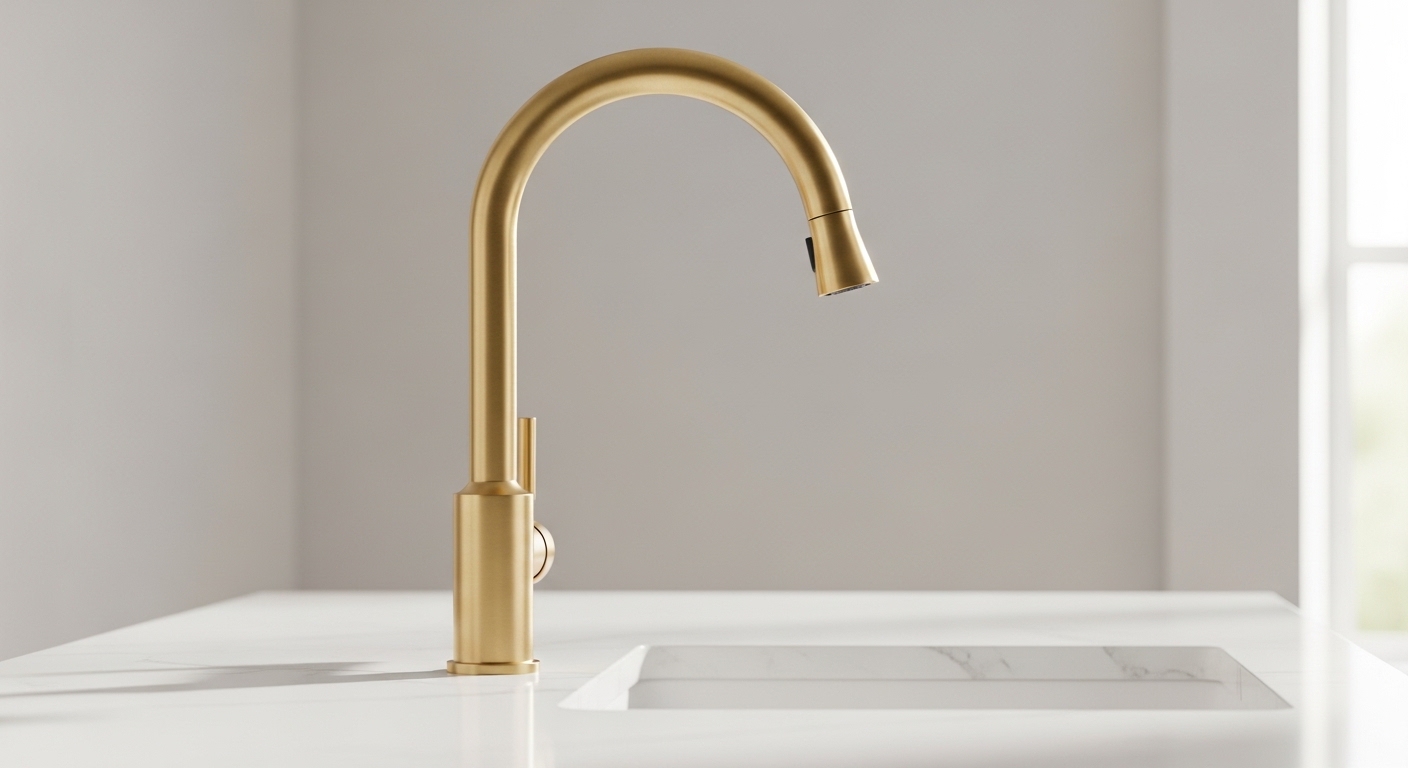
If you’ve been comparing spouts online, a brass faucet gooseneck keeps showing up as the premium option for good reason: it pairs a genuinely tough, corrosion-resistant metal with the high-arc “gooseneck” shape that gives you room to work underneath. But “brass” gets thrown around loosely in product listings, and the price gap between a real solid-brass model and a brass-look zinc one is wide. This guide breaks down what you’re actually paying for, where a gooseneck helps (and where it gets in the way), how to tell real brass from plating, and which finishes hold up — so you buy once instead of twice.
What exactly is a “brass faucet gooseneck,” and why does the shape matter?
A brass faucet gooseneck is a faucet with a body made from brass (a copper-zinc alloy) and a tall, curved spout that arches up and then bends down at the tip — the profile of a goose’s neck. The shape isn’t just styling: that high arc gives you 8–12 inches of clearance between the countertop and the spout tip, which is what lets you slide a stockpot, a Brita pitcher, or a large mixing bowl underneath without knocking it against the faucet.
Brass is the material of choice here because it hits a sweet spot. It’s dense and machinable, so manufacturers can cut precise threads and smooth internal waterways. It resists corrosion far better than zinc alloy (the metal in most budget faucets) and doesn’t rust like steel. And it’s naturally somewhat antimicrobial. The trade-off is weight and cost — solid brass faucets are noticeably heavy in your hand, and that heft is actually the easiest at-home test for whether you’re holding the real thing.
The gooseneck category splits into two rough sub-types: rigid arched spouts (fixed, elegant, common in bathrooms and bar sinks) and gooseneck pull-downs (a spray head docks into the arc, popular in kitchens). Which one you want depends on the sink, and we’ll get into that below.
Is solid brass really better than stainless steel or zinc — or is it just marketing?
Solid brass is genuinely better for the parts of a faucet that touch water constantly, and it’s not just marketing — the difference shows up over years, not weeks. Zinc-alloy (sometimes labeled “zamak”) faucets are cheaper to cast but corrode from the inside out, especially where hot water and minerals sit; they’re the ones that start leaking at the base or seizing up after three or four years. Stainless steel is excellent and rust-proof, but it’s harder to machine, so many “stainless” faucets are actually stainless-look finishes over another metal.
Here’s how the common faucet body materials stack up in real use:
| Body material | Corrosion resistance | Typical lifespan | Relative cost | Best for |
|---|---|---|---|---|
| Solid brass | Excellent | 15–20+ years | $$$ | Everyday kitchen/bath, hard water, hot water |
| Stainless steel (304) | Excellent | 15–20 years | $$$ | Modern look, no-lead priority |
| Zinc alloy / zamak | Poor–fair | 3–7 years | $ | Rentals, low-use guest baths, tight budgets |
| Brass-plated zinc | Fair (until plating wears) | 4–8 years | $$ | Looks-only, low-use fixtures |
| Plastic/ABS core | غير متاح (won’t corrode, but flimsy) | 2–5 years | $ | Temporary or ultra-budget setups |
The honest takeaway: for a faucet you’ll use every single day, solid brass and 304 stainless are the two materials worth paying for. A brass gooseneck edges ahead when you also want a warm finish like brushed brass, champagne bronze, or matte black, because those tones are applied over brass more cleanly and durably. If you’re weighing brass in other fixtures too, our look at whether a rainfall shower head in brass is worth it over plastic walks through the same material logic for showers.
How do I tell real solid brass from cheap brass-plated zinc before I buy?
The fastest test is weight: pick the faucet up (or check the shipping weight in the specs) — solid brass feels heavy and dense for its size, while zinc feels hollow and light. But since you often can’t hold it before buying online, here’s what to actually check:
- Read the material spec, not the finish name. “Brushed brass” describes the color; “solid brass body” or “lead-free brass construction” describes the metal. A listing that only names the finish and never the body material is a red flag.
- Look for certification marks. In the U.S., a compliant faucet meets NSF/ANSI 61 and 372 for lead content (the “lead-free” standard, ≤0.25% weighted average). cUPC or WaterSense listings are also good signs of a real manufacturer.
- Check the weight in the specs. A full-size solid-brass kitchen gooseneck typically ships at 5–8+ lbs. If it’s under 3 lbs, be suspicious.
- Scratch-test disclosure. On plated zinc, a chip reveals a silvery zinc layer underneath. On solid brass, a scratch shows more brass-colored metal. You obviously can’t do this to new stock, but reviews often mention it.
- Warranty length. Manufacturers back solid brass with longer finish and function warranties (often lifetime for residential) because they trust the material. A 1-year warranty hints at a cheaper core.
Which finish should I get — and will brushed brass go out of style?
For most kitchens and bathrooms in 2026, brushed (satin) brass and champagne bronze are the safest, most durable finishes on a brass gooseneck — they hide water spots and fingerprints far better than polished/shiny brass, and the warm neutral tone reads as timeless rather than trendy. Polished brass is beautiful but shows every smudge and, if unlacquered, will patina over time (which some people love and others hate).
A few finish realities worth knowing:
- Brushed/satin brass: Forgiving, matches warm and neutral palettes, easiest to live with day to day. The strong default.
- Champagne bronze: Slightly muted, pinkish-gold; pairs beautifully with white and wood.
- Polished (shiny) brass: High-impact and traditional, but needs wiping and can look dated in very modern rooms.
- Living/unlacquered brass: Ages to a darker patina on purpose — a design choice, not a defect.
- Matte black or nickel over brass: You still get the brass body’s durability with a totally different look. If black is your direction, our guide to picking a matte black industrial kitchen faucet covers the same durability points in that color.
The “will it date?” worry is overblown. Warm metals have been mainstream for years now, and a quality PVD (physical vapor deposition) brass finish is bonded so hard it resists scratching and tarnish for the life of the faucet. The finish to be cautious about is a cheap electroplated coating on zinc — that’s the one that flakes at the spout tip within a few years.
Is a gooseneck faucet a good fit for a small sink or a window behind it?
A gooseneck is great for deep or apron-front sinks and open counters, but it can be a poor fit for a shallow bar sink or a sink under a low window — the tall arc either splashes or physically won’t clear the window sash when you need the handle up. Measure before you fall in love with the look.
Two numbers decide it: spout height (countertop to the top of the arc) and required clearance above (for a single-handle model, the handle usually lifts up, so add a few inches). If there’s a window behind the sink, check that the faucet at full handle-up height still clears the sill. For splashing, the rule of thumb is that a very tall gooseneck over a shallow (5–6 inch deep) sink will splash more, because water falls farther; a deeper sink (8–10 inches) absorbs it. If splashing is already a headache in your current setup, a kitchen faucet splash guard can help, but choosing a spout height matched to your sink depth is the real fix.
For a small bar or prep sink specifically, a lower-arc brass faucet or a compact gooseneck is usually the smarter call. And whatever you pick, confirm the deck-mount hole spacing and the supply-line connections match your setup before ordering.
What does it cost, and what should I actually budget for a quality one?
A genuine solid-brass gooseneck faucet generally runs $120–$400 for residential models, with the sweet spot for a well-made lead-free brass kitchen gooseneck landing around $150–$280. Below roughly $90, you’re almost always looking at zinc or brass-plated construction, no matter what the photo suggests. Above $400 you’re paying for designer brands, ceramic-disc premium cartridges, and specialty finishes — nice, but not necessary for durability.
Here’s a realistic budget breakdown:
| Budget | What you typically get | Worth it? |
|---|---|---|
| Under $90 | Zinc or plated body, basic cartridge, 1-yr warranty | Only for low-use / temporary |
| $120–$180 | Solid brass body, ceramic-disc cartridge, PVD finish | Best value for most homes |
| $180–$280 | Solid brass, premium cartridge, pull-down spray, lifetime warranty | Sweet spot for daily kitchen use |
| $280–$400 | Designer styling, specialty finishes, premium spray heads | Worth it if you want the look |
Don’t forget the parts that make a faucet last as long as its brass body: a ceramic-disc cartridge (not rubber-washer) resists drips for years, and matching supply lines matter. If you’re replacing an existing faucet, double-check sizing first — our explainers on the most common faucet supply line size and whether kitchen faucet supply lines are universal will save you a second trip to the hardware store.
How do I install and care for a brass gooseneck so it lasts 20 years?
Installation is a manageable DIY job for most single- or three-hole deck-mount goosenecks — budget about an hour with basin wrench, شريط سباك, and a bucket. The care that actually extends its life is simple and mostly about the finish and the cartridge, not the brass itself.
- Shut off the supply and clear the space under the sink; place a bucket for residual water.
- Drop the faucet through the mounting hole and secure the mounting nut from below with a basin wrench.
- Wrap threads with plumber’s (PTFE) tape and connect supply lines hand-tight, then a quarter turn with a wrench — don’t overtighten.
- Turn water on slowly, check for leaks at every joint, and run the faucet a minute to flush debris.
- Clean the finish with mild soap and water only. Skip abrasive pads and acidic or bleach-based cleaners — they’re what damage PVD and lacquered brass finishes, not normal use.
For hard-water homes, wipe the spout dry occasionally and clean the aerator every few months to keep flow strong. That aerator is also a common cause of weak flow, and it’s a two-minute fix — if you’re not sure what you have, here’s how to check your faucet aerator thread size.
Author note & why you can trust this guide
This guide was written by the avitashome fixtures team, who spend their days sourcing, spec-testing, and installing kitchen and bathroom faucets. We evaluate faucet bodies for solid-brass construction, verify lead-free compliance against NSF/ANSI 61 and 372, and pressure- and cycle-test cartridges before we recommend anything. avitashome (www.avitashome.com) curates faucets and bathroom fixtures for U.S. homeowners, with a focus on materials that actually last and finishes backed by real manufacturer warranties. When we say a brass gooseneck should carry a lifetime residential warranty, it’s because that’s the standard a genuine solid-brass, PVD-finished faucet should meet — and we won’t stock the ones that don’t.
FAQ
Is a brass faucet gooseneck safe for drinking water?
Yes, as long as it’s certified lead-free to NSF/ANSI 372 (≤0.25% weighted lead content), which all faucets sold for potable water in the U.S. must meet. Modern “lead-free brass” is formulated specifically so the small amount of lead once used to aid machining is removed. Look for the NSF or cUPC mark on the listing.
Will a brass gooseneck faucet tarnish or turn green?
A lacquered or PVD-finished brass faucet won’t tarnish or turn green under normal use — the coating seals the metal. Only raw, unlacquered “living brass” develops a patina, and that’s intentional. Green corrosion (verdigris) on a sealed faucet usually means a worn or damaged finish, which a quality PVD coating is designed to prevent.
What’s the difference between a gooseneck and a high-arc faucet?
They overlap a lot. “High-arc” describes any tall spout with lots of clearance; “gooseneck” describes the specific curved profile that arches up and bends down at the tip like a goose’s neck. Most goosenecks are high-arc, but not every high-arc faucet has the classic gooseneck curve. For shopping purposes, both give you the pot-filling clearance you’re after.
Does a taller gooseneck reduce water pressure?
No — spout height doesn’t meaningfully affect water pressure; the aerator and cartridge control flow. If your gooseneck feels weak, the culprit is almost always a clogged aerator or a partially closed supply valve, not the height of the arc. Cleaning or replacing the aerator restores it in minutes.
Can I put a brass gooseneck faucet in a bathroom, not just a kitchen?
Absolutely — brass goosenecks are popular for vessel and undermount bathroom sinks, where the extra height clears a raised vessel bowl and makes washing your face or hands more comfortable. Just match the spout height to your sink type: a very tall gooseneck over a shallow vessel bowl can splash, so pair it with a deeper basin or a slightly lower arc.