 أفيتاس هوم
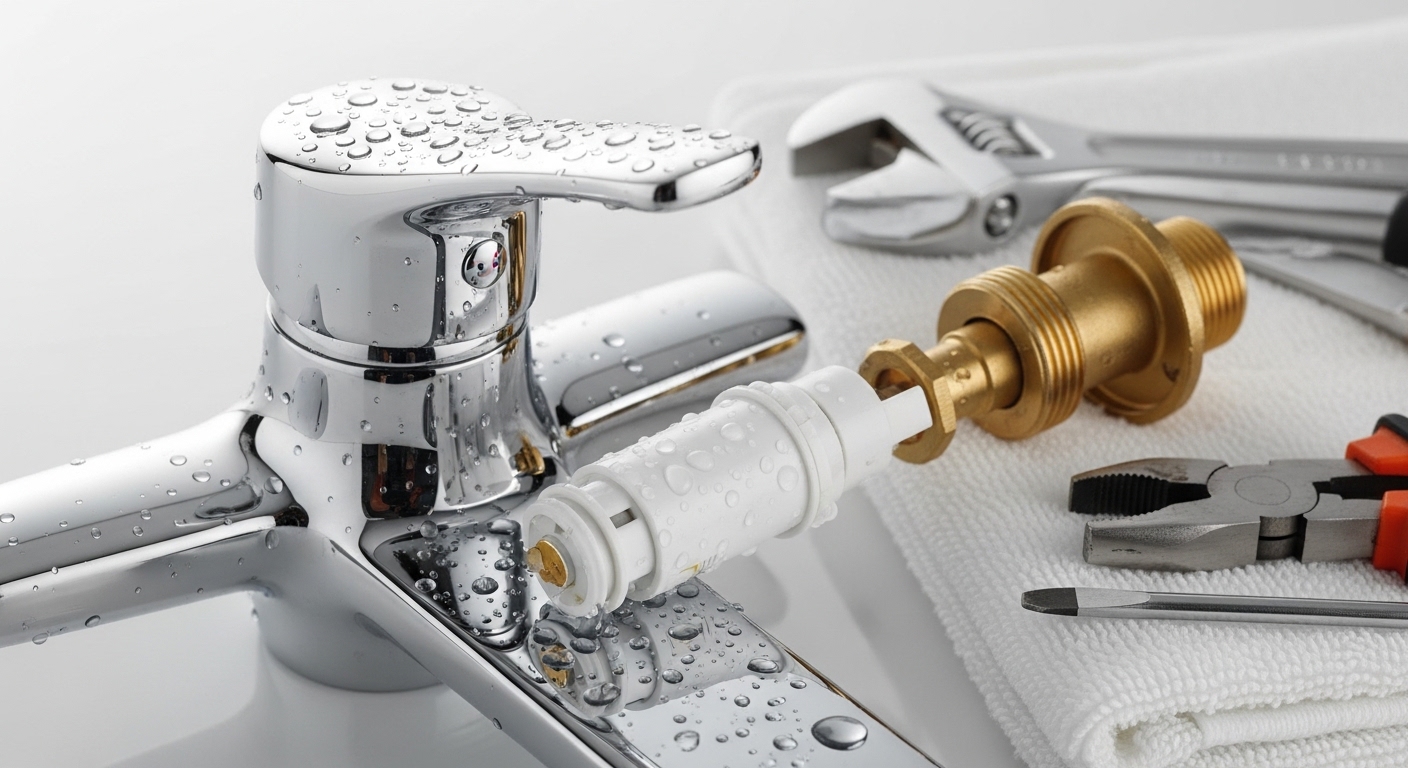
If your tub is dripping, spraying, hard to turn, or mixing hot and cold on its own, a faucet cartridge replacement bathtub repair is almost always the fix — not a whole new valve. The cartridge is the plastic-and-brass core inside your handle that controls how much hot and cold water flows and blends. It wears out, gets clogged with hard-water minerals, or the internal seals crack. Swapping it is one of the most satisfying, money-saving plumbing repairs a homeowner can do, and this guide walks you through exactly how, what parts to buy, and when to call a pro instead.
What exactly is a bathtub faucet cartridge, and how do I know mine is bad?
The cartridge is the removable valve core behind your tub handle that controls water flow and temperature. You know it’s bad when you get a persistent drip after the handle is fully off, water temperature that won’t hold steady, a handle that turns too loosely or too stiffly, or reduced flow from the tub spout. Any one of these usually points at a worn cartridge, not a broken faucet.
Here’s the quick logic most plumbers use. A single dripping spout that keeps going long after you shut the handle almost always means the cartridge’s internal seals or ceramic discs have failed — they can no longer make a watertight seal. If hot and cold won’t blend properly, or scalding water sneaks through when you asked for warm, the cartridge’s mixing chamber is worn or scaled up with mineral deposits. And if the handle suddenly feels gritty or seized, mineral buildup inside the cartridge is the usual culprit. Cartridges are consumable parts — even good ones last roughly 5 to 15 years depending on your water hardness.
Before you buy anything, figure out what you actually have. Bathtub valves come in a few families: single-handle cartridge valves (by far the most common today), two-handle valves with a separate hot and cold cartridge or stem on each side, and older compression/washer stems. Snap a photo of your handle and trim, and if you can, find the brand stamped on the escutcheon (the wall plate) or the handle. Moen, Delta, Kohler, Pfister, and Grohe each use their own cartridge designs, and they are not interchangeable.
Can I really replace a bathtub cartridge myself, or do I need a plumber?
Yes — for the vast majority of single-handle and two-handle tub faucets, replacing the cartridge is a beginner-friendly DIY job that takes 45 to 90 minutes and needs only basic hand tools. You only need a plumber if the valve body inside the wall is cracked or leaking, if the cartridge is corroded solid and won’t budge even with a puller, or if you have no accessible shut-off and aren’t comfortable turning off your home’s main water.
The honest truth is that the cartridge swap itself is easy. The two things that trip people up are (1) buying the wrong replacement part, and (2) a cartridge that’s fused in place by years of mineral scale. Both are solvable. If you’d rather understand the full teardown before committing, our companion walkthrough on how to change a faucet in a bathtub yourself covers the surrounding trim work in more detail, and it pairs perfectly with this cartridge-focused guide.
When you should NOT DIY: if you see water damage in the wall or ceiling below the tub, if the pipes are visibly corroded, or if the valve body (the fixed brass housing the cartridge slides into) is cracked, call a licensed plumber. Replacing a valve body usually means opening the wall and sweating new copper — a different job entirely.
What tools and parts do I need for a bathtub cartridge replacement?
You need one exact-match replacement cartridge plus a small tool kit: a Phillips and flat screwdriver, a set of Allen (hex) keys, needle-nose pliers, plumber’s grease, and — critically — a cartridge-puller tool for stubborn cartridges. Total parts cost is typically $15–$60 for the cartridge and under $25 for a puller if you don’t already have one.
Here’s the full shopping and staging list:
- The correct cartridge — matched to your faucet brand and model. This is the whole ballgame; more on identifying it below.
- Screwdrivers (Phillips + flathead) and a full Allen key set — most single-handle tub handles are held by a tiny set screw.
- Needle-nose pliers and channel-lock pliers for retaining clips and bonnet nuts.
- A cartridge-puller — brand-specific pullers (Moen sells one for its 1222/1225 cartridges) or a universal puller save you when a cartridge is scaled in place.
- Silicone plumber’s grease — never petroleum jelly; it degrades rubber O-rings.
- White vinegar to dissolve mineral scale on the valve body once the old cartridge is out.
- A towel and a bucket to catch residual water and to plug the drain so you don’t lose the tiny clip or screw.
How do I identify the right replacement cartridge so I don’t buy the wrong one?
Identify your cartridge by matching three things: the faucet brand, the valve model number, and the physical shape of the old cartridge you pull out. The safest method is to remove the old cartridge first, photograph it next to a ruler, note any part numbers stamped on it, and match it exactly — or bring it to the store. Buying by brand alone is the #1 cause of a failed repair.
Brands are proprietary. A Moen cartridge will never fit a Delta valve, and even within one brand there are multiple cartridge families. Here’s a quick orientation:
| Brand | Common tub cartridge | Typical price | Notes |
|---|---|---|---|
| Moen | 1222 / 1225 (single-handle) | $20–$45 | Lifetime warranty; a puller tool makes removal easy |
| Delta | RP series (e.g., RP19804) or ceramic 17 series | $15–$40 | Many Delta valves use a washer/stem, not a modern cartridge |
| Kohler | GP series ceramic-disc | $30–$60 | Match by trim/valve model carefully |
| Pfister | 0X8 / JX series | $20–$40 | Older two-handle models use stems |
| Grohe | Thermostatic or 46 series | $40–$90 | Thermostatic cartridges cost more; verify spec exactly |
The gold-standard move: turn off the water, pull the old cartridge (steps below), then match it. Manufacturers stamp identifying numbers into the plastic. If you can read “1222” on a white cartridge, you have a Moen — done. Many brands also honor a limited lifetime warranty on the cartridge itself; if you register your faucet or can prove original purchase, Moen and Delta will often mail you a free replacement cartridge. Always keep your model number handy when you call.
Step by step: how do I actually replace the cartridge in my bathtub?
Replace a bathtub cartridge in seven steps: shut off water, remove the handle, remove the trim/escutcheon, pull the retaining clip or bonnet nut, extract the old cartridge, grease and insert the new one in the same orientation, then reassemble and test. Take a photo at every stage so reassembly is foolproof.
- Shut off the water. Use the tub’s built-in stops if you have them, or close your home’s main supply. Open the tub handle to release pressure and drain the line.
- Plug the drain. A dropped set screw or retaining clip down the drain will ruin your afternoon.
- Remove the handle. Pop off the decorative cap, loosen the set screw (usually an Allen screw underneath or behind the handle), and pull the handle straight off.
- Remove the escutcheon and any sleeve. Unscrew the wall plate and slide off the plastic or metal sleeve to expose the valve.
- Release the cartridge. Most cartridges are held by a small horizontal U-clip (pull it out with needle-nose pliers) or a threaded brass bonnet nut (unscrew counter-clockwise). Note the orientation — mark the “up” position with a marker or your photo.
- Pull the old cartridge. Grip the stem with pliers and pull straight out, wiggling gently. If it’s scaled in and won’t move, thread on your cartridge-puller and use it — do not lever against the wall or you can crack the valve body.
- Clean, grease, and install the new cartridge. Scrub the valve bore with vinegar to remove scale, apply a thin film of silicone plumber’s grease to the new O-rings, and slide the new cartridge in with the exact same orientation as the old one (hot/cold alignment matters — install it backwards and your hot and cold will be reversed). Reinstall the clip or bonnet nut.
Then reassemble the trim in reverse order, turn the water back on slowly, and test through the full hot-to-cold range. Check for drips at the handle and at the spout. If everything’s dry and the temperature blends smoothly, you’re done.
Why is my new cartridge still leaking or the handle still stiff?
If the tub still drips or the handle feels wrong after a fresh cartridge, the usual causes are: the cartridge is installed in the wrong orientation, you bought a slightly-wrong part, the O-rings weren’t greased, or scale/debris is trapped between the cartridge and valve seat. Nine times out of ten it’s orientation or a not-quite-matching part.
Run through this troubleshooting checklist:
- Still dripping from the spout? Pull the cartridge, confirm it’s the exact match, and check that it’s seated fully and clipped in. A cartridge that isn’t pushed all the way home won’t seal.
- Hot and cold reversed? You installed the cartridge rotated 180°. Pull it and flip it.
- Handle too stiff? You likely skipped the silicone grease, or you used the wrong lubricant. Regrease the O-rings.
- New drip at the base of the handle? The cartridge O-rings may be pinched, or the bonnet nut isn’t snug. This is a different symptom from a spout drip — our guide on a bathroom faucet leaking from the handle breaks down that specific fix, and the same principles apply to a tub.
- Low flow after the swap? Debris from the old parts got knocked loose. Remove the cartridge, flush the line briefly with a rag over the opening, and reinstall.
One more thing worth knowing: a loose, wobbly handle is not always a cartridge problem. If your handle spins or rocks but the water still works fine, you may just have a loose set screw or worn adapter — see why a shower faucet gets loose and how to tighten it for good, since tub and shower valves share the same handle hardware. And if you have an older or unusual valve, confirm your tub spout connection type so you don’t confuse a spout-side leak with a cartridge failure.
How much does a bathtub cartridge replacement cost — DIY vs. plumber?
Doing it yourself costs about $15–$85 total: the cartridge ($15–$60) plus a puller and grease if you don’t own them. Hiring a plumber runs $150–$350 for the same job, since you’re paying $100–$250 in labor on top of the part. For a straightforward single-handle valve, DIY saves you the most money of nearly any bathroom repair.
| Path | Parts | Labor | Total | Time |
|---|---|---|---|---|
| DIY (own tools) | $15–$60 | $0 | $15–$60 | 45–90 min |
| DIY (buy puller too) | $15–$85 | $0 | $15–$85 | 45–90 min |
| Licensed plumber | $15–$60 | $100–$250 | $150–$350 | 1 visit |
If your cartridge is under a manufacturer warranty, the part may be free — bringing DIY cost to essentially the price of grease. That’s why identifying the brand and keeping proof of purchase pays off.
FAQ
How long does a bathtub faucet cartridge last?
A quality cartridge lasts about 5 to 15 years. Hard water shortens that dramatically because mineral scale grinds down the seals and clogs the mixing chamber. If you’re on well water or very hard municipal water, expect the shorter end and consider a whole-house filter or softener to extend the life of every cartridge in your home.
Do I have to turn off the water to the whole house to replace a tub cartridge?
Not always. Some tub valves have integrated stop screws behind the trim that let you isolate just that fixture. If yours doesn’t, you’ll need to close your home’s main shut-off valve. Either way, always open the handle afterward to bleed off pressure before you start disassembling.
Are bathtub faucet cartridges universal?
No. Cartridges are brand- and model-specific. A Moen cartridge won’t fit a Delta or Kohler valve, and even within one brand there are several incompatible families. Always match by pulling the old cartridge and comparing it directly, or by confirming your exact valve model number before buying.
What if the old cartridge won’t come out?
Mineral scale is usually the reason a cartridge seizes. Soak the exposed valve with white vinegar for 15–20 minutes to dissolve buildup, then use a brand-specific or universal cartridge-puller tool that grips and draws it out straight. Never pry sideways against the valve body — that can crack the housing and turn a $30 repair into a wall-opening plumbing job.
Can a bad cartridge cause scalding or fluctuating water temperature?
Yes. When the cartridge’s mixing chamber wears out or scales up, it can no longer blend hot and cold accurately, so you get sudden temperature swings or scalding. If you have a thermostatic or pressure-balancing valve, a failed cartridge can defeat that safety feature — which is a strong reason to replace it promptly rather than living with it.
Is replacing the cartridge enough, or should I rebuild the whole valve?
For most drips and temperature problems, replacing just the cartridge is enough. Only rebuild or replace the valve body if it’s physically cracked, corroded, or leaking inside the wall. If you have a two-handle wall-mount setup and the leak is coming from the escutcheon or stem side, a broader wall-mount faucet repair kit may be the better call than a single cartridge.
A note on expertise and standards
Author note: This guide was written by the avitashome fixtures team, drawing on hands-on installation and repair of hundreds of tub and shower valves across Moen, Delta, Kohler, Pfister, and Grohe systems. We test cartridges and trim in-house for flow consistency and seal integrity before we recommend them.
Brand credibility: avitashome is a dedicated faucet and bathroom-fixtures retailer focused exclusively on taps, showers, tub fillers, and their replacement parts — not a general home-goods store. Because fixtures are all we do, we stock brand-matched cartridges and can help you identify the exact part your valve needs.
Standards and warranty: Reputable cartridges are built to ASME A112.18.1 / CSA B125.1 faucet standards, and pressure-balancing/thermostatic valves are governed by ASSE 1016 for anti-scald protection. Major manufacturers like Moen and Delta back their cartridges with a limited lifetime warranty — keep your model number and proof of purchase so you can claim a free replacement part before you pay for one.