 أفيتاس هوم
If you’re standing under a sad trickle wondering why does my shower head have low pressure, the honest answer is that 8 خارج 10 times it’s something you can fix yourself in under an hour with a bag of white vinegar, a wrench, and a paperclip. Shower heads are simple mechanical devices, and low flow almost always traces back to one of a handful of culprits — clogged nozzles, a flow restrictor, a dirty filter, or a valve that isn’t fully open. Before you call a plumber or buy a new fixture, work through the causes below in order, cheapest and easiest first.
Below is the exact diagnostic order a plumber uses, translated into plain English, so you can pinpoint your problem instead of guessing.
What’s the most common reason a shower head loses pressure?
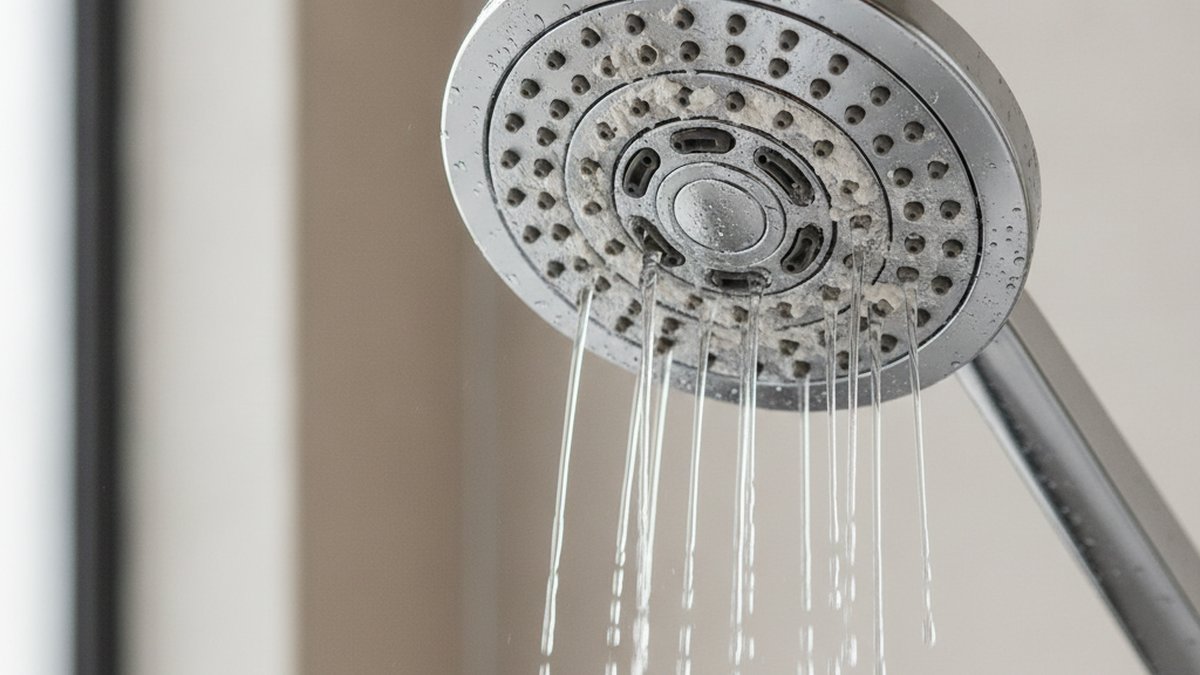
Mineral buildup — limescale — is the number one cause. Hard water leaves calcium and magnesium deposits that slowly plug the tiny spray nozzles and the internal screen, choking flow until only a few holes still spray.
You can usually confirm this by looking. Run the shower and watch the face of the head: if some nozzles spray hard while others dribble or shoot sideways, that’s classic clogging, not a whole-house pressure problem. Rubber-tipped nozzles (the little soft nubs on many modern heads) are actually the easy fix here — you can often rub the scale off with your thumb while the water runs.
The fix costs about a dollar:
- Fill a sturdy plastic bag with white vinegar (or a 50/50 vinegar-water mix if your finish is delicate).
- Slip the bag over the shower head so the whole face is submerged, and secure it with a rubber band or zip tie.
- Let it soak 1 hour for light buildup, or overnight for heavy scale. Skip overnight soaks on brass, oil-rubbed bronze, or gold finishes — long acid exposure can dull them.
- Remove the bag, use an old toothbrush and a paperclip to clear any stubborn nozzles, then run hot water for a minute to flush debris.
If you have chronically hard water, this isn’t a one-time job — you’ll be re-soaking every few months. We cover the deep-clean routine and how to tell scale from grit in our guide on how to clean a tub faucet aerator when the water barely trickles out, and the same principle applies to shower heads.
Could a flow restrictor be causing my low shower pressure?
Yes — and it’s the most overlooked cause. Nearly every shower head sold in the U.S. since the 1990s ships with a flow restrictor, a small plastic disc that caps flow to meet the federal limit of 2.5 gallons per minute (GPM). WaterSense-labeled heads restrict even further, to 2.0 GPM or less.
That restrictor is doing exactly what it’s designed to do, but if your home already has modest pressure, it can leave you feeling shortchanged. The restrictor is a small colored disc (often red, pink, or white) seated where the shower head screws onto the arm.
Here’s the important part: removing a flow restrictor is legal for personal use but can void your warranty and will raise your water and heating bills. If you want to try it, unscrew the head from the shower arm, pop out the rubber washer, and gently pry the disc out with a small flathead screwdriver or needle-nose pliers. Keep the disc — you may want it back. A better move for most people is to buy a head engineered to feel strong at low flow rather than tearing out safety hardware.
Why does my shower head have low pressure only on the hot side or after a remodel?
If pressure dropped suddenly — especially right after plumbing work, a water heater swap, or a new fixture install — suspect a partly closed valve or a dislodged screen, not scale. Scale builds up slowly over months; a sudden change points to something mechanical that moved.
Run through these quick checks:
- Main and branch shut-off valves: After any plumbing work, a valve may have been left only partly open. Make sure your main water valve and any in-line valves are turned fully counterclockwise (open).
- Hot-side only? If cold runs strong but hot is weak, the issue is likely at the water heater — a partially closed heater shut-off valve or sediment in the tank. This is common in homes with hard water and an aging tank.
- Shower valve cartridge: A worn or debris-clogged mixing cartridge behind the wall restricts flow to the head. This is the same part that causes temperature and pressure problems at tub spouts — see our walkthrough on a bathtub faucet replacement cartridge swap without calling a plumber for how the cartridge works and when to replace it.
- Inline filter screen: Many shower arms and heads have a small mesh screen that catches sediment. After a remodel, pipe debris (Teflon tape shreds, solder bits, rust flakes) often lands right there. Unscrew the head and rinse the screen.
How do I diagnose it step by step? (The 15-minute test)
Isolate the problem by testing from the head outward. The goal is to answer one question: is the restriction in the shower head, or upstream in the plumbing?
- Remove the shower head and turn the water on with just the bare shower arm. Strong, full flow from the arm? Then your head (or restrictor) is the problem — clean or replace it. Weak flow even from the bare arm? The problem is upstream.
- Check other fixtures. Turn on the bathroom sink and kitchen faucet. If everything in the house is weak, you have a whole-home pressure issue (pressure regulator, main line, or municipal supply). If only the shower is weak, it’s local.
- Test your pressure with a gauge. A $12 screw-on gauge from any hardware store threads onto a hose bib or the shower arm. Normal residential static pressure is 45–80 psi. Below 40 psi feels weak; above 80 psi is high enough to damage fixtures and usually means you need a pressure-reducing valve check.
- Inspect the pressure-reducing valve (PRV). Homes on municipal water often have a bell-shaped PRV near the main shut-off. These fail over 7–12 years and are a classic cause of a whole-house pressure drop.
The table below maps symptoms to the most likely cause and fix so you can jump straight to the right one.
| Symptom | Most Likely Cause | Typical Fix | DIY Difficulty |
|---|---|---|---|
| Some nozzles spray, others dribble | Mineral / limescale buildup | Vinegar soak + clear nozzles | Easy (30–60 min) |
| Even, weak flow from a newer head | Flow restrictor | Remove or replace restrictor disc | Easy (10 min) |
| Sudden drop after plumbing work | Clogged screen or partly closed valve | Rinse screen, fully open valves | Easy (15 min) |
| Weak on hot side only | Water heater valve / sediment | Open heater valve, flush tank | Moderate |
| Every fixture in the house is weak | Failing PRV or main line issue | Test PRV; call utility/plumber | Hard (pro) |
| Weak flow only from this shower | Worn mixing cartridge | Replace shower valve cartridge | Moderate |
Will a new shower head fix low water pressure, or am I wasting money?
A new head fixes low pressure only if the restriction was in the old head — scale you couldn’t fully clear, or a restrictor you don’t want to remove. It will not help if your actual household pressure is low; no shower head can create pressure that isn’t there.
That said, if your home genuinely has low supply pressure, the smart buy is a head engineered for it. High-efficiency and “low-pressure” shower heads use smaller, precisely angled nozzles and air injection (mixing air into the water) to make a modest flow rate feel powerful. A well-designed 1.8 GPM head can feel stronger than a clogged 2.5 GPM head. If low pressure is your reality, our roundup of the best rainfall shower head for low water pressure walks through which designs actually deliver a satisfying spray on weak supply.
A few buying pointers when pressure is your main concern:
- Look for air-injection technology — it boosts perceived force without more water.
- Choose fewer, larger nozzles over dozens of tiny ones; concentrated jets feel stronger at low flow.
- Pick rubber (silicone) nozzle tips so you can wipe scale off by hand and avoid future clogging.
- Skip huge rainfall heads if your pressure is under 45 psi — that wide face spreads a weak flow thin, and it feels like standing in a drizzle.
How do I keep it from happening again?
Prevent buildup before it starts, because in hard-water homes, clogging is a “when,” not an “if.” The single biggest factor is your water hardness.
Ongoing maintenance is simple:
- Wipe rubber nozzles with your thumb every week or two — 10 seconds prevents most clogs.
- Do a vinegar soak every 2–3 months in hard-water areas, twice a year in soft-water areas.
- Consider a whole-home or inline shower filter if your water leaves white crust on everything. Filtration reduces the sediment and scale that reach every fixture — the same logic behind keeping your other fixtures’ screens clean, which we cover in our piece on the faucet water filter parts you actually need to keep clean water flowing.
- Flush your water heater annually to clear sediment that starves the hot side.
If you rent or share plumbing, the fastest realistic win is a rubber-tip head plus a monthly vinegar soak — it sidesteps the parts of the system you can’t touch.
When should I stop DIYing and call a plumber?
Call a pro when the problem is clearly upstream and behind a wall or fixed pipe. Specifically: if a pressure gauge reads under 40 psi across the whole house, if you suspect a failed pressure-reducing valve, if you have galvanized steel pipes (which corrode shut internally over decades), or if the shower valve cartridge is seized and won’t budge.
These jobs involve shutting off the main, soldering, or working inside the wall — worth the money to get right the first time. Anything on the outlet side of the shower arm, though, is genuinely DIY-friendly, and you’ve now got the full playbook above.
FAQ
Is it illegal to remove the flow restrictor from my shower head?
No, it’s not illegal to remove a restrictor from a shower head you own for personal use — the 2.5 GPM federal standard applies to manufacturers selling fixtures, not to what you do at home. However, removing it can void your warranty, will increase your water and energy bills, and isn’t something a plumber will do for you on a code-regulated job. Try cleaning and a low-pressure-optimized head first.
Can hard water permanently ruin a shower head?
Yes, eventually. Repeated scale buildup can permanently block metal nozzle channels that won’t clear even with soaking, and acidic descaling over years can pit and dull the finish. Rubber-tip nozzles resist this best because scale flakes off the flexible surface. If a head no longer sprays evenly after a thorough overnight vinegar soak and nozzle-clearing, it’s usually cheaper to replace it than to keep fighting it.
Why is my shower pressure low but my sink pressure is fine?
When only the shower is weak, the restriction is local to that fixture — almost always a clogged shower head, a flow restrictor, a debris-filled inline screen, or a worn shower-valve cartridge. A healthy sink proves your incoming household pressure is fine, so you can skip the whole-house diagnostics and focus on the shower head and valve. Start by testing flow from the bare shower arm.
How much does low water pressure cost to fix myself?
Most DIY fixes cost under $15: a jug of white vinegar, a cheap pressure gauge, and maybe a replacement rubber washer or filter screen. A new low-pressure-optimized shower head runs $25–$80. Replacing a shower valve cartridge is typically $15–$50 in parts. You only reach real expense — $150–$600 — if you need a plumber to replace a pressure-reducing valve or repipe corroded lines.
Does a vinegar soak damage the shower head finish?
White vinegar is safe for chrome and stainless steel for extended soaks, but it can dull or etch brass, oil-rubbed bronze, matte black, and gold/champagne finishes if left too long. For those finishes, use a 50/50 vinegar-water mix, limit the soak to 30–60 minutes, and rinse thoroughly afterward. Always check the manufacturer’s care instructions, since aggressive descaling can void the finish warranty.
What water pressure is considered “normal” for a shower?
Normal residential static water pressure is 45–80 psi, and most showers feel comfortable at 45 psi and up. Below 40 psi, showers start to feel weak; above 80 psi, you risk damaging fixtures and appliances and should have a pressure-reducing valve checked. A $12 screw-on gauge at the shower arm or hose bib tells you exactly where you stand in a couple of minutes.
About the author: This guide was written by the avitashome fixtures team, drawing on hands-on testing of dozens of shower heads and valve cartridges across hard- and soft-water homes. At avitashome (see how we evaluate quality faucet brands), we specialize exclusively in faucets, shower heads, and bathroom fixtures — we pressure-test products against WaterSense and ASME A112.18.1 flow standards, and we recommend heads backed by manufacturer warranties so your fix lasts. When in doubt about your home’s plumbing, consult a licensed plumber.