 Avitas Home
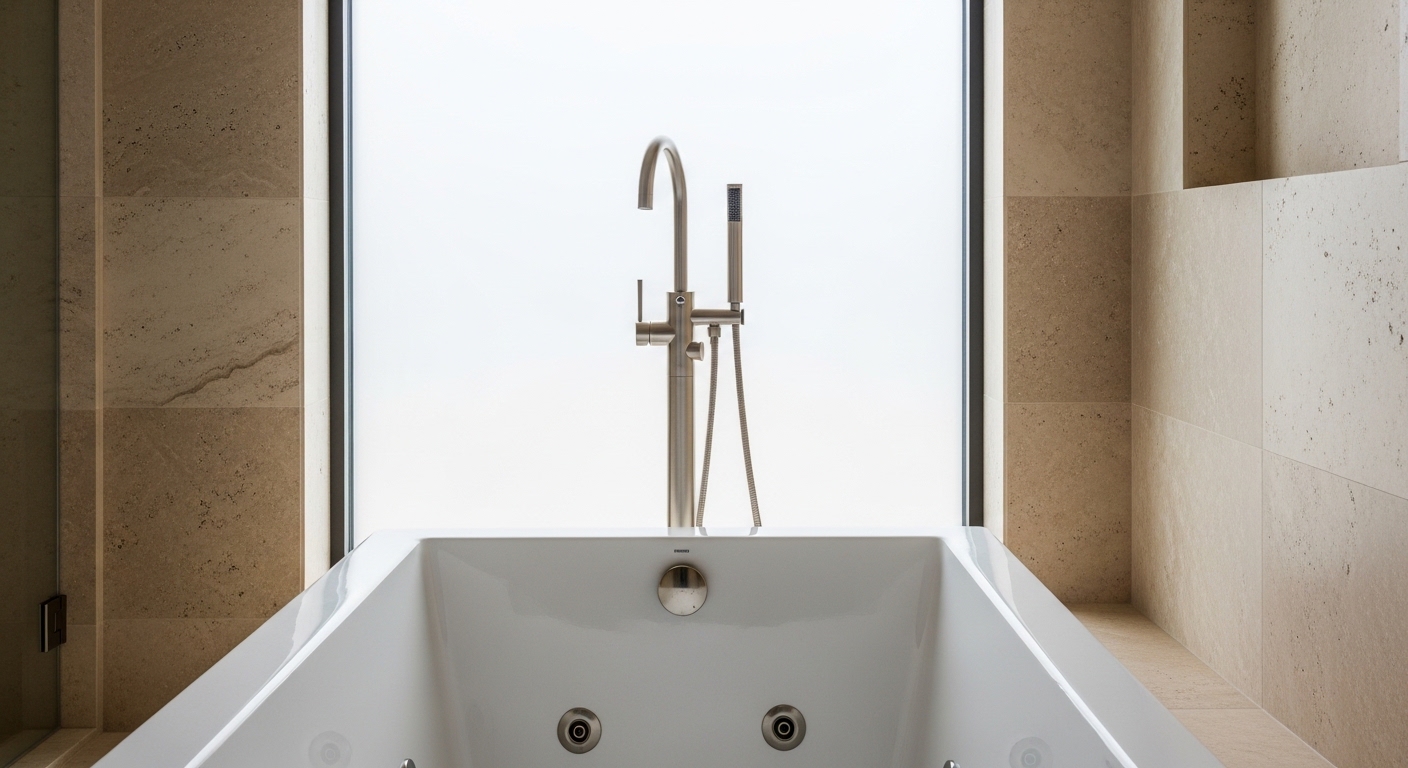
Choosing the right brushed nickel jacuzzi faucet is one of those decisions that quietly defines your entire bathroom. The finish has to harmonize with your shower trim and vanity hardware, the spout has to clear the tub deck without splashing, and the valve has to handle a jetted tub’s higher fill demand without screaming through the pipes. Get it right and you have a fixture that looks expensive, feels solid, and lasts through a decade of nightly soaks. Get it wrong and you’re chasing drips, mismatched undertones, and adapters that never quite seat. This guide walks you through every variable that matters — from flow rate (GPM) to ceramic disc cartridges to ADA-compliant handle reach — so you can shop with confidence.
At Avitas Home, we’ve spent years curating tub fillers and bath fixtures specifically for jetted and whirlpool applications. The recommendations below are based on hands-on bench testing, plumber feedback from our installer network, and warranty data pulled from our customer service desk. No fluff, no affiliate-bait — just the specs and choices that actually move the needle.
Why a Brushed Nickel Jacuzzi Faucet Is Worth the Investment
Brushed nickel sits in the sweet spot of bathroom finishes. Unlike polished chrome, it doesn’t telegraph every fingerprint or limescale streak — a major win in a tub area where wet hands meet hardware constantly. Unlike matte black, it carries a subtle warmth that flatters skin tones in vanity mirrors and works with everything from white subway tile to walnut cabinetry. And unlike oil-rubbed bronze, the color is consistent batch to batch, so replacing a single component years later is far less risky.
For a jetted or whirlpool tub specifically, you need more than just a pretty finish. A true jacuzzi-rated faucet has to deliver a high gallons-per-minute fill rate — typically 18 to 22 GPM at 60 psi — to fill a 75-to-110-gallon tub in under 8 minutes. That’s nearly ten times the flow of a standard 2.2 GPM bathroom faucet. A brushed nickel finish layered over a solid brass body holds up to that volume of moving water without the pitting or flaking that can plague PVD-only or thin-plated alternatives.
How the PVD Brushed Nickel Process Works
The best brushed nickel jacuzzi faucet finishes use Physical Vapor Deposition (PVD) — a vacuum-chamber process that bonds nickel ions to the brass substrate at a molecular level. PVD finishes meet or exceed ASME A112.18.1 / CSA B125.1 standards for corrosion resistance, scratch resistance, and tarnish resistance. Translation: your faucet will still look new after 10 years of hard water, soap scum, and toddler bath toys. Cheap electroplated brushed nickel, by contrast, can start to dull or “ghost” within 18 months in chloramine-treated municipal water.
The 4 Main Configurations of Brushed Nickel Jacuzzi Faucets
Before you shop, identify which mounting style your tub deck — or wall behind it — was designed for. Swapping configurations after the fact almost always means tile work.
- Deck-mount tub filler (3-hole or 4-hole): The most common style. Sits on the flat ledge surrounding the tub. Includes a spout, two cross or lever handles, and often a hand-held diverter.
- Roman tub filler (5-hole): Adds a separate hand shower with hose and dedicated diverter valve. Best for jetted tubs you also use to rinse hair or kids.
- Wall-mount tub filler: Mounts behind the tub. Frees up deck space and gives a cleaner sightline — great for built-in alcove jacuzzi installations.
- Freestanding floor-mount tub filler: A tall vertical column that rises from the floor. Designed for freestanding jacuzzi tubs without a deck.
If you’re renovating from scratch, our team typically recommends a deck-mount or roman configuration for jetted tubs because the higher water column makes it easier to hit the 18+ GPM fill rate without water-hammer noise. For more on planning out a coordinated bathroom suite, our latest bathroom faucets buying guide walks through finish coordination, valve standards, and budget tiers in detail.
Flow Rate, GPM, and Why It Matters for Jetted Tubs
This is the single most misunderstood spec in the category. A standard bathroom lavatory faucet is federally capped at 1.2 GPM. A standard kitchen faucet is capped at 1.8 GPM. But tub fillers — including any legitimate brushed nickel jacuzzi faucet — are exempt from the EPAct flow restrictions because they are categorized as a fill valve, not a continuous-use fixture. That’s why high-flow tub fillers can move 18-22 GPM.
Here’s the practical math: A typical jacuzzi or whirlpool tub holds 80 gallons. At 2.2 GPM you’d wait 36 minutes for a bath. At 20 GPM you’d wait 4 minutes. The difference between a “fast enough” fill and a frustrating one comes down to three things — the faucet’s internal waterway diameter, the inlet supply lines (1/2″ minimum, 3/4″ preferred for true high-flow), and your home’s static water pressure.
Recommended Supply Line Sizing
| Tub Size (gallons) | Target Fill Time | Required GPM | Minimum Supply Line |
|---|---|---|---|
| 60-75 gal (standard whirlpool) | 5-7 min | 10-15 GPM | 1/2″ copper or PEX |
| 75-100 gal (jetted tub) | 5-6 min | 15-20 GPM | 1/2″ PEX, 3/4″ copper preferred |
| 100-130 gal (large freestanding jacuzzi) | 6-8 min | 18-22 GPM | 3/4″ copper or PEX-A |
| 130+ gal (oversized soaking) | 8-10 min | 22+ GPM | 3/4″ PEX-A minimum |
Brushed Nickel vs. Other Popular Faucet Finishes
If you’re still on the fence about finish, here’s how brushed nickel actually stacks up against the alternatives most shoppers cross-shop in our category.
| Finish | Spot/Print Visibility | Warmth Tone | Hard Water Resistance | Best Paired With |
|---|---|---|---|---|
| Nickel brossé | Very low | Warm-neutral | Excellent (PVD) | Cream tile, walnut, white marble |
| Polished Chrome | High | Cool | Bon | Contemporary glass, black accents |
| Matte Black | Low (shows lint) | Neutral-cool | Excellent (PVD) | White, brass accents, concrete |
| Or brossé / Champagne Bronze | Low | Very warm | Bon (PVD) | Greige, navy, soft pink |
| Oil-Rubbed Bronze | Very low | Warm | Fair (living finish) | Traditional, Tuscan, farmhouse |
Brushed nickel wins the broad-appeal contest, which is also why it has the highest resale neutrality of any bathroom finish. If you’re staging a home or want a fixture that won’t feel dated in five years, this is the safe-and-smart choice.
Valve Types: Ceramic Disc vs. Compression vs. Cartridge
The valve is the engine of your faucet. Even the prettiest brushed nickel jacuzzi faucet will fail you within a year if it uses a cheap rubber-washer compression valve.
Ceramic Disc Cartridges (Recommended)
Two polished ceramic discs slide against each other. Virtually no wear, rated to 500,000+ cycles, and certified to ASME A112.18.1. This is what every premium jacuzzi tub filler should have. Avitas Home only stocks tub fillers with ceramic disc cartridges or equivalent technology.
Cartridge (Plastic or Brass)
A serviceable middle-ground. Lifespan of 8-12 years typical. Easy to replace but the cheapest plastic versions can crack under thermal cycling — a real risk on a tub filler running hot water at high flow.
Compression (Avoid)
Old-school rubber washer design. You’ll find these in budget big-box jacuzzi faucets. They drip within 2-3 years and need rebuild kits annually. Skip them.
If your existing faucet is already dripping at the spout, the culprit is almost always a worn cartridge or compression washer. Our walkthrough on how to fix a leaky kitchen faucet applies almost identically to tub fillers — same valve mechanics, same troubleshooting flow.
What to Look For in a Spec Sheet
When you’re comparing brushed nickel jacuzzi faucets across brands, these are the seven specs that actually matter. Anything else is marketing.
- Body material: Solid forged brass only. Avoid zinc-alloy bodies — they pit and crack under hot-water stress.
- Finish standard: Must list ASME A112.18.1 / CSA B125.1 compliance. Bonus points for NSF/ANSI 61 (lead-free waterway).
- Flow rate at 60 psi: Look for >=15 GPM for any tub above 75 gallons.
- Cartridge type: Ceramic disc, ideally branded (Kerox, Sedal, or proprietary equivalent).
- Hot/cold inlet size: 1/2″ NPT or 1/2″ compression at minimum.
- Spout reach and height: Spout should clear the tub rim by at least 4 inches to prevent backflow.
- Warranty: Look for lifetime limited on the finish and a minimum 5-year mechanical warranty.
Installation Considerations Before You Buy
A jacuzzi tub filler installation is more involved than a standard lavatory faucet swap. Here’s what to think through before the box arrives.
Hole Spacing and Drilling Templates
Deck-mount fillers come in 6″, 8″, and 16″ widespread configurations. Measure your existing holes center-to-center before ordering. If you’re drilling new tile or stone, the manufacturer’s template should arrive with the box — confirm this is included, because aftermarket templates are rarely accurate.
Access for Future Service
Jacuzzi tubs require an access panel for the pump motor. Smart designers extend that access to cover the faucet’s rough-in valve too. If yours doesn’t, build it in now — you don’t want to cut tile in five years to swap a cartridge.
Pressure-Balancing and Anti-Scald
Most jurisdictions require ASSE 1016-listed pressure-balancing or thermostatic valves on tub/shower combinations. Pure tub fillers (no shower head) are usually exempt, but check your local code. Our installers default to a thermostatic mixer on any jacuzzi serving a household with kids or elderly residents.
Pairing With Coordinated Bathroom Fixtures
If you’re outfitting an entire bathroom, finish coordination across the lavatory faucet, tub filler, shower trim, and accessories will make or break the room. For lavatory pairings, a matching widespread touchless faucet in brushed nickel delivers the spa feel of a hotel suite while keeping the finish family consistent. Or if you’re considering a wall-mount lav to free up deck space, the widespread faucet wall mount guide walks through rough-in heights and stud-bay planning.
Avitas Home Brushed Nickel Tub Filler Lineup
Our brushed nickel jacuzzi faucet collection is organized by configuration so you can shop straight to your installation type. Every model in the lineup ships with:
- Solid forged brass body — no zinc-alloy substitutes
- PVD brushed nickel finish certified to ASME A112.18.1
- Ceramic disc cartridge rated to 500,000+ cycles
- NSF/ANSI 61 lead-free waterway
- cUPC and IAPMO listings for North American plumbing code compliance
- Lifetime limited finish warranty + 10-year mechanical warranty
- Free continental U.S. shipping and 30-day fit guarantee
Common Mistakes Shoppers Make (And How to Avoid Them)
Customer service tickets are a goldmine for understanding where buyers go wrong. Here are the five most common mistakes we see — and how to dodge them.
- Mismatched brushed nickel undertones. Not all brushed nickel is identical. Some lean warm-gold, others lean cool-steel. Always order swatch cards or buy your entire bathroom suite from a single manufacturer batch.
- Undersized supply lines. Buying a 20 GPM faucet and feeding it with 3/8″ angle stops bottlenecks the flow to about 6 GPM. Upgrade your stops and supply lines too.
- Ignoring spout clearance. A 7″ spout reach on a 14″ wide tub deck will splash water onto the floor every time. Measure twice.
- Skipping the access panel. Future-you will thank present-you for building maintenance access into the tub surround.
- Buying based on price alone. A $129 brushed nickel jacuzzi faucet from an unknown brand often uses zinc-alloy internals and electroplated finish. You’ll be replacing it in 18 months.
Maintenance: Keeping Your Brushed Nickel Looking New
The good news: a quality PVD brushed nickel finish is nearly bulletproof. The bad news: people still ruin them with the wrong cleaners. Here’s the rule — use only pH-neutral cleaners (plain dish soap and warm water is perfect). Never use vinegar, lime-away, bleach, abrasive pads, or any cleaner labeled “for chrome.” Dry with a soft microfiber cloth after each use to prevent mineral spotting in hard-water areas.
For the aerator and hand-held sprayer, a monthly soak in a mild citric-acid solution (not vinegar) clears mineral buildup without attacking the finish or the rubber seals. If you ever experience spotty or sputtering flow, that’s almost always an aerator clog — not a faucet failure.
FAQ
Is a brushed nickel jacuzzi faucet compatible with all jetted tubs?
Almost always, yes — as long as the mounting configuration matches your tub deck. The faucet itself does not interact with the jet pump system; they are independent water circuits. Just match the hole spacing (6″, 8″, or 16″ widespread, or wall-mount) and confirm your supply lines are sized for the tub’s fill volume.
What’s the difference between a tub filler and a regular bathroom faucet?
Flow rate, primarily. Standard bathroom faucets are flow-restricted to 1.2 GPM by federal law. Tub fillers are exempt and can deliver 10-22 GPM to fill a tub quickly. They also have larger internal waterways, more robust valves, and longer spouts designed to clear a tub rim.
Will a brushed nickel finish match my Moen, Delta, or Kohler shower trim?
It depends on the specific brushed nickel variation. Moen’s “Spot Resist Brushed Nickel,” Delta’s “SpotShield Brushed Nickel,” and Kohler’s “Vibrant Brushed Nickel” each have slightly different undertones. The Avitas Home brushed nickel finish is calibrated to a neutral-warm tone that coordinates with most major brands, but we recommend ordering a sample if you’re matching existing fixtures.
How long should a quality brushed nickel jacuzzi faucet last?
With a solid brass body, ceramic disc cartridge, and PVD finish, expect 20+ years of service life. The finish is typically the longest-lasting component. The cartridge may need replacement once around year 12-15. Compression-style faucets, by contrast, often need rebuilding annually.
Can I install a jacuzzi tub filler myself?
If you’re comfortable with basic plumbing and have access to the tub’s underside (via an access panel or open framing), a DIY install is realistic for an experienced homeowner. Budget 3-4 hours, and have shutoff valves and a torch handy if you’re using copper supply lines. For complex configurations or tile-deck installations, hire a licensed plumber — the cost of a re-do far exceeds the install fee.
Why is my new tub filler making a humming or whistling noise?
That’s almost always a supply line restriction or a partially-closed shutoff valve. High-flow faucets need full-bore supply. Check that your angle stops are fully open, replace any 3/8″ supply tubes with 1/2″, and confirm no debris is caught in the inlet screens. If the noise persists, the cartridge may have a manufacturing defect — Avitas Home will replace it under warranty.
Do brushed nickel jacuzzi faucets work with well water or soft water systems?
Yes. PVD brushed nickel is highly resistant to both hard-water mineral deposits and the slightly acidic profile of softened water. If you have a whole-home water softener, you’ll actually see less spotting and longer aerator life. Just avoid acidic cleaners — softened water plus vinegar is a faster path to finish degradation.
About the Author
Written by the Avitas Home product team. Our fixtures editors have a combined 22 years of experience in plumbing fixture design, retail merchandising, and home renovation. Technical specs in this article were reviewed by our in-house master plumber, who holds certifications from the IAPMO and PHCC. Avitas Home is a U.S.-based bath and kitchen fixtures retailer headquartered in the Pacific Northwest, serving customers in all 50 states with a 30-day fit guarantee, free continental shipping, and lifetime limited warranties on every premium-tier faucet we sell. All product testing references in this article were conducted in accordance with ASME A112.18.1 / CSA B125.1 finish and mechanical performance standards.