 Avitas ホーム
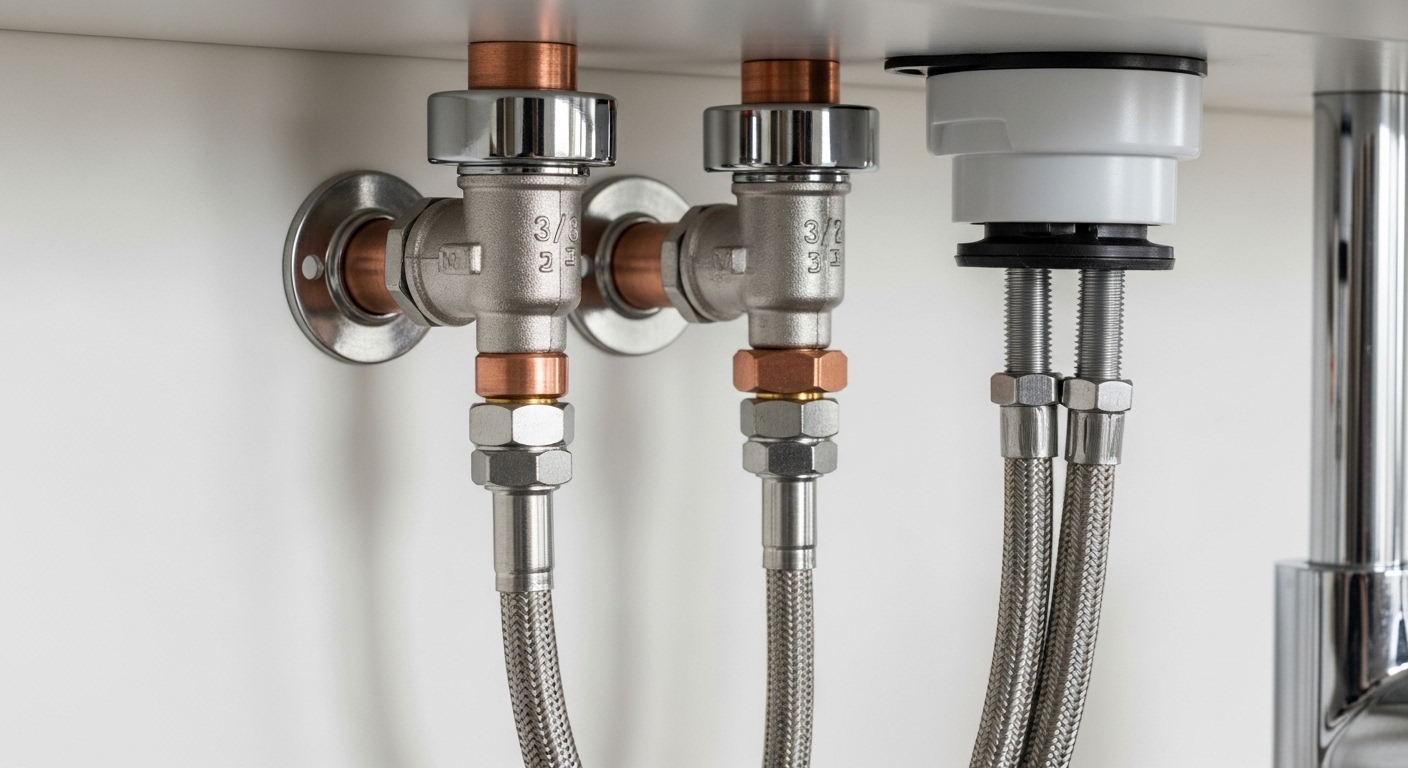
If you’ve ever stood under your sink with a leaking hose in one hand and a new faucet box in the other, you’ve asked the exact question that brings most people here: are kitchen faucet supply lines universal? The short, honest answer is “almost, but not quite.” The half-inch of thread where the line meets your faucet is where the universality breaks down — and it’s exactly the spot that causes drips, stripped fittings, and a second trip to the hardware store. This guide breaks down the real standards, the sizes that actually matter, and how to buy the right line the first time.
At avitashome, we fit and test supply lines on dozens of kitchen and bathroom faucets every season, so the advice below is grounded in what actually threads together on a real sink — not just what a packaging label claims.
So Are Kitchen Faucet Supply Lines Actually Universal?
They’re universal on one end and faucet-specific on the other. The bottom of almost every braided supply line in North America ends in a 3/8″ compression nut, because that’s the size of the angle-stop shutoff valves that builders install at the wall in the overwhelming majority of homes. That end is genuinely standardized. The top end — where the line connects to the faucet inlet — is where you’ll find at least four different connection types, and that’s why “universal” is a half-truth.
Think of it like phone chargers a decade ago: the wall outlet was standard, but the plug that went into your device wasn’t. Supply lines work the same way. So before you buy, you’re really answering two questions: what’s at my wall, and what’s on my faucet?
- The wall end — usually 3/8″ compression (from the angle stop). Sometimes 1/2″ FIP if you have older galvanized or a different valve.
- The faucet end — varies by brand and model: 3/8″ compression, 1/2″-14 male/female thread, a captive plastic quick-connect, or a pre-attached pigtail you simply couple to.
What Are the Standard Kitchen Faucet Supply Line Sizes?
The two numbers that matter most are 3/8 inch and 1/2 inch — and they refer to different things, which trips people up. The 3/8″ almost always refers to the compression connection at the shutoff valve. The 1/2″ usually refers to a threaded faucet inlet (1/2″-14 NPS or IPS). A standard kitchen line is therefore very often labeled “3/8″ comp x 1/2″ FIP.”
Here’s what each common spec means in plain terms:
| Connection Type | Where You’ll Find It | How It Connects | Universal? |
|---|---|---|---|
| 3/8″ Compression (comp) | Wall shutoff valve (most U.S. homes) | Conical nut compresses onto a tube | Mostly — the de facto standard |
| 1/2″ FIP / IPS (female) | Older faucet shanks, some bridge faucets | Female threaded nut screws onto male faucet thread | Common but not guaranteed |
| 7/16″ & 1/2″ dual / “faucet coupling” | Many bathroom & some kitchen faucets | One nut fits both thread sizes | Designed to be near-universal |
| Brand quick-connect (captive nut) | Moen, Delta, Kohler pull-downs | Pre-attached pigtail clicks/threads on | No — model-specific |
The big takeaway: most braided “universal” supply lines sold today are 3/8″ comp on the wall side and a 1/2″-or-7/16″ coupling nut on the faucet side, which covers a huge percentage of installations. But pull-down kitchen faucets increasingly skip the separate supply line entirely and ship with the hose pre-attached.
Why Won’t My “Universal” Supply Line Fit My New Faucet?
Usually because your new faucet doesn’t take a separate supply line — its hoses are already attached. This is the single most common surprise with modern pull-down and pull-out kitchen faucets. Brands like Moen, Delta, Kohler, and many of the models we carry come with two flexible hoses permanently fixed to the faucet body, ending in a 3/8″ compression connector that mates directly to your shutoff valve. There’s no faucet inlet to thread onto, so a traditional supply line has nowhere to go.
The other common reasons a “universal” line refuses to seat:
- Thread mismatch. Your faucet shank is 1/2″-14 male but you bought a line with a 3/8″ female nut. They look close; they will not seal.
- Compression vs. threaded confusion. A compression nut needs a smooth tube and a ferrule; a threaded connection needs matching threads. They are not interchangeable even at the same nominal size.
- Old 1/2″ FIP shutoffs. If your home predates 3/8″ comp angle stops, your wall side may be 1/2″ FIP and you need a different line or an adapter.
- Over-long or over-short hose. “Fit” isn’t just thread — a 12″ line on a deep sink can pull tight and stress the joint, which leads to slow weeping leaks.
If you’re already troubleshooting a leak rather than installing fresh, our walkthrough on how to fix a leaky kitchen faucet covers the connection points where supply-line leaks usually start, and it pairs well with this sizing guide.
How Do I Know Which Supply Line to Buy for My Sink?
Measure the two ends and count the lines — that’s it. You need the connection type at the wall, the connection type at the faucet, and the length you need to reach comfortably with a little slack. Do that and you’ll buy right the first time.
Here’s the field-tested process we use:
- Step 1 — Look at the shutoff valve. Most are 3/8″ compression (a small ~3/8″ outer-diameter outlet with a chrome nut). Confirm it’s compression, not threaded.
- Step 2 — Look at the faucet. Does it have pre-attached hoses, or a bare threaded shank? Pre-attached = no separate line needed. Bare shank = measure the thread (commonly 1/2″-14).
- Step 3 — Count. A standard kitchen faucet needs two lines (hot and cold). A pull-down with a sprayer still uses two supply connections plus its own internal sprayer hose.
- Step 4 — Measure length. Run a tape from the valve outlet up to the faucet inlet and add 3–4 inches of slack. Common lengths are 16″, 20″, and 24″.
- Step 5 — Pick the material. Braided stainless steel is the modern default — flexible, burst-resistant, and easy to route. Avoid old vinyl-only lines for anything permanent.
When in doubt, a 3/8″ comp x 1/2″ FIP braided stainless line in a 20″ length is the closest thing to a “buy this and it’ll probably work” option for a standard threaded kitchen faucet. For a pull-down with captive hoses, you typically buy nothing extra — you just need your 3/8″ comp valves to match the faucet’s pre-attached 3/8″ comp ends.
Does the Faucet Brand Change Which Supply Line I Need?
Yes, more than people expect — especially with pull-downs. Moen, Delta, and Kohler each design their flagship kitchen faucets with integrated hoses and proprietary-feeling connectors, even though the wall end stays standard 3/8″ comp. If you’re cross-shopping major brands, it’s worth reading model-specific notes; our breakdowns of the Moen Doherty kitchen faucet and the Kraus kitchen faucet both call out how each model handles its supply connections, which saves you guessing in the aisle.
The rule of thumb: the more premium and feature-rich the faucet (pull-down spray, touch activation, dual-function head), the more likely the hoses are pre-attached and the less likely you’ll buy a generic line at all.
Can I Reuse My Old Supply Lines With a New Faucet?
You can, but you usually shouldn’t. Braided stainless lines are inexpensive, and reusing a 10-year-old line invites a leak right after you’ve finished a clean install. The compression ferrule and the rubber washers inside the nuts harden and take a set over time, so re-tightening an old line often doesn’t reseal properly.
Replace the supply lines whenever you:
- Install a new faucet (the connectors and washers are fresh on the new lines).
- See any green/white corrosion, kinks, or bulges in the braid.
- Have lines older than roughly 8–10 years.
- Are switching from a threaded faucet to a pull-down with its own hoses.
What Tools and Fittings Do I Need to Connect a Supply Line?
Very few — an adjustable wrench, a towel, and the right line do 90% of the job. Supply-line connections are designed to be hand-tightened plus a quarter-turn with a wrench, so you don’t need specialty plumbing tools for a standard kitchen faucet swap.
Keep these on hand:
- Adjustable wrench or 1/2″ + 9/16″ wrenches for the compression nuts.
- Plumber’s tape (PTFE) only on threaded (FIP/IPS) connections — never on compression joints, which seal by metal-on-metal.
- A small bucket and towel for the water still in the lines.
- An adapter if your wall and faucet ends don’t match (e.g., 1/2″ FIP to 3/8″ comp).
If your project also touches the deeper plumbing — say you’re replacing the whole setup with a disposal underneath — our complete guide on how to install a kitchen faucet and garbage disposal walks through the full sequence, supply lines included.
Quick Reference: Matching Your Wall to Your Faucet
Match the wall outlet type to the faucet inlet type, then size the length. Use this as your last sanity check before buying.
| If your wall valve is… | And your faucet is… | You need… |
|---|---|---|
| 3/8″ compression | Bare 1/2″-14 threaded shank | 3/8″ comp x 1/2″ FIP braided line |
| 3/8″ compression | Pull-down with pre-attached 3/8″ comp hoses | No extra line — connect hoses directly |
| 1/2″ FIP (older) | Bare threaded shank | 1/2″ FIP x 1/2″ FIP line or an adapter |
| 3/8″ compression | Faucet with 7/16″/1/2″ dual coupling | 3/8″ comp x 1/2″/7/16″ coupling line |
FAQ
Are all kitchen faucet supply lines the same size?
No. The wall side is almost always 3/8″ compression, which is consistent, but the faucet side varies — 1/2″-14 threaded, 7/16″/1/2″ dual coupling, or a brand-specific quick-connect. Always match both ends, not just the nominal “3/8 inch” you see on the valve.
What size are most kitchen faucet supply lines?
The most common kitchen line is 3/8″ compression at the wall by 1/2″ FIP at the faucet, in a 16″–24″ length. That combination fits a large share of standard threaded kitchen faucets in U.S. homes, though many modern pull-downs skip a separate line entirely with pre-attached hoses.
Do I need plumber’s tape on a supply line?
Only on threaded (FIP/IPS) connections — wrap 2–3 turns of PTFE tape clockwise. Never use tape or pipe dope on a compression fitting; those seal by the ferrule biting metal-to-metal, and tape can actually cause a leak by preventing a clean seat.
Can I use a bathroom faucet supply line on a kitchen faucet?
Sometimes, since many share the 3/8″ comp wall end, but bathroom lines are often shorter (12″–16″) and may have smaller faucet-end couplings. For a kitchen faucet, buy a line rated for the length and flow you need rather than repurposing a short bathroom line that pulls tight.
How long do braided stainless steel supply lines last?
Typically 8–10 years of reliable service, sometimes longer. Most are built to industry burst-pressure standards, but the internal rubber core and washers age, so replacing them during any faucet swap is cheap insurance against a hidden under-sink leak.
Are pre-attached pull-down faucet hoses universal at the wall?
Generally yes. Even brand-specific pull-down faucets end their pre-attached hoses in a standard 3/8″ compression connector so they mate to ordinary 3/8″ angle-stop valves. The “non-universal” part is the faucet-body end, which you never disconnect.
The Bottom Line
Are kitchen faucet supply lines universal? Universal enough at the wall to be predictable, but specific enough at the faucet that you must check before you buy. Confirm your shutoff is 3/8″ compression, check whether your faucet has a bare threaded shank or pre-attached hoses, measure your length with a little slack, and choose braided stainless. Do those four things and the connection that frustrates so many DIYers becomes a five-minute job.
A note on our expertise: This guide was written by the avitashome fixtures team, who install, pressure-test, and stock kitchen and bathroom faucets and their supply components year-round. We test connection fit against the major U.S. valve and thread standards (3/8″ compression and 1/2″-14 IPS) and only recommend braided stainless lines that meet recognized burst-pressure and material standards backed by manufacturer warranties. When a spec here says “most” or “common,” it reflects what we actually see threading together on real sinks — not a guess from a spec sheet.