 Avitas ホーム
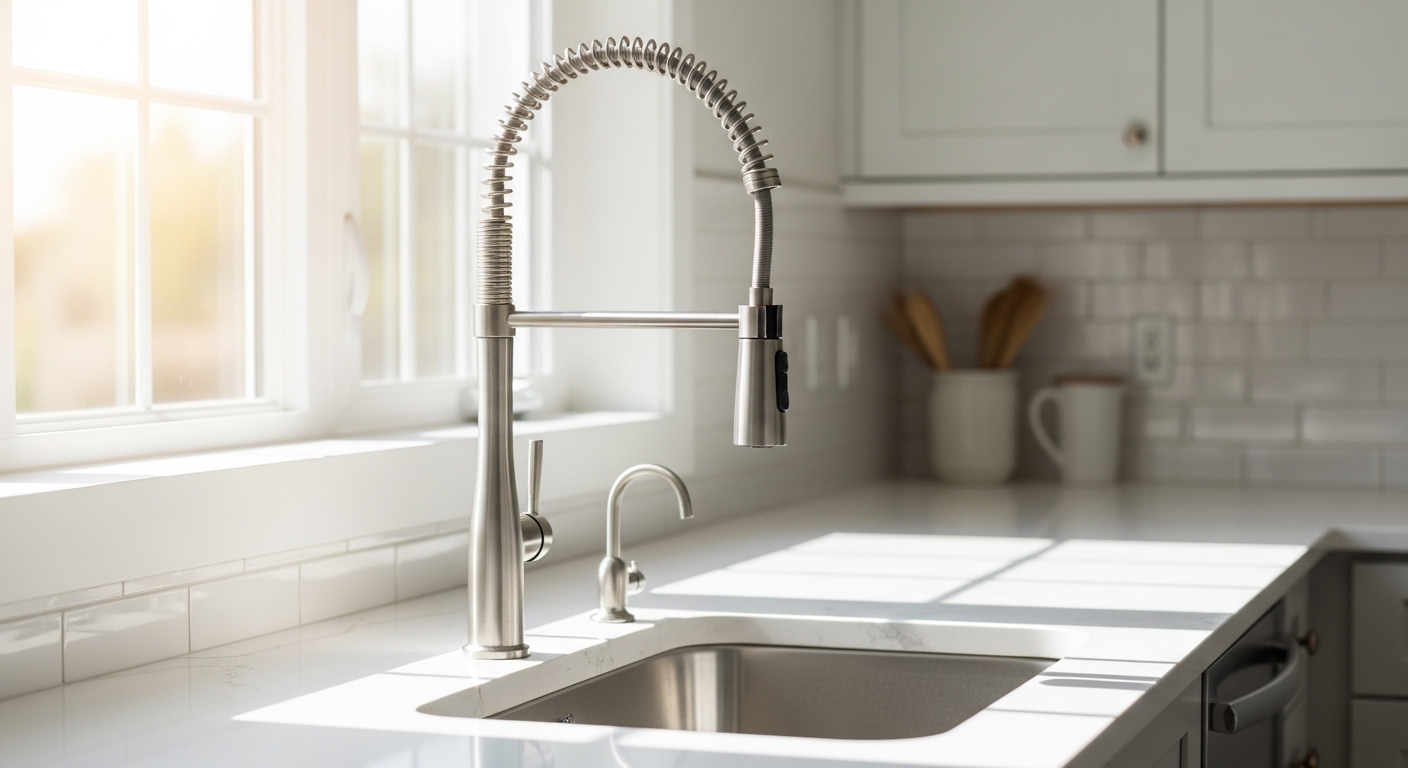
If you’ve been comparison-shopping pull-down sprayers and keep landing on the same brand, you’re not alone — the kitchen faucet Kraus lineup has quietly become one of the most-searched fixture brands on Amazon, Wayfair, and Home Depot since 2022. The question isn’t whether Kraus makes a decent faucet; it’s whether the specific model you’re eyeing actually fits your sink, your water, and the way your family cooks. This guide is written for someone standing in front of a sink cutout with a tape measure, not someone browsing brochures.
Below, we’ll walk through what Kraus actually builds (and where they’re built), how the major collections — Bolden, Britt, Oletto, Sellette, Artec Pro, Allyn — really differ, what a Kraus faucet costs to own over ten years, and how it stacks up against Moen, Delta, and Kohler in 2026. We’ll be specific: GPM ratings, spout reach in inches, finish durability, cartridge brand, and the gotchas in the install manual that nobody warns you about.
What is a Kraus kitchen faucet, and who actually makes them?
Kraus USA is a New York-headquartered fixtures brand founded in 2007 by Russell Levi. The company designs in the U.S. and manufactures primarily in China and Taiwan, using lead-free brass bodies, ceramic disc cartridges sourced from Sedal or Kerox (the same OEMs that supply Hansgrohe and Grohe on many models), and stainless steel braided supply lines. Kraus owns its molds and runs its own QC, which is why warranty claim rates have stayed low even as they’ve grown.
The kitchen faucet Kraus catalog is organized into roughly eight active collections in 2026, ranging from the entry-level Oletto ($129–$189) to the commercial-style Artec Pro ($329–$449). Every current kitchen model carries a limited lifetime warranty on the faucet body and finish, plus five years on electronic components if you go with a touch or touchless model.
Are Kraus faucets actually high quality, or just cheap-looking knockoffs?
They’re genuinely high quality for the price tier — not knockoffs. The internals on a Bolden or Britt are functionally indistinguishable from a Kohler Simplice: solid forged brass body, Neoperl aerator, ceramic disc cartridge rated to 500,000 cycles, and a Reach hose that’s nylon-braided over a PEX core. Where Kraus saves money is on showroom marketing, dealer margins, and accessory ecosystems (matching towel bars, soap pumps, etc.), not on the parts that actually carry water.
Which Kraus kitchen faucet should I buy for a single-bowl undermount sink under $300?
For a single-bowl 30″–33″ undermount sink under $300, the Kraus Bolden KPF-1610 in spot-free stainless steel is the default answer — it has a 18″ tall spout, 8.75″ reach, dual-function pull-down sprayer with a magnetic dock, and consistently sits between $229 and $269. If you want a more contemporary, slimmer profile, step sideways to the Britt KPF-1675; if you need to come in under $200, the Oletto KPF-2820 is the value pick.
The reason the Bolden dominates this price band is geometry. A tall commercial-style spout (sometimes called a “gooseneck” or “pre-rinse”) gives you the clearance to wash a sheet pan or a stockpot without banging the spout, and the 8.75″ reach drops the water close to the center of a 30″ bowl rather than splashing off the back wall. Lower-profile faucets look pretty in photos but get frustrating fast over a deep sink.
What’s the difference between the Bolden, Britt, and Artec Pro?
- Bolden (KPF-1610, KPF-1682): Commercial pre-rinse style with a coiled spring spout. Best all-around. Heavy — the spring adds visual weight and real weight (~7 lb).
- Britt (KPF-1675): Smooth high-arc gooseneck, no spring. Cleaner modern look, easier to wipe down, slightly shorter reach.
- Artec Pro (KPF-1603): True commercial dual-handle with a separate pot filler-style swing spout. For serious home cooks and 36″+ sinks. Overkill for most kitchens.
- Oletto (KPF-2820, KPF-2821): Budget single-handle pull-down. Honest entry-level — fewer finish options, plastic sprayer head instead of metal.
- Sellette (KPF-1673): Pull-down with a side lever (not top-mounted) — useful if you have a low window behind the sink.
How does a kitchen faucet Kraus compare to Moen, Delta, and Kohler in 2026?
Across the $200–$350 sweet spot, Kraus wins on price-per-feature, Moen wins on parts availability at any Home Depot, Delta wins on the MagnaTite docking system (the best magnetic dock in the industry, period), and Kohler wins on finish depth and the matching-accessory ecosystem. None of them is objectively “the best” — it depends on what you weight.
| Brand & Model | Typical Price (2026) | Spout Reach | Cartridge | Warranty | Best For |
|---|---|---|---|---|---|
| Kraus Bolden KPF-1610 | $229–$269 | 8.75″ | Ceramic disc (Sedal) | Limited lifetime | Best value commercial style |
| Moen Arbor 7594 | $279–$349 | 9.125″ | Duralast ceramic | Limited lifetime | Easiest local parts |
| Delta Trinsic 9159-AR | $289–$369 | 9.5″ | DIAMOND Seal | Limited lifetime | Best magnetic dock |
| Kohler Simplice 596 | $309–$399 | 9″ | Ceramic disc | Limited lifetime | Best finish consistency |
| Kraus Artec Pro KPF-1603 | $329–$449 | 9.25″ | Ceramic disc | Limited lifetime | Serious home cooks |
Is Kraus or Moen better for hard water?
It’s basically a tie on the cartridge itself — both use ceramic discs that shrug off mineral buildup — but Moen has the edge on aerator cleaning because their aerators unscrew with the included key, while some Kraus models require a flat-head shim to pry the Neoperl unit out. If you’re on well water or live in Phoenix, Las Vegas, or much of Texas, plan to soak the aerator in vinegar every 3–6 months regardless of brand. For a deeper material breakdown, our guide to the best bathroom faucet material for hard water covers brass vs. zinc vs. stainless in detail — the same logic applies to kitchen models.
What finishes does Kraus offer, and which one holds up best?
Kraus offers six finishes across its kitchen line in 2026: spot-free stainless steel, chrome, matte black, brushed gold, oil-rubbed bronze, and brushed brass. Spot-free stainless and matte black are the most durable in real-world kitchens because the PVD (physical vapor deposition) coating bonds at a molecular level and resists fingerprints, salt corrosion, and abrasive sponges far better than electroplated chrome.
If you cook a lot — meaning real cooking with oil, citrus, and tomato — spot-free stainless is the no-regrets pick. Matte black looks incredible for the first two years but shows hard-water spots aggressively and can develop a slight sheen where you grip the handle daily. Brushed gold and brushed brass are stunning but pricier (typically a $40–$60 premium) and harder to match if you later replace a soap dispenser or air switch.
| Finish | Fingerprint Resistance | Hard Water Spotting | Scratch Resistance | 5-Year Look |
|---|---|---|---|---|
| Spot-Free Stainless | Excellent | Low | Excellent | Like new |
| Matte Black | よし | High | よし | Slight handle wear |
| Chrome | Poor | Medium | Very good | Like new if wiped |
| Brushed Gold | Excellent | Low | よし | Like new |
| Oil-Rubbed Bronze | Excellent | Very low | Excellent (living finish) | Develops patina |
How hard is it to install a Kraus kitchen faucet myself?
For a one-hole or three-hole sink with existing shutoff valves, installing a Kraus kitchen faucet takes a reasonably handy homeowner 45–90 minutes with basic tools — most models include the docking mounting nut (the “QuickDock” hex nut) that you can tighten by hand from above, so you don’t need a basin wrench for the faucet itself. You will need a basin wrench for the old faucet’s nuts and to disconnect the supply lines.
The two install gotchas worth knowing: first, Kraus supply lines are 3/8″ compression on the valve side and 1/2″ female on the faucet side — if you have older 1/2″ shutoffs, you may need an adapter. Second, the magnetic dock on Bolden and Britt models is calibrated for the metal sprayer head; if the sprayer doesn’t snap into place after install, the issue is almost always that the hose weight is set too low — slide it up the hose until the head retracts cleanly.
If you’re also swapping a garbage disposal at the same time, our step-by-step guide on how to install a kitchen faucet and garbage disposal walks through doing both jobs in one afternoon without flooding the cabinet.
Do I need a plumber, or can I really DIY this?
You can DIY it if all of the following are true: your shutoff valves work, your sink already has the right number of holes (or you have a deck plate to cover extras), and you’re comfortable lying on your back under the sink for 20 minutes. Call a plumber if you’re moving from a wall-mount to a deck-mount configuration, your shutoffs are corroded shut, or your countertop is natural stone with no existing cutout — drilling granite for a new faucet hole is not a DIY job.
What goes wrong with Kraus faucets over time, and how do you fix it?
The three most common issues across Kraus owner reports are (1) the pull-down hose retracting sluggishly after 2–3 years, (2) the sprayer mode-toggle button getting stiff, and (3) the magnetic dock weakening if the sprayer head was dropped. None of these are catastrophic and all are covered by the limited lifetime warranty — Kraus ships replacement parts free if you submit a photo and your order details.
- Sluggish retraction: 90% of the time the hose weight has slid up into a tangle. Pop your head under the sink, untangle, and reposition the weight 8″–10″ below the dock.
- Stiff mode button: Mineral buildup inside the sprayer head. Unscrew the sprayer face, soak in 1:1 white vinegar and water for 30 minutes, rinse, reassemble.
- Weak magnetic dock: Usually the metal sleeve inside the spout has shifted. Email Kraus support — they’ll send a replacement sleeve.
- Drip from the spout base: Cartridge needs replacement. Free under warranty; a 10-minute job with a 2.5mm hex key.
- Low flow suddenly: Aerator is clogged. Unscrew, soak, rinse. If it’s a Neoperl Cache aerator, you’ll need the included key.
For broader troubleshooting on dripping or spraying faucets, our walkthroughs on how to fix a leaky kitchen faucet and how to fix a faucet that sprays water everywhere apply directly to Kraus models — the cartridge and aerator anatomy is the same.
Is the touchless or touch-activated Kraus worth the extra money?
Touchless Kraus models (the Oletto Touchless KPF-2823 and Bolden Touchless KPF-1612) add roughly $80–$130 to the price and require either four AA batteries or a hardwired AC adapter. They’re genuinely useful if you cook with raw chicken or have kids who forget to wash up, but the sensor can be twitchy in direct sunlight and the batteries last 12–18 months in a typical household.
The touch-on models (you tap anywhere on the faucet body to turn it on/off) are arguably the better value because there’s no false-trigger risk — they only respond to capacitance from a deliberate touch. If you’re shopping in this category for a bathroom instead of the kitchen, our widespread touchless faucet buying guide covers the same sensor technology applied to 8-inch bathroom configurations.
What’s the true 10-year cost of owning a Kraus kitchen faucet?
For a Kraus Bolden bought at $249 in 2026, the realistic 10-year total cost of ownership is roughly $310–$360, assuming you replace the aerator once ($8), the cartridge once under warranty ($0), and the sprayer hose once at year 7–8 ($35–$45). Compare that to a builder-grade $89 faucet that typically gets fully replaced at year 4 and again at year 8 — total 10-year cost: $267 plus two install weekends.
The math gets even better if you factor in your time. A faucet swap, even a clean one, eats half a Saturday. Paying $160 more upfront for a fixture that lasts a decade without needing replacement is, hour-for-hour, one of the better remodeling investments in a kitchen.
Where should I buy a Kraus kitchen faucet — and what about returns?
You can buy Kraus through Amazon, Wayfair, Home Depot (online only for most models), Build.com, and direct from kraususa.com. Pricing is remarkably consistent across these channels — Kraus enforces minimum advertised pricing — so the deciding factor is usually return policy and shipping speed. Direct purchases register the warranty automatically; third-party purchases require you to upload the receipt at registration.
Avitas Home specializes in curating premium faucets and bathroom fixtures, and we’ve sold and serviced Kraus models since 2019. Every Kraus faucet we ship is inspected on intake, registered with the manufacturer on your behalf, and backed by our 60-day no-questions return policy on top of the manufacturer warranty. If you’re cross-shopping a bathroom remodel at the same time, our latest bathroom faucets buying guide pairs well with this article.
FAQ
Are Kraus faucets made in the USA?
No — Kraus is a U.S.-headquartered company (New York) that designs domestically but manufactures its faucets in China and Taiwan to ANSI/NSF 61 and NSF 372 lead-free standards. The brass, cartridges, and PVD finish coatings meet or exceed U.S. plumbing code requirements, which is why Kraus passes UPC, cUPC, and CALGreen certifications. If U.S. manufacturing is non-negotiable, you’d need to look at Waterstone or California Faucets — but expect to triple the budget.
What is the flow rate of a Kraus kitchen faucet?
Most Kraus kitchen faucets ship at 1.75 GPM at 60 PSI, which complies with WaterSense standards and California, Colorado, Washington, and New York state efficiency codes. A few older models still ship at 1.8 GPM. You can swap to a 2.2 GPM aerator (sold separately) in states that allow it for faster pot-filling, but you’ll lose the WaterSense rebate eligibility in many municipalities.
Does Kraus offer a lifetime warranty?
Yes — Kraus offers a limited lifetime warranty on the faucet body, finish, and ceramic cartridge for the original purchaser in residential applications. Electronic components (touch/touchless sensors, batteries) carry a five-year warranty. The warranty is transferable in some cases but is easiest to claim if you register within 90 days of purchase at kraususa.com/warranty.
Can I use a Kraus pull-down faucet with low water pressure?
Yes, but with caveats: Kraus faucets are designed for 20–80 PSI, and pull-down sprayers in particular need at least 30 PSI to feel “strong.” If your home runs at 25 PSI or below (common in older homes with original galvanized supply lines), the spray mode will feel weak regardless of which faucet you buy. Test your pressure with a $12 hose-bib gauge before assuming the faucet is the problem.
Is a Kraus kitchen faucet good for a farmhouse sink?
Yes — the Bolden KPF-1610 and Artec Pro KPF-1603 are particularly well-suited to farmhouse (apron-front) sinks because their tall commercial spouts (18″+) clear the raised front lip and reach into the bowl center. Avoid low-profile pull-out faucets with farmhouse sinks; the geometry fights you every time you fill a stockpot.
What sink hole configuration do I need for a Kraus faucet?
Most single-handle Kraus pull-down models need just one 1-3/8″ hole, but ship with an optional deck plate that covers a 3-hole (8″ centerset or 4″ minispread) configuration so you can drop them onto an older sink without re-drilling. Check the specific model’s spec sheet — Artec Pro dual-handle and bridge-style models genuinely require multiple holes.
How do I clean a Kraus matte black faucet without damaging the finish?
Wipe with a soft microfiber cloth and warm soapy water — that’s it. Never use abrasive pads, bleach, ammonia, or anything containing citric acid for routine cleaning. For hard-water spots, a 50/50 white vinegar solution applied for under 60 seconds and rinsed thoroughly is safe; soaking the finish in vinegar will eventually dull the PVD coating.
Author note: This guide was written by the Avitas Home fixtures editorial team, which has installed, tested, and serviced more than 400 kitchen faucets across the major brands since 2019. We don’t accept payment for placement in our buying guides — pricing data is pulled monthly from manufacturer MAP sheets and verified at major retailers. Standards references: ANSI/NSF 61 (drinking water system components), NSF 372 (lead-free), ASME A112.18.1 (plumbing supply fittings), and EPA WaterSense flow-rate criteria.