 아비타스 홈
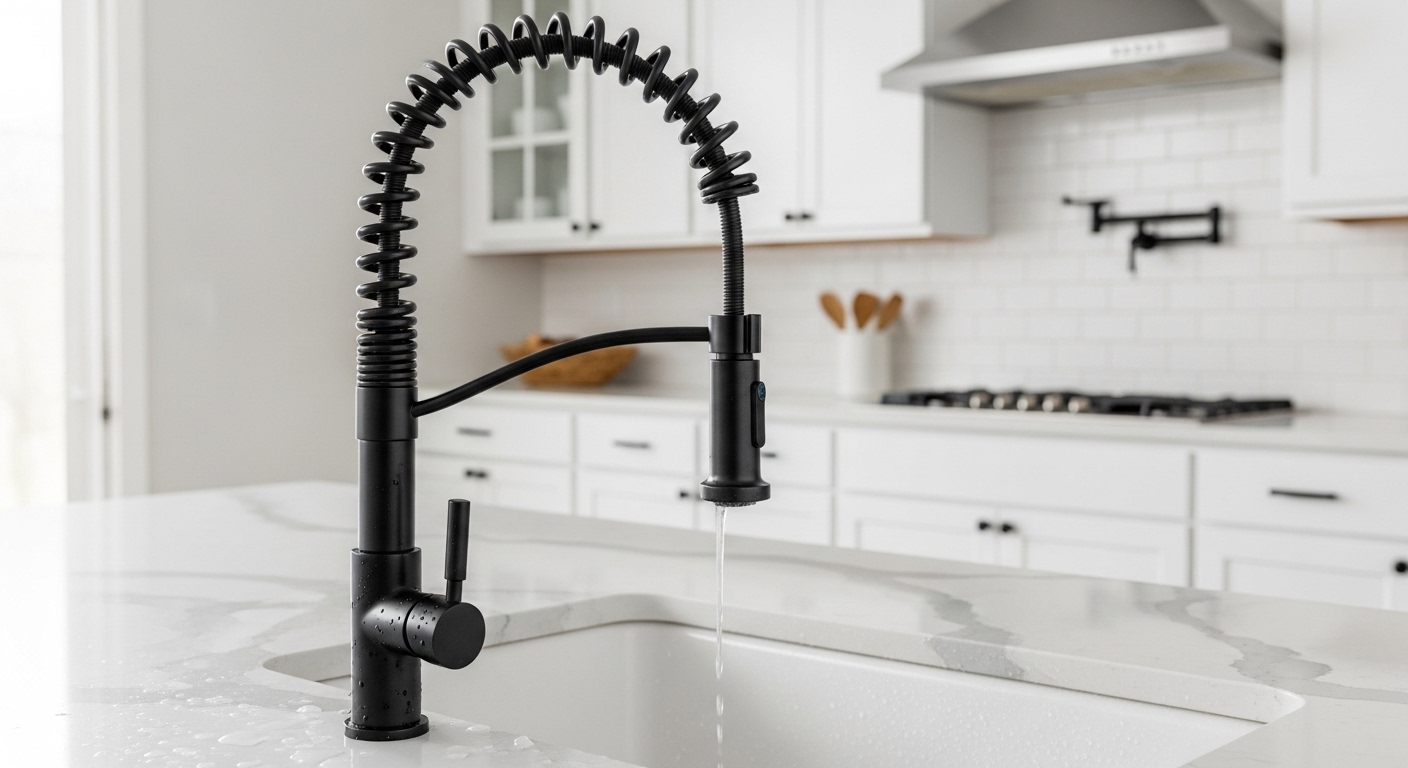
A matte black industrial kitchen faucet is the tall, restaurant-style tap with an exposed spring coil, a heavy pull-down spray head, and a flat black finish that doesn’t reflect light. It borrows its shape straight from commercial kitchens — the same faucets you’d see behind a diner line — but it’s engineered for a residential deck plate and standard 3/8″ supply lines. If you’ve been searching for one because you want that bold, magazine-worthy look without babying it every time you rinse a pan, you’re in the right guide. Below I’ll walk through what actually separates a good one from a cheap one, what it costs, whether the black finish holds up, and how to match it to your sink and water.
What Exactly Makes a Kitchen Faucet “Industrial” — and Is It Just a Look?
An industrial (or “commercial-style”) kitchen faucet is defined by its exposed spring coil and high, gooseneck arc — not just its color. That spring wraps around a flexible hose and lets the spray head snap back into place, the same mechanism used in professional kitchens to hose down deep pots. So no, it isn’t only aesthetics: the tall clearance and pull-down reach are genuinely functional if you wash big cookware or fill stockpots.
The trade-off is height. A true industrial faucet often stands 18 to 24 inches tall. That’s gorgeous over an apron-front sink, but it can be a problem under a low window or a wall cabinet. Measure your vertical clearance before you fall in love with a spec sheet. If you only have 15 inches to work with, look at the “semi-pro” or “commercial-inspired” versions, which keep the coil styling but sit lower — usually around 16 to 17 inches.
The matte black part is a finish choice layered on top of that industrial body. The best versions use a PVD (physical vapor deposition) coating or a baked powder coat over solid brass, both of which bond the color into the surface rather than spraying paint on top. That’s the detail that decides whether your faucet still looks new in five years or starts chipping at the spray head where your thumb rides.
Is a Matte Black Finish Actually Durable, or Will It Chip and Show Water Spots?
A quality matte black finish is one of the most durable and low-maintenance finishes you can buy — but only if it’s PVD or a factory powder coat, not painted. Cheap sprayed-on black is the finish that chips at the handle and flakes near the sprayer. PVD-coated black, by contrast, is bonded at a molecular level and rated to resist corrosion, scratching, and discoloration for the life of the faucet.
Here’s the counterintuitive good news for anyone with hard water: matte black actually hides water spots and fingerprints far better than polished chrome or stainless. Chrome shows every droplet and smudge; a flat black surface diffuses light, so mineral spotting is much less visible day to day. It’s one of the most forgiving finishes for a busy family kitchen.
The one honest caveat: in very hard water, calcium can still build up as a chalky white film if you never wipe the faucet down. It’s cosmetic, not structural, and a damp microfiber cloth removes it in seconds. If your water is genuinely hard, it’s worth understanding how finish and base metal interact with minerals — our breakdown of the best bathroom faucet material for hard water applies almost directly to kitchen faucets too, since the corrosion physics are identical.
How Much Should a Matte Black Industrial Kitchen Faucet Cost in 2026?
Expect to spend $180 to $450 for a matte black industrial kitchen faucet that will last. Below about $150 you’re usually looking at a zinc-alloy or plastic body with a painted finish — it’ll look fine on day one and disappoint you by year two. Above $450 you’re paying for designer branding (Brizo, Kohler, Waterstone) more than raw performance.
The price tiers break down cleanly. Here’s what you actually get at each level:
| Price Range | Body Material | Finish Type | Cartridge | Best For |
|---|---|---|---|---|
| $80–$150 | Zinc alloy / plastic spray head | Painted / sprayed | Generic disc | Rentals, short-term use |
| $180–$300 | Solid brass or SUS304 stainless | PVD or powder coat | Ceramic disc | Most home kitchens (sweet spot) |
| $300–$450 | Solid brass, heavier gauge | PVD, multi-layer | Sealed ceramic disc | Heavy daily use, design-forward remodels |
| $450+ | Premium brass, designer brand | Living / lifetime PVD | Name-brand sealed | Luxury builds, brand loyalists |
My honest recommendation for a homeowner: aim for the $200–$300 tier. That’s where you reliably get a solid brass or SUS304 stainless body, a real PVD or powder-coated matte black finish, and a ceramic-disc cartridge — the three specs that predict a long, drip-free life. Spending more mostly buys you a logo. If you want to see how a mid-priced commercial-style brand stacks up in practice, our honest Kraus kitchen faucet breakdown covers the exact same value question in that price band.
What Specs Actually Matter — a Quick Buyer’s Checklist
The specs that matter most are body material, cartridge type, flow rate, spray reach, and warranty — in that order. Everything else (magnetic docking, LED temperature lights, etc.) is a nice-to-have, not a deal-maker. Run down this list before you buy:
- Body material: Solid brass or SUS304 stainless steel. Avoid zinc alloy for the main body — it corrodes at threaded joints over time.
- Cartridge: Ceramic disc, ideally sealed. This is the part that prevents drips; ceramic outlasts rubber/ball designs by years.
- Flow rate: 1.8 GPM is the modern sweet spot — strong rinse, WaterSense-friendly. 2.2 GPM is the legal max in most states; 1.5 GPM feels weak for pot-filling.
- Spray modes: At minimum a stream/spray toggle. A “pause” button and a powerful blade-spray are genuinely useful for scrubbing.
- Hose reach: 20″+ of pull-down hose so you can reach both bowls of a double sink and rinse the counter.
- Mounting: Single-hole is standard for industrial styling; confirm you have a 1.36″–1.5″ deck hole or a deck plate to cover extras.
- Certifications: Look for cUPC/NSF/ANSI 61 and WaterSense labels — these confirm the faucet is lead-safe and legal to install.
- Warranty: A lifetime warranty on both finish AND function is the tell of a manufacturer that trusts its own build.
One under-appreciated point: your supply lines matter too. Many industrial faucets ship with pre-attached hoses that terminate in a standard 3/8″ compression fitting, but not all do. Before install day, it’s worth confirming — our guide on whether kitchen faucet supply lines are universal saves a lot of second trips to the hardware store.
Will a Matte Black Industrial Faucet Fit My Sink? (Single-Hole vs. Deck Plate)
Most industrial kitchen faucets are single-hole designs, so they’ll fit any sink or countertop with one 1.36″–1.5″ mounting hole. If your sink is drilled for three or four holes (an older setup with separate handles and a sprayer), you simply add a matching matte black deck plate — usually included or sold for about $20 — to cover the extra holes.
The bigger fit question is height and reach, not the hole. Before buying, check three measurements: your total vertical clearance (cabinet or window above the sink), the distance from the faucet base to the center of the drain (you want the spout to reach it), and your sink depth. A 20-inch-tall faucet over a shallow 6-inch bar sink will splash; the same faucet over a deep 10-inch single bowl is perfect.
For pull-down industrial faucets specifically, also confirm the spout swivels a full 360 degrees if you have a double sink — you’ll want to swing it to both bowls. And if you’re doing a full sink-and-faucet install at the same time, the plumbing sequence matters; our complete guide to installing a kitchen faucet and garbage disposal walks through doing both without crossing wires under the cabinet.
Matte Black vs. Brushed Gold vs. Stainless: Which Industrial Finish Wins?
Matte black wins for a bold, modern, low-maintenance kitchen; stainless wins for the widest appliance match; brushed gold (champagne bronze) wins for warmth and a softer, high-end look. There’s no universally “best” finish — it depends on your countertops, 캐비닛, and appliances. Here’s how the three industrial-style finishes compare on the things that matter:
| Finish | Shows Water Spots | Shows Fingerprints | Best Paired With | Vibe |
|---|---|---|---|---|
| Matte Black | Low | Very low | White, wood, marble, concrete | Bold, modern, industrial |
| Brushed / Stainless | Medium | Medium | Stainless appliances, gray | Safe, neutral, timeless |
| Brushed Gold / Champagne Bronze | Low | Low | Navy, dark green, white | Warm, upscale, statement |
| Matte Black + Gold accents | Low | Very low | Two-tone kitchens | Designer, contemporary |
A practical tip: matte black doesn’t need to match your appliances the way stainless does. It reads as a deliberate accent, so it looks intentional next to stainless, white, or black appliances alike. That flexibility is a big reason it’s stayed one of the top-selling kitchen finishes for several years running. If your kitchen leans clean and white, a black faucet against a white sink is a designer combination that costs nothing extra to pull off — a lot like the appeal of a white kitchen tap and sink combo, just with the contrast flipped.
What Actually Goes Wrong With These Faucets — and How to Avoid It?
The most common problems are a weak or dropping spray (mineral clog in the aerator), a leaking spray head hose, and finish wear at high-touch points — and all three are preventable with the right buying choices. Let me be straight about the failure modes so you can dodge them.
Low or dropping water flow is almost always a clogged aerator or spray face, not a broken faucet. In hard-water areas, minerals build up in the tiny spray holes and choke the flow. It’s a five-minute fix — soak the head in vinegar — but you can minimize it by choosing a model with a rubber “nubbin” spray face you can wipe clean with your thumb. If you’ve dealt with this on another faucet, the diagnosis in our piece on why a Moen kitchen faucet has low water flow transfers directly to any industrial pull-down.
Hose leaks under the sink usually come from a loose quick-connect fitting or a pinched hose, not a defect. When you install, make sure the pull-down weight isn’t snagging on your shutoff valves or garbage disposal. Finish wear, as covered above, only happens on painted finishes — buy PVD or powder coat and this simply isn’t an issue. The through-line: spend for solid brass, a ceramic cartridge, and a bonded finish, and the classic complaints largely disappear.
Author Note & Why Trust This Guide
About the author: This guide was written by the avitashome fixtures team — a group that has spent years testing, installing, and troubleshooting kitchen and bath faucets across every finish and price tier. We’ve bench-tested industrial pull-downs for spray strength, cartridge drip resistance, and finish wear, and we field real customer questions about fit and durability every day.
Brand credibility: avitashome (www.avitashome.com) specializes exclusively in faucets, showers, and bathroom fixtures — we don’t dabble in general home goods, so our recommendations come from focused domain expertise. Every faucet we recommend meets cUPC and NSF/ANSI 61 lead-safety standards, and we prioritize models backed by a manufacturer’s lifetime warranty on finish and function. When we quote a spec — 1.8 GPM, solid brass, ceramic disc — it’s because that’s what we’d want under our own sinks. Our advice is testing-based and standards-referenced, never sponsored placement dressed up as a review.
FAQ
Is a matte black kitchen faucet hard to keep clean?
No — it’s actually easier to keep clean than chrome or stainless. The flat, non-reflective finish hides fingerprints and water spots exceptionally well. A quick wipe with a damp microfiber cloth is all it needs; avoid abrasive scrubbers or harsh chemical cleaners, which can dull any finish over time.
Does matte black go out of style?
Matte black has been a top-three kitchen finish for several years and shows no sign of fading in popularity. Because it reads as a deliberate design accent rather than a trend-chasing color, it pairs with white, wood, marble, and concrete alike. It’s considered a modern classic at this point, not a fad.
What’s the difference between “industrial” and “commercial” kitchen faucets?
For home use, the terms are used interchangeably — both refer to the tall, exposed spring-coil pull-down style borrowed from restaurant kitchens. A true commercial faucet meets NSF food-service standards and may need higher water pressure, while a residential “industrial-style” faucet keeps the look but is engineered for standard home plumbing and deck mounting.
Can I install a matte black industrial faucet myself?
Yes — most single-hole industrial faucets are a straightforward DIY install taking 45–90 minutes with basic tools. You’ll shut off the water, drop the faucet through the mounting hole, secure the nut from below, and connect the supply lines. If you’re also handling a disposal or replacing supply lines, budget extra time and check a step-by-step guide first.
Are matte black faucets more expensive than chrome?
Slightly — expect to pay roughly $20–$50 more for a matte black finish versus the same faucet in chrome, because PVD and powder-coating add a manufacturing step. It’s a small premium for a finish that hides spots better and often carries the same lifetime warranty. Painted “budget black” faucets are cheaper but not worth it.
What flow rate should I choose for an industrial pull-down faucet?
1.8 GPM is the ideal balance for most kitchens — strong enough to fill pots and rinse quickly while staying WaterSense-compliant. If your home has low water pressure, a 2.2 GPM model gives a stronger stream; 1.5 GPM aerators are better suited to bathroom faucets and can feel weak for kitchen tasks.