 Домашняя страница Avitas
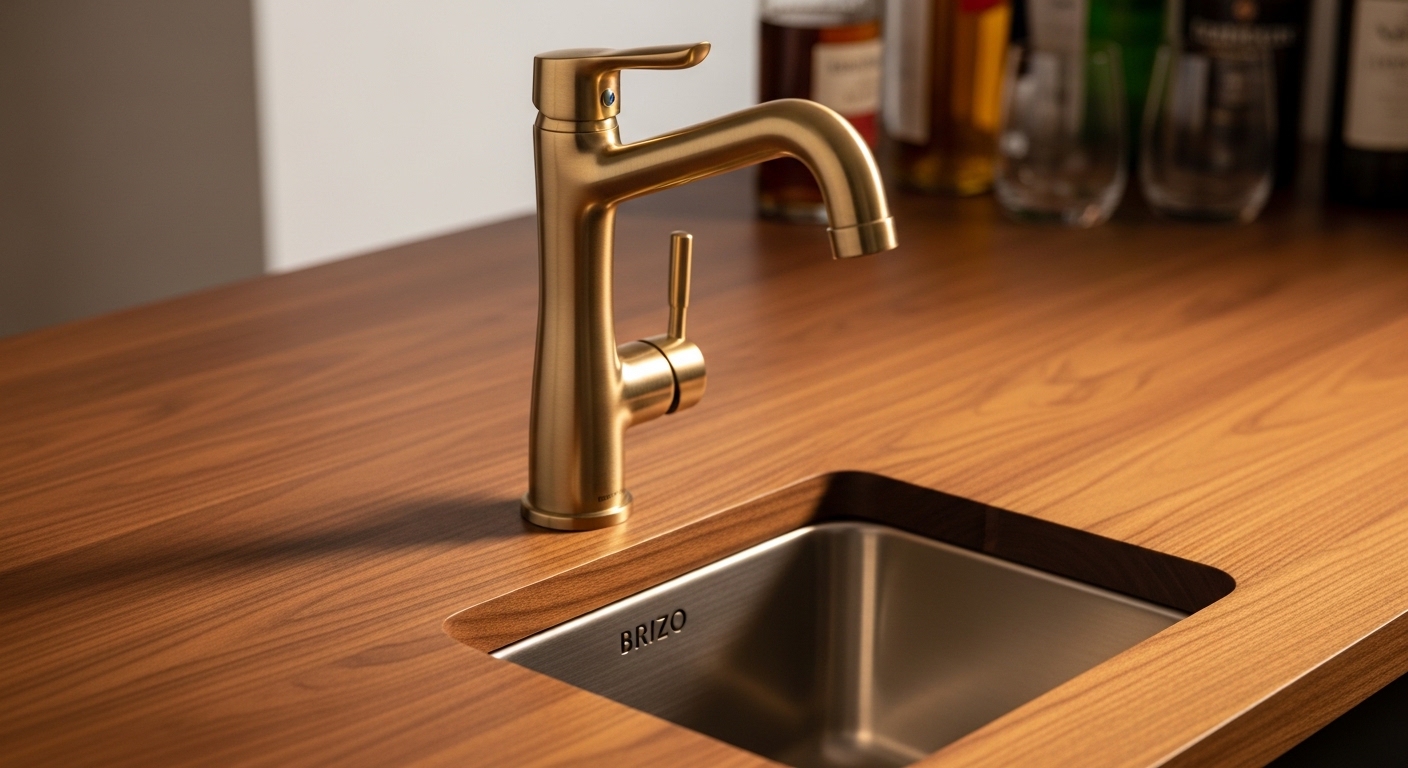
If you’ve been searching for a bar faucet Brizo setup, you’re usually dealing with a small secondary sink — a prep station in the island, a wet bar near the living room, or a butler’s pantry — and you want it to look as good as the main kitchen faucet without dominating the space. Brizo (the luxury line built by the same parent company as Delta) makes some of the most convincing “jewelry for the kitchen” bar faucets on the market, but they’re a real investment, and the model names blur together fast. Below is a plain-English breakdown of what you’re actually paying for, which models make sense for which sink, and how to not overspend.
What exactly is a bar faucet, and how is a Brizo one different?
A bar faucet is a smaller, single-handle faucet built for a compact secondary sink — typically a bar or prep sink around 9 to 15 inches wide. It’s physically scaled down from a main kitchen faucet: a slimmer spout, a lower flow (usually 1.5–1.8 GPM), and often a single hole in the deck instead of three. A Brizo bar faucet is different mainly in three ways: material, finish quality, and warranty backing.
Where a budget bar faucet is often zinc-alloy or thin-wall brass with a plated coating, Brizo bar faucets are forged from solid brass and use the company’s Brilliance physical vapor deposition (PVD) finishes, which are far more scratch- and tarnish-resistant than standard electroplating. That’s the core of the price gap. You’re not paying for more water — a $60 faucet and a Brizo both pour water — you’re paying for a fixture that still looks like the showroom model after ten years of citrus, wine, and cleaning spray.
- Body: solid, low-lead forged brass rather than zinc pot-metal.
- Finish: Brilliance PVD (Luxe Gold, Luxe Nickel, Matte Black, Polished Chrome) that’s warrantied not to corrode, tarnish, or discolor.
- Valve: ceramic-disc cartridge rated for hundreds of thousands of on/off cycles.
- Warranty: lifetime limited on both function and finish for residential owners.
Which Brizo bar faucet model should I actually buy?
For most home bars and prep sinks, pick from three Brizo families: Solna (transitional, curved), Litze (industrial-modern, angular), and Rook (soft contemporary). Each comes in a bar/prep size, and the “right” one depends less on your sink and more on your kitchen’s existing style — bar faucets are usually chosen to echo the main faucet.
Here’s the honest cheat sheet: get a pull-down bar faucet if you’ll rinse produce, wash cocktail shakers, or fill tall pitchers; get a fixed high-arc spout if you mostly pour water and fill glasses and want the cleanest look; and get a fixed low-arc if the faucet sits under a low upper cabinet or window.
| Brizo Bar Faucet | Style | Spout Type | Best For | Approx. Цена |
|---|---|---|---|---|
| Solna Bar/Prep | Transitional | Pull-down, high-arc | Busy prep sinks, produce rinsing | $400–$520 |
| Litze Bar/Prep | Industrial modern | Pull-down or fixed | Modern kitchens, angular hardware | $450–$620 |
| Rook Bar/Prep | Soft contemporary | Fixed high-arc | Wet bars, glass-filling only | $350–$480 |
| Odin Bar/Prep | Modern minimalist | Pull-down | Statement islands | $500–$650 |
One practical note: check the spout height and reach against your sink. Bar sinks are small, and a tall pull-down like the Odin can splash in a shallow 6-inch-deep bowl. If your prep sink is compact, the Rook or a fixed-spout Solna keeps the water landing where it should.
How much does a Brizo bar faucet cost, and is it worth it over Delta or Kraus?
A Brizo bar faucet runs roughly $300 to $650, versus about $90–$200 for a comparable Delta or Kraus bar faucet. Whether the premium is “worth it” comes down to one question: how much does the finish and the designer look matter in this specific spot?
Here’s the reasoning most buyers land on. In a main kitchen you use the faucet dozens of times a day, so mechanical durability dominates. A bar or prep faucet gets used far less — so the money shifts toward appearance and coordination. That’s exactly where Brizo earns its keep: the Brilliance finishes, especially Luxe Gold and Brilliance Black, hold their tone in a way plated budget faucets don’t. If your bar faucet sits three feet from a Brizo main faucet, matching them is the whole point.
If you’re cross-shopping, it’s worth reading our honest breakdown of whether a Kraus kitchen faucet is worth it and our Moen Doherty reviews — both are strong mid-tier options if you decide a full Brizo bar faucet is more than the spot needs. The short version: Kraus and Moen give you excellent function for a third of the money; Brizo gives you the finish depth, the solid-brass heft, and the design language that reads as luxury.
- Choose Brizo when the bar faucet is visible, needs to match premium hardware, and the finish longevity matters.
- Choose Delta/Moen/Kraus when it’s a hidden utility prep sink or a rental, and pure function is the goal.
What finish holds up best on a bar faucet — especially with hard water?
For hard water, the most forgiving Brizo bar-faucet finishes are Brilliance Luxe Nickel (brushed) and Matte Black, because their textured, non-mirror surfaces hide the white mineral spotting that plagues shiny finishes. Polished Chrome and Luxe Gold look stunning but show water spots and fingerprints faster, so they need a quick wipe-down more often.
The finish is only half the hard-water story, though — the water chemistry itself is what actually attacks fixtures over time. If you’re on well water or a hard municipal supply, it’s worth understanding the best faucet material for hard water before you commit, because solid brass (what Brizo uses) resists mineral corrosion far better than the zinc bodies in cheap bar faucets. Hard water is exactly the scenario where paying up for real brass pays you back.
Care-wise, keep it simple: warm water, a drop of dish soap, a soft cloth. Skip anything abrasive, acidic (no vinegar soaks), or ammonia-based — those strip PVD finishes and can void the finish warranty. A soft toothbrush handles the aerator and the base of the spout where mineral buildup starts.
Can I install a Brizo bar faucet myself, and what should I check first?
Yes — a Brizo bar faucet is a standard DIY install for anyone comfortable working under a sink, and it typically takes 45–90 minutes. Before you buy, check three things: the number of mounting holes in your deck, the countertop thickness, and your shutoff valve situation.
- Hole count: Most Brizo bar faucets are single-hole. If your sink deck already has extra holes, order the matching deck plate (escutcheon) in the same finish.
- Deck thickness: Brizo mounts fit standard countertops, but very thick stone (over ~2.5 inches) can need longer supply lines or an extension.
- Supply lines: Confirm your shutoffs are 3/8-inch compression and in working order. If yours are stiff or weeping, replace them while you’re down there.
The general workflow — shut off water, disconnect the old faucet, drop the new one through the deck, tighten the mounting nut, connect supply lines, restore water, and check for leaks — is the same as a full-size faucet. If your bar sink shares a cabinet with a disposal or you’re doing the main sink at the same time, our step-by-step guide on installing a kitchen faucet and garbage disposal walks through the tight-space plumbing that trips people up.
One niche but real consideration: if your bar faucet lives on a self-serve home bar, some owners add bar tap locks to control access to the sink or nearby beverage taps. Not a faucet issue exactly, but it’s the same “behind the bar” project, and worth knowing about before your build-out.
What flow rate and features do bar faucets actually need?
A bar faucet needs a lower flow than a main kitchen faucet — 1.5 to 1.8 GPM is plenty, since you’re filling glasses and pitchers, not scrubbing sheet pans. Brizo bar faucets ship compliant with federal and California/Colorado low-flow standards, and many meet WaterSense and CALGreen criteria, which matters if you’re in a jurisdiction that enforces them.
Feature-wise, here’s what genuinely helps at a bar or prep sink versus what’s just marketing:
- Worth it: a pull-down wand with a dual spray/stream toggle for rinsing shakers and produce; a MagneDock magnet that snaps the wand back cleanly; and a smooth ceramic-disc handle for one-finger operation with wet hands.
- Situational: SmartTouch touch-activation — great if your hands are full of ice or garnish, overkill for a rarely used wet bar.
- Skip: ultra-high spouts on a shallow bar sink; they look dramatic and splash constantly.
Match the spout height to the sink depth, not to the photo you saw online. A 15-inch spout over a 5-inch-deep bar bowl is a splash machine no matter whose logo is on it.
Author note & why you can trust this guide
This guide was written by the Avita Home fixtures team — we’ve specified, installed, and lived with bar and prep faucets across every major brand tier, from $50 builder units to full Brizo suites, and we test finishes for water-spotting and scratch resistance in real hard-water conditions rather than just repeating spec sheets. Avita Home (www.avitashome.com) is a dedicated faucet and bathroom-fixtures retailer; we curate fixtures for fit, finish durability, and warranty backing, not just price. Everything above reflects the current Brizo residential product line and its published lifetime limited warranty on function and finish. Always confirm the exact model number, hole configuration, and warranty terms on the manufacturer’s documentation before purchasing, since lineups and finish availability change year to year.
FAQ
Is Brizo the same as Delta?
Brizo and Delta are separate brands under the same parent company, Masco. They share some core valve and cartridge technology and manufacturing know-how, but Brizo is the premium, design-forward line with higher-end finishes and styling, while Delta is the mainstream, value-focused brand. A Brizo bar faucet uses more solid brass and the upgraded Brilliance finishes compared to a same-price Delta.
How wide should a bar sink faucet be?
Scale the faucet to a sink that’s usually 9–15 inches wide and 5–7 inches deep. Aim for a spout height and reach that lands the water in the center of the bowl — for a compact bar sink, a spout reach of about 6–8 inches and a moderate height under 10 inches avoids splashing while still clearing tall glasses and pitchers.
Does a Brizo bar faucet come with a lifetime warranty?
Yes. Brizo backs its residential faucets, including bar/prep models, with a lifetime limited warranty covering both mechanical function and the finish for the original homeowner. Commercial installations carry a shorter term. Keep your proof of purchase, and avoid abrasive or acidic cleaners, which can void the finish coverage.
Can I use a bar faucet as a main kitchen faucet?
You can, but it’s usually a compromise. Bar faucets are shorter, lower-flow, and have less spout reach, so filling large stockpots or washing sheet pans is awkward. In a very small kitchen or a tiny apartment it can work fine; in a standard kitchen, use a full-size kitchen faucet at the main sink and reserve the bar faucet for the prep or bar sink.
What’s the difference between a bar faucet and a prep faucet?
In practice, very little — the terms are used interchangeably, and Brizo often labels the same model “bar/prep.” The subtle distinction: a “bar” faucet leans toward drink service (filling glasses, ice, a fixed or low spout is fine), while a “prep” faucet leans toward food prep and benefits from a pull-down spray for rinsing produce. Choose the spout type based on which task you’ll do more.
Why does my new bar faucet drip or spot so quickly?
Fast spotting is almost always hard water, not a defect — mineral-heavy water leaves white marks on shiny finishes as it dries. Switch to a brushed or matte finish, wipe the spout after use, and clean the aerator periodically. A persistent drip after shutting off, on the other hand, usually points to a worn ceramic cartridge or debris on the seal, which is a straightforward warranty replacement on a Brizo.