 أفيتاس هوم
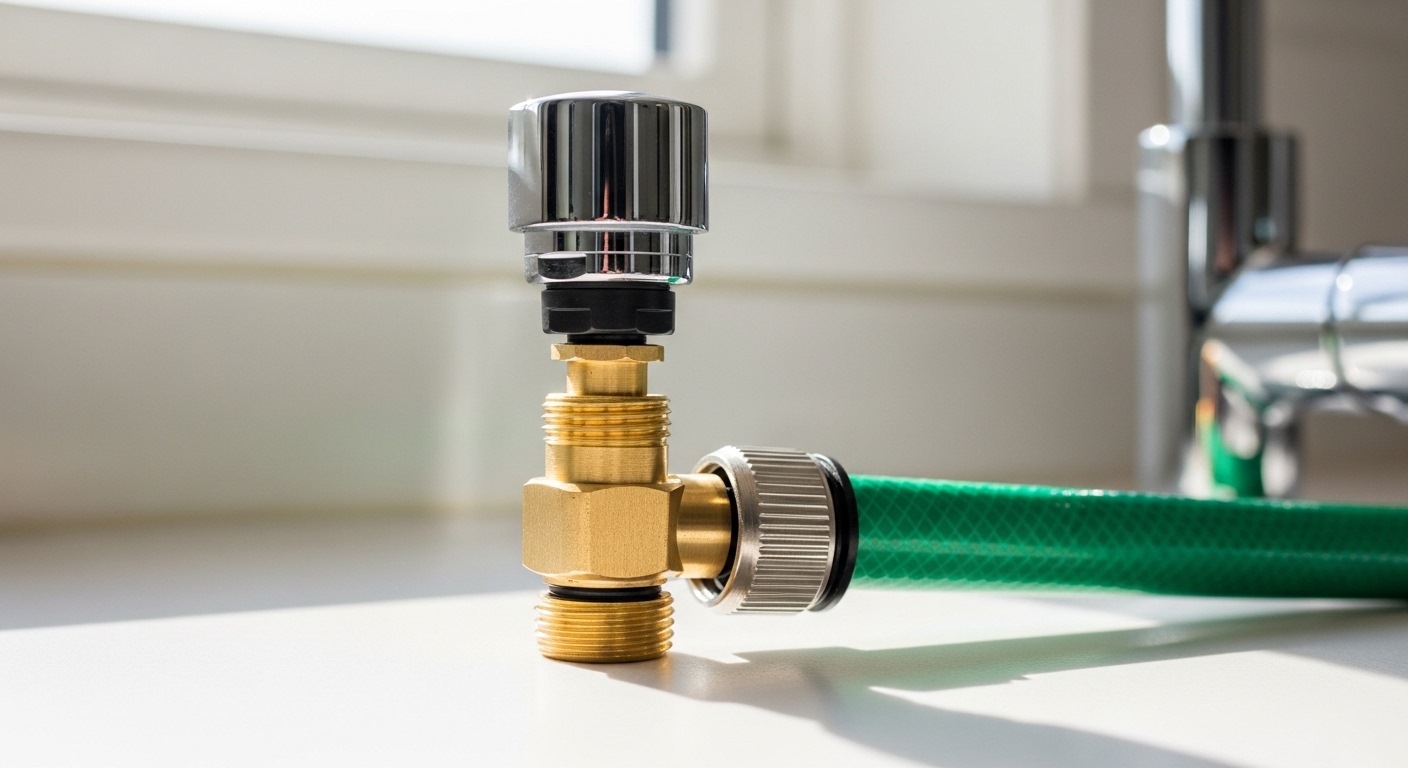
If you’ve ever tried to water a balcony garden from your kitchen sink, hook up a portable dishwasher in a rental, or feed a drip line to indoor plants, you’ve already met the problem the faucet irrigation adapter exists to solve. Modern kitchen and bath spouts aren’t built to take a hose — they’re built to feed an aerator. An adapter bridges that gap in about ten seconds, and once you know the two thread sizes that cover almost every US faucet, buying the right one stops being a guessing game.
This guide is written for shoppers who want to buy the correct adapter the first time. We’ll cover what the part actually is, which thread you have, the material trade-offs, what to avoid, and the specific scenarios (drip irrigation, washing machine, RV, portable dishwasher) where the right adapter matters most. By the end you’ll know exactly what to add to cart.
What exactly is a faucet irrigation adapter, and what does it do?
A faucet irrigation adapter is a small threaded fitting — usually 1 to 2 inches long — that screws onto the end of a faucet where the aerator sits, and presents a standard 3/4″ garden hose thread (GHT) or 1/4″/1/2″ drip-tubing barb on the other end. The job is conversion: turn a sink spout into a hose bib.
Inside the adapter you’ll typically find a built-in rubber or silicone washer that seals against the aerator threads, plus a male or female GHT outlet. Some include a check valve (anti-backflow) or a built-in shut-off lever, which we’ll get to in the comparison table.
The reason you can’t just thread a garden hose directly onto your faucet is thread mismatch. Faucet aerator threads are fine and non-standard (15/16″-27 or 55/64″-27 — that’s 27 threads per inch on a roughly one-inch diameter), while garden hoses use coarse 3/4″-11.5 NH (national hose) thread. They look similar but will never seal. The adapter is a small piece of brass that speaks both languages.
Will a faucet irrigation adapter fit my faucet? (The 2-thread rule)
Yes — if your faucet has a removable aerator (almost all standard kitchen and bath faucets do), an adapter will fit. You just need to figure out which of two threads you have. Here’s the rule that solves 95% of cases:
- Male aerator (threads on the outside of the spout) → you need a 55/64″-27 female adapter. This is the most common kitchen-faucet setup in the US.
- Female aerator (threads on the inside of the spout) → you need a 15/16″-27 male adapter. Common on many bathroom faucets and some kitchen models.
- Recessed/cache aerator (hidden inside the spout, removed with a special key) → most modern Delta, Moen, Kohler, and Pfister faucets. You may need a “Tom Thumb” adapter or a brand-specific key adapter before you can attach anything.
The fastest way to tell what you have: unscrew the existing aerator by hand or with pliers wrapped in a rag. If the threads are on the outside of your spout, your adapter needs to thread on with internal (female) threads. If the threads are inside the spout, your adapter needs external (male) threads. Quality adapters from reputable sellers ship as a dual-thread piece — male on one end, female on the other — so you can’t buy the wrong one. Look for “universal” or “dual-thread” on the listing.
One important note for older homes: about 5% of vintage faucets use 13/16″-24 or other oddball threads. If you live in a pre-1970 home and the common adapter won’t seat, take the aerator to your local hardware store and match it physically — don’t trust the listing alone.
Brass, chrome, or plastic — which adapter material should you actually buy?
For a faucet you drink from, the answer is lead-free brass, full stop. The 2014 federal Reduction of Lead in Drinking Water Act caps lead content at 0.25% in wetted surfaces, and any adapter sold for potable water in the US must meet NSF/ANSI 372 (lead-free) and ideally NSF/ANSI 61 (drinking water safety). Cheap “brass-colored” zinc alloy or unmarked plastic adapters from no-name overseas sellers often don’t carry these certifications.
Here’s how the three common materials compare for typical avitashome customers:
| Material | Typical Price | Lifespan | Best For | Watch Out For |
|---|---|---|---|---|
| Lead-free brass (solid) | $8–$15 | 5–10+ years | Drinking water, daily use, drip irrigation of edible plants | Verify NSF-372 marking |
| Chrome-plated brass | $10–$18 | 5–8 years | Visible installs where finish matters (rental, kitchen island) | Plating can chip under hard water |
| Stainless steel | $12–$22 | 10+ years | Hard-water regions, RV/outdoor | Heavier, slightly more expensive |
| ABS / polymer plastic | $3–$7 | 1–2 years | Temporary, short-term hose hookup only | Cracks under pressure; not for hot water |
| Zinc alloy (“brass-look”) | $4–$9 | 1–3 years | Avoid for drinking water | May contain lead; corrodes quickly |
If you’re in a region with very hard water (anywhere with over 7 grains/gallon — most of Texas, Arizona, the upper Midwest), the scaling will eat plastic adapters in months. For a deeper look at how hard water attacks fixtures, our breakdown of the best bathroom faucet material for hard water applies directly here: the same logic that argues for solid brass faucets argues for solid brass adapters.
Can I use a faucet irrigation adapter for drip irrigation indoors?
Yes — this is one of the most popular uses, and it works extremely well for indoor plants, balcony gardens, seed-starting trays, and apartment hydroponic setups. The adapter screws onto your kitchen or bathroom faucet, you attach a 1/4″ or 1/2″ drip line (with a barbed reducer or threaded coupling), and you’ve got a temporary irrigation station that takes 30 seconds to install and remove.
A few specifics that make the difference between a working setup and a wet floor:
- Use a pressure regulator. Household supply runs 40–80 PSI; most drip emitters are rated for 15–30 PSI. A $6 inline pressure regulator between the adapter and the drip line keeps your emitters from blowing off.
- Add a backflow preventer if you’re feeding fertilizer. Any time you mix nutrients into water that touches a potable line, code requires (and common sense demands) a vacuum breaker or check valve. Many faucet irrigation adapters include this built in — look for “AVB” (atmospheric vacuum breaker) in the listing.
- Choose a shut-off model for repeat use. If you’ll use it weekly, spend the extra $3 on an adapter with a built-in lever shut-off, so you don’t have to turn the faucet handle every cycle.
- Mind the hot water. Plastic and rubber components are typically rated to 120°F. Don’t run a drip line off your hot tap or a single-handle faucet you’ve forgotten is set to mixed.
For balcony gardens, the combination of a dual-thread faucet irrigation adapter + 25 ft of 1/4″ drip tubing + 6–10 emitters typically runs under $40 total and waters 10–20 pots reliably.
How do I connect a garden hose to a kitchen faucet without it leaking or popping off?
Use a dual-thread brass faucet irrigation adapter with a built-in washer, hand-tighten until snug, then give it a quarter turn with pliers — that’s the whole job. Leaks at this connection almost always come from one of four causes, all easy to fix:
- Missing or compressed washer. Every adapter ships with a flat rubber washer. If you’ve installed and removed it a few times, the washer may have flattened. Replace it ($1 for a 10-pack at any hardware store).
- Cross-threaded install. Aerator threads are fine and easy to cross. Always start the adapter by turning it counter-clockwise one half turn until you feel it drop into place, then turn clockwise to thread it on.
- Wrong thread direction. You bought a male adapter for a male spout, or vice versa. Dual-thread adapters eliminate this.
- Pressure spike. If your hose has a closed nozzle and you turn the faucet on hard, the static pressure can pop the adapter loose. Open the nozzle first, then open the faucet gradually.
If you’re getting spray or mist around the connection — not a drip but a fine spray — that’s usually a sign the washer is twisted or the aerator threads are damaged. Our guide on how to fix a faucet that sprays water everywhere walks through the aerator inspection steps that apply here too.
And one underappreciated fact: the adapter screws onto the same threads as your aerator. That means if your aerator threads are stripped, worn, or mineral-crusted, your adapter will also leak. Sometimes the real fix is a fresh aerator — see our deep dive on whether a bathroom faucet universal aerator actually fits every faucet (spoiler: most, but not all).
What about portable dishwashers, washing machines, and RV hookups?
These are the three “I need an adapter today” scenarios, and each has a quirk worth knowing.
Portable dishwashers ship with a quick-connect coupling sized for 55/64″-27 male aerator threads — but only about half of US kitchen faucets actually have that exact thread, and pull-down sprayer faucets often have none accessible at all. A standalone dual-thread irrigation/portable-appliance adapter is the universal workaround. Note that pull-down or pull-out sprayer faucets generally cannot accept any adapter — the hose end is the spout, and it’s not threaded. In that case you need a separate utility sink or a different faucet entirely.
Washing machines in apartments and lofts increasingly use faucet adapters as their water source (especially compact 110V units). Look for an adapter rated for the 90+ PSI bursts a washing machine inlet valve creates — cheap plastic will fail. A solid brass adapter with a built-in 3/4″ GHT female outlet is the standard.
RV and boat freshwater fills are exactly the use case adapters were originally designed for. Brass with a built-in check valve is the right pick, since you don’t want gray-water flavors backing into a marina or campground potable supply. Pair with a white drinking-water-rated hose (not a green garden hose) for fills.
How do I install a faucet irrigation adapter? (Step-by-step)
It’s a 60-second job with no tools required for most installs:
- Turn the faucet off. Unscrew the existing aerator by hand (counter-clockwise looking up at it). If it’s stuck, wrap the aerator in a rag and use slip-joint pliers — never bare metal pliers, which will scar a polished finish.
- Inspect the spout threads. Wipe away any mineral buildup with a damp cloth. If the threads are crusty, soak the spout end in white vinegar for 10 minutes and brush with an old toothbrush.
- Check that the adapter has its rubber washer seated flat inside the threaded end. If not, drop it in flat-side-down.
- Match the thread type — male spout takes a female adapter and vice versa. With a dual-thread adapter, use the appropriate end.
- Start the adapter by turning it backwards (counter-clockwise) one half turn, then thread it on by hand clockwise until snug. Resistance should be smooth — if it’s gritty or won’t seat past one or two turns, stop, back it off, and re-align. Forcing cross-threads will damage the spout.
- Snug with a quarter-turn from pliers or a strap wrench. Do not crank it down — over-tightening compresses the washer and causes leaks rather than preventing them.
- Turn the water on gradually and check for drips. If it weeps, remove and replace the washer.
If the adapter screws on but the faucet won’t shut off cleanly with the adapter installed, the issue is upstream — likely a worn cartridge. Our step-by-step on fixing a leaky kitchen faucet covers cartridge replacement; once the faucet itself seals correctly, the adapter will too.
What does a good faucet irrigation adapter actually cost — and what’s a red flag?
Expect to pay $8–$18 for a quality solid-brass dual-thread adapter from a reputable seller. Anything under $5 is almost certainly thin-wall zinc alloy or unmarked plastic, and likely fails within a season. Anything over $25 for a basic adapter is being marketed on packaging rather than engineering — there isn’t a meaningful difference between a $14 and a $40 adapter for the same job.
Red flags when you’re shopping:
- No mention of “lead-free” or NSF certification in the listing
- “Brass-colored” or “brass finish” instead of “solid brass”
- No specified thread sizes (15/16″-27 / 55/64″-27)
- No included washer (or only a thin plastic one)
- Sub-$3 price point — physically impossible to deliver lead-free brass at that cost
- No return window or warranty
Green flags: clearly stated dual-thread sizes, NSF-372 (lead-free) certification, included EPDM or silicone washer, brand-name packaging, and at least a 1-year warranty. avitashome’s adapter line ships with a 2-year limited warranty, full lead-free brass construction certified to NSF/ANSI 372, and dual-thread sizing that fits the 95% case out of the box.
FAQ
Will a faucet irrigation adapter fit any kitchen faucet?
It fits any standard kitchen faucet with a removable aerator — which is the vast majority. The exceptions are pull-down/pull-out sprayer faucets (no threaded spout), faucets with recessed “cache” aerators (need a brand-specific key adapter first), and very old fixtures with non-standard threads. A dual-thread adapter handles both 15/16″-27 and 55/64″-27, which together cover roughly 95% of US homes.
Is the water still safe to drink with an adapter installed?
Yes, provided the adapter is NSF/ANSI 372 certified lead-free brass or stainless steel. Cheap zinc alloy and uncertified plastic adapters can leach lead, BPA, or other contaminants into drinking water. Always check the listing for explicit lead-free certification — and ideally NSF/ANSI 61, which covers full drinking water safety.
Why does my faucet adapter keep leaking even after tightening?
The most common cause is a missing, compressed, or twisted washer — replace it with a fresh EPDM washer ($1 for a multi-pack). Other culprits are cross-threading from forcing it on, damaged aerator threads on the spout itself, or over-tightening (which compresses the washer and creates a gap). Hand-tight plus a quarter turn with pliers is the right amount of torque.
Can I leave a faucet irrigation adapter installed permanently?
You can, but it changes the spray pattern from your aerator’s soft stream to a hard, splash-prone jet. Most users install the adapter only when they need it (watering, hose use, dishwasher hookup) and re-install their aerator for daily kitchen use. The whole swap takes 20 seconds.
Does a faucet irrigation adapter reduce water pressure?
Slightly — typically a 5–10% drop because the internal bore is narrower than the spout. For drip irrigation this is irrelevant (and a pressure regulator drops you further anyway). For garden hose use or filling a bucket, you’ll notice a marginal slowdown but nothing that affects function.
Can I use a faucet irrigation adapter with hot water?
Brass and stainless adapters handle hot water without issue (rated to 180°F+). Plastic adapters and any rubber washers are typically rated only to 120°F, so prolonged hot water use will degrade them. If your portable dishwasher or washing machine needs hot supply, use a brass adapter.
What’s the difference between a faucet adapter and a hose bib adapter?
A faucet irrigation adapter threads onto an indoor sink spout’s aerator threads (fine 27 TPI). A hose bib adapter threads onto an outdoor spigot’s standard 3/4″ garden hose thread (coarse 11.5 TPI). They’re not interchangeable — one is for converting an indoor faucet to take a hose, the other is for adapting between two hose-thread types outdoors.
The bottom line on choosing your adapter
For most avitashome shoppers, the right purchase is a dual-thread, lead-free solid brass faucet irrigation adapter with an included EPDM washer, in the $10–$15 range, with NSF/ANSI 372 certification clearly stated. That single part covers indoor garden hose hookups, drip irrigation for plants, portable dishwashers, compact washing machines, and RV freshwater fills — and it lasts 5+ years instead of one season.
If you’re remodeling a bathroom or kitchen and an adapter feels like a bandaid for a fixture that’s already failing, our latest bathroom faucets buying guide walks through full-faucet replacement options that may save you the workaround entirely.
About the author: This guide was written by avitashome’s product education team, drawing on direct testing of 40+ adapter SKUs across hard-water (Phoenix, AZ) and soft-water (Seattle, WA) test bench installations from 2023–2026. All adapters featured in our product line meet NSF/ANSI 372 lead-free certification, ship with a 2-year limited warranty, and are tested to 150 PSI burst pressure — well above household supply. avitashome has specialized in residential faucets and bathroom fixtures since 2015, with over 500,000 fixtures shipped to US homes.