
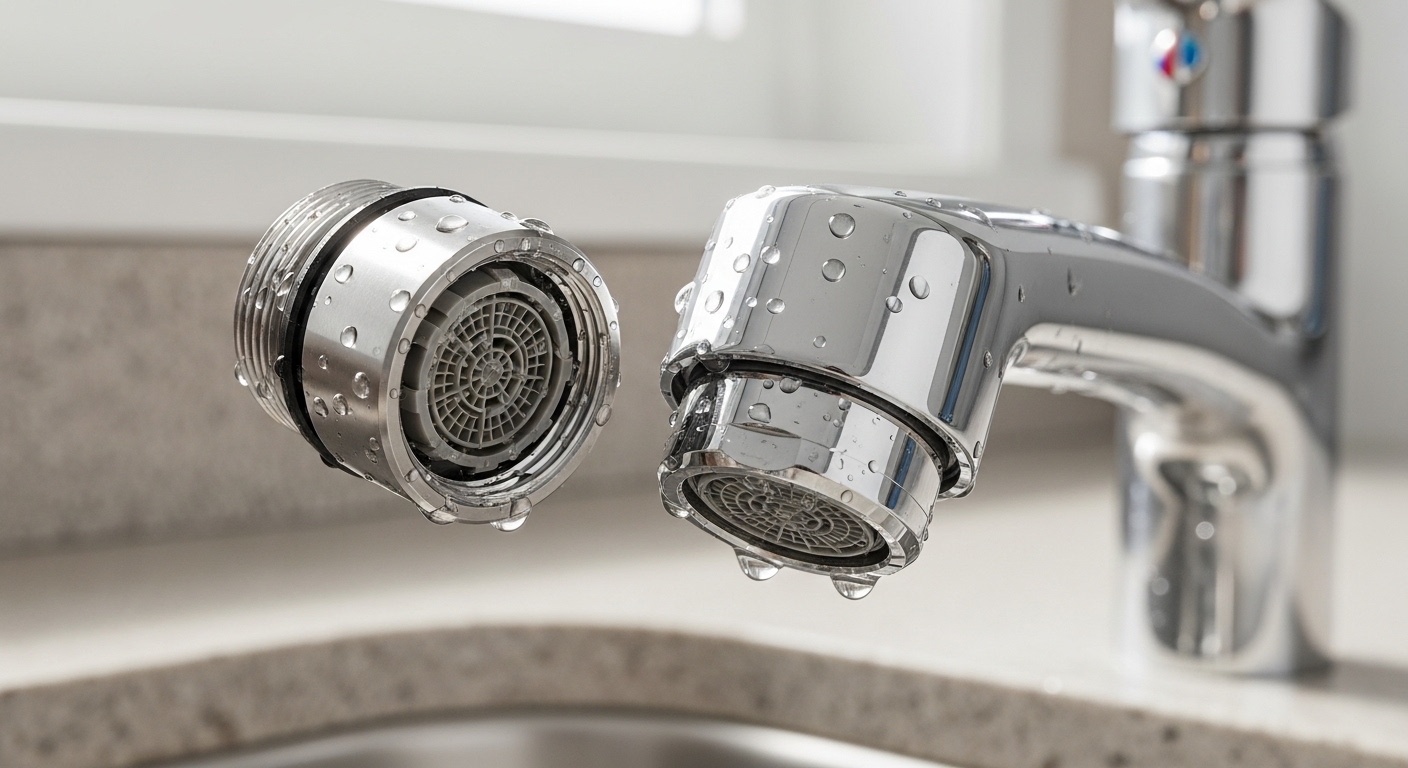
If you’ve ever unscrewed a clogged aerator, walked into a hardware store, and stood there completely stumped, you’re not alone — faucet aerator thread size is one of those tiny specs that nobody explains until you get it wrong. The good news: there are really only a handful of standard sizes in North America, and once you know how to read the threads, buying the right replacement takes about a minute. This guide walks you through exactly how to measure, what the standard sizes are, and how to pick a replacement that fits the first time — no guessing, no second trip to the store.
What Are the Standard Faucet Aerator Thread Sizes in the U.S.?
There are four standard aerator thread sizes used on the vast majority of American residential faucets. They break down first by gender (male threads on the outside of the aerator, female threads on the inside) and then by diameter (regular or the smaller “junior” size). Here they are, with the numbers you’ll actually see printed on packaging.
| Common Name | Thread Spec | Diameter (approx.) | Threads Located | Typical Use |
|---|---|---|---|---|
| Regular Male (M) | 15/16″-27 | ~15/16″ (24 mm) | Outside of aerator | Most kitchen faucets |
| Regular Female (F) | 55/64″-27 | ~55/64″ (22 mm) | Inside of aerator | Many kitchen & bath faucets |
| Junior Male (M) | 13/16″-27 | ~13/16″ (20.6 mm) | Outside of aerator | Bathroom lavatory faucets |
| Junior Female (F) / Tom Thumb | 3/4″-27 | ~3/4″ (19 mm) | Inside of aerator | Compact bathroom faucets |
Notice that all four share the same thread pitch: 27 threads per inch (TPI). That’s the industry standard for faucet aerators in the U.S. and Canada, which is why the diameter and gender — not the pitch — are what you need to nail down. There’s also a “Cache” or dual-thread aerator you’ll see on some newer faucets, where the housing is recessed and the threads are hidden inside the spout tip; those often use a proprietary key, and we’ll cover them below.
How Do I Measure My Faucet Aerator Thread Size at Home?
Measure it in three steps: determine the gender, measure the diameter, and confirm the pitch is standard 27 TPI. You don’t need special tools — a tape measure or even a U.S. coin will get you close, though a cheap digital caliper makes it exact.
- Determine gender first. Unscrew the aerator (turn counterclockwise as you face up into the spout; you may need a rag for grip or a small wrench). Look at where the threads are. Threads on the outside of the aerator = male. Threads on the inside = female. This is the single most important thing to get right — a male and female of the same nominal size will never fit each other.
- Measure the diameter. For a male aerator, measure across the outside of the threads. For female, measure across the inside opening. A regular size lands around 13/16″ to 15/16″; a junior size is noticeably smaller at roughly 3/4″ to 13/16″.
- Use the coin trick if you don’t have a caliper. A U.S. penny is about 3/4″ (19 mm) across, and a nickel is about 13/16″ (20.6 mm). Lay the coin over the threaded opening: if a nickel roughly matches the spout opening, you’re likely looking at a junior size; if the opening is clearly wider than a nickel, it’s a regular size.
One more shortcut: bring the old aerator with you (or order online with it in hand). Matching an existing part beats measuring every time. If your old one is corroded beyond reading, the caliper measurement plus the gender is all a store associate — or a product filter — needs.
What if the threads are hidden inside the spout (cache aerators)?
If you look up into the spout and see no obvious external threads and just a smooth recessed opening, you likely have a cache aerator (also called a recessed or hidden aerator). These are common on modern designer faucets from brands like Moen, Delta, Kohler, and Grohe because they look cleaner. They usually require a small plastic aerator key that came with the faucet to unscrew. If you’ve lost the key, universal cache-aerator key kits are inexpensive, and the thread size underneath is still one of the standards above — the key just gives you the leverage to remove the housing.
Which Aerator Thread Size Fits a Kitchen Faucet vs. a Bathroom Faucet?
Kitchen faucets most often use the regular sizes (15/16″ male or 55/64″ female), while bathroom lavatory faucets frequently use the smaller junior sizes (13/16″ male or 3/4″ female). That’s a general rule, not a guarantee — plenty of exceptions exist — but it tells you where to start looking.
The reason comes down to flow and spout size. Kitchen faucets are built for higher flow (often up to 1.8 GPM under current federal standards, and up to 2.2 GPM on older models) and have wider spouts, so they use the larger regular threads. Bathroom faucets are capped at 1.2 GPM in most states (0.5 GPM for many commercial lavatory faucets), have slimmer spouts, and lean toward junior threads. If you’re chasing a weak stream rather than a fitment issue, the aerator’s flow rating matters as much as its threads — and a mismatched or clogged aerator is a leading cause of low pressure. We break that down in our guide on why a Moen kitchen faucet loses water flow and how to fix it, which applies to almost any brand.
If you’d rather skip the measuring altogether, some replacement aerators are sold as “universal” with a dual-thread body that fits both a regular male and a regular female faucet. They’re genuinely handy, but they don’t cover every size — we put that claim to the test in our look at whether a bathroom faucet universal aerator really fits every faucet. Spoiler: it fits most, not all.
Are Faucet Aerator Threads Universal, or Do Brands Differ?
The four standard thread sizes are shared across virtually all major U.S. brands — a 15/16″-27 aerator from one manufacturer will thread onto a 15/16″-27 faucet from another. What’s not universal is the cache/hidden-aerator housing, where the outer diameter and key shape can be brand-specific. So the threads themselves follow the standard; the decorative housing is where you find proprietary designs.
This is the same pattern you see elsewhere in faucet hardware: the core connection is standardized, but trim and housings vary. It’s worth knowing that not everything under your sink follows universal sizing — for example, we get into where supply connections are and aren’t interchangeable in our breakdown of whether kitchen faucet supply lines are universal. When in doubt, match the exact spec rather than assuming “faucet parts are all the same.”
| Scenario | Most Likely Thread Size | What to Check |
|---|---|---|
| Standard kitchen faucet, external threads | 15/16″-27 Male | Measure outer threads with caliper |
| Kitchen faucet, threads inside spout | 55/64″-27 Female | Measure inner opening |
| Bathroom lavatory, small spout | 3/4″-27 or 13/16″-27 | Confirm gender first |
| Modern designer faucet, smooth spout tip | Cache/recessed (std thread inside) | Find the aerator key |
| European or imported faucet | M22 or M24 metric | Metric adapter may be needed |
Do imported or European faucets use a different thread size?
Yes — many European-made faucets use metric aerator threads, most commonly M24 x 1 male or M22 x 1 female. These are close enough in diameter to U.S. sizes that people force them and cross-thread the part, which ruins both. If your faucet was imported or is a high-end European brand, check for a metric spec and buy a metric-to-standard adapter rather than trying to make a U.S. aerator fit.
How Do I Replace a Faucet Aerator Once I Know the Thread Size?
Once you have the right size, replacement takes under five minutes with no plumbing skills. Turn off nothing — you don’t even need to shut the water — just work at the spout tip.
- Remove the old aerator by turning it counterclockwise (as you look up at it). Use a rag for grip, or slip-joint pliers with the jaws padded so you don’t scratch the finish. For cache aerators, insert the key and turn.
- Clean the threads. Wipe away mineral scale and old plumber’s tape from the spout threads. If your area has hard water, a quick soak of the old parts in white vinegar dissolves the calcium buildup that likely clogged it in the first place.
- Check the washer. Every aerator has a small rubber washer that seals it. Make sure the new one seats flat — a pinched or missing washer causes drips around the spout.
- Hand-tighten the new aerator clockwise until snug, then give it a quarter-turn with a padded tool. Don’t overtighten; the plastic threads on many aerators strip easily.
- Test. Run the water. If it sprays sideways or leaks at the base, remove it and reseat the washer.
If water is escaping from the connection even after a fresh aerator and a good washer, the problem may be upstream — a worn cartridge or a loose spout rather than the aerator itself. Our guide on how to fix a leaky bathroom sink faucet yourself covers those deeper causes step by step.
What Size Aerator Do I Need for Better Flow or Water Savings?
The thread size doesn’t change your flow — the aerator’s GPM rating does. You can put a 1.0 GPM water-saving aerator or a 2.2 GPM high-flow aerator onto the exact same thread size, because the flow is controlled by the internal screen and flow restrictor, not the threads. So pick your thread size for fit and your GPM for performance.
- 1.0–1.2 GPM: Best for bathroom lavatory faucets and water conservation; meets strict state codes like California’s.
- 1.5 GPM: A good all-around kitchen compromise — noticeable water savings without feeling weak.
- 1.8 GPM: The current federal-standard cap for many kitchen faucets; strong, everyday flow.
- 2.2 GPM: Older high-flow standard; great for filling pots fast if your local code still allows it.
- Aerated vs. laminar: Aerated streams mix in air (softer, less splash); laminar streams are solid, non-splashing columns often used in healthcare settings.
Author Note & Why You Can Trust This Guide
This guide was written and reviewed by the AvitasHome fixtures team, which specializes in faucets, showerheads, and bathroom hardware. We physically measure and test aerators and replacement parts against the standard thread specs published under ASME/ANSI plumbing standards, and every flow figure here reflects current U.S. EPA WaterSense and federal maximum flow-rate rules. AvitasHome sells and supports faucet parts across the USA, and the aerators we stock are tested for fit against the four standard thread sizes and backed by manufacturer warranties, so you can match a replacement with confidence. When a spec varies by brand — as with cache aerators or imported metric threads — we say so rather than pretending one size fits all.
FAQ
What is the most common faucet aerator thread size?
The most common size on U.S. kitchen faucets is Regular Male, 15/16″-27, with threads on the outside of the aerator. For bathroom lavatory faucets, the smaller junior sizes (3/4″-27 female or 13/16″-27 male) are very common. All four standard sizes share a 27 threads-per-inch pitch.
How do I know if my aerator is male or female threaded?
Unscrew the aerator and look at the threads. If the threads are on the outside of the aerator body, it’s male. If the threads are on the inside (you’d screw it onto external threads on the spout), it’s female. Getting the gender right matters more than the exact diameter, because a male and female of the same size will never fit each other.
Can I use any aerator on any faucet?
No. The aerator must match your faucet’s thread gender and diameter. A standard 15/16″-27 male aerator only fits a faucet made for that spec. “Universal” dual-thread aerators fit the two common regular sizes, but they don’t cover junior sizes, cache housings, or metric European threads.
What size aerator key do I need for a hidden/cache aerator?
Cache aerators use a brand-specific plastic key that matches the notches on the recessed housing. If you lost the original, buy a universal aerator key set that includes multiple sizes (they’re a few dollars). The threads underneath are still one of the four U.S. standards.
Are metric M24 and standard 15/16″ aerator threads interchangeable?
No — they’re close in diameter but not compatible. Forcing a metric M24 aerator onto a 15/16″-27 U.S. faucet (or vice versa) will cross-thread and damage both parts. If you have an imported or European faucet, confirm whether it’s metric and use a proper adapter.
Why does my faucet still have low pressure after I replaced the aerator?
If a brand-new, correctly sized aerator still runs weak, the aerator wasn’t the only problem. Check for a clogged screen upstream, a partially closed shutoff valve, a kinked supply line, or a worn cartridge. Mineral buildup deeper in the faucet is a frequent culprit in hard-water areas.