
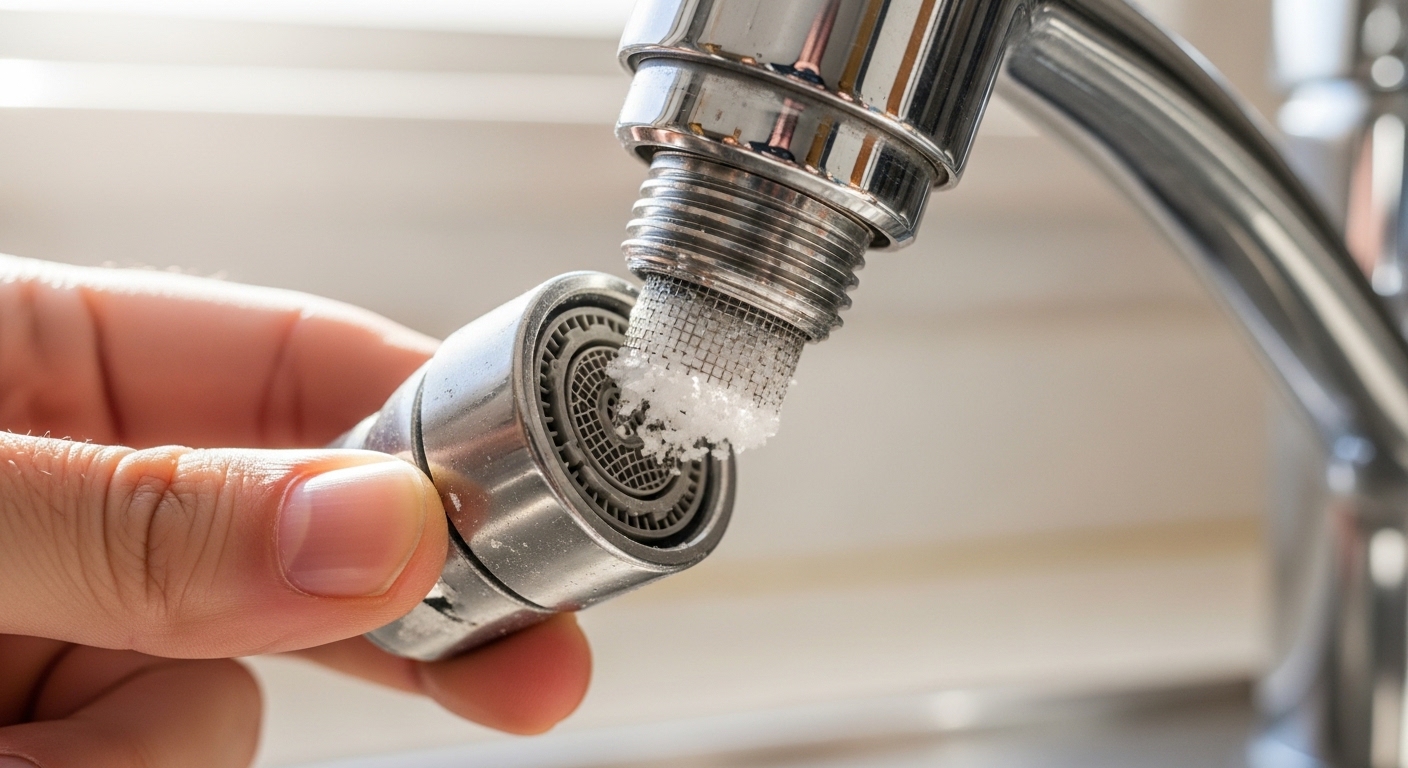
Learning how to clean a faucet head with white vinegar is the single cheapest fix for a faucet that’s spraying sideways, dribbling, or splitting into two weak streams. Nine times out of ten the culprit isn’t your plumbing or your water pressure — it’s hard-water mineral scale (calcium carbonate and lime) clogging the tiny screen at the tip of the spout, called the aerator. White vinegar is a mild acetic acid, and acid dissolves that mineral buildup without hurting your chrome, brass, or stainless finish. Below is exactly how to do it, how long to soak, when the bag trick beats unscrewing, and how to keep the gunk from coming back.
Why does white vinegar actually dissolve the gunk in a faucet head?
White vinegar works because the crusty white or greenish buildup in your faucet head is mineral scale — mostly calcium and magnesium carbonate — and those minerals dissolve in mild acid. Distilled white vinegar is roughly 5% acetic acid, which is strong enough to break down scale in 30 minutes to a few hours but gentle enough that it won’t pit chrome, damage the rubber washers, or strip most faucet finishes.
Here’s what’s happening at the tip of your faucet. The aerator is a small screw-on fitting that mixes air into the water to soften the stream and cut splashing. Inside it sits a fine mesh screen and a flow restrictor. Every time water passes through, trace minerals get left behind, and over months they cement into a hard crust that blocks most of those little holes. Water then squeezes through whatever holes are left, which is why the stream sprays crooked or splits. Vinegar re-dissolves that crust back into solution so you can rinse it away.
One important caveat: use plain distilled white vinegar, not apple cider vinegar (it’s darker and can stain) and never mix vinegar with bleach — that combination releases toxic chlorine gas. Straight vinegar, on its own, is all you need.
What’s the fastest way — unscrew the aerator or use the vinegar bag trick?
If your aerator unscrews easily, take it off and soak it in a cup of vinegar — that’s faster and more thorough. If it’s stuck, corroded, or you’re cleaning a pull-down sprayer or shower head you can’t remove, use the “vinegar bag” trick: tie a bag of vinegar over the whole faucet head so it soaks in place. Both work; the choice is really about whether the part comes off without a fight.
Method 1: Unscrew and soak (best for standard sink faucets)
- Turn off the faucet and plug the drain (so no small parts vanish down it).
- Wrap the aerator with a cloth or masking tape to protect the finish, then unscrew it counterclockwise by hand. If it won’t budge, use pliers over the tape.
- Disassemble the aerator over your hand — note the order of the screen, washer, and restrictor so you can rebuild it.
- Drop the parts into a small bowl or cup of undiluted white vinegar. Soak 30 minutes for light scale, up to overnight for a thick crust.
- Scrub each part with an old toothbrush; poke stubborn holes clear with a toothpick or a straightened paperclip.
- Rinse thoroughly under running water, reassemble in the same order, and screw back on hand-tight plus a slight nudge.
Method 2: The vinegar bag (best for shower heads and fixed spouts)
- Fill a sturdy zip-top sandwich bag about one-third full with white vinegar.
- Submerge the faucet head or shower head into the bag so all the nozzles are covered.
- Secure the bag to the neck of the fixture with a rubber band or a zip tie.
- Leave it 30 minutes to a few hours (overnight for heavy buildup, but don’t leave brass or plated finishes soaking longer than a few hours to be safe).
- Remove the bag, run hot water for a minute to flush loosened debris, and wipe the nozzles. On rubber-nipple shower heads, massage the tips with your thumb to pop off softened scale.
How long should you soak a faucet head in vinegar?
Soak for 30 minutes if the buildup is light, 2–4 hours for moderate scale, and overnight (8–12 hours) only for a badly encrusted aerator. More time dissolves more mineral, but there’s a point of diminishing returns and a mild risk to delicate plated or brass finishes if you leave them submerged for many hours.
Use this quick reference to match soak time to how bad the buildup is and what your faucet is made of:
| Buildup Level | Recommended Soak Time | Finish Caution |
|---|---|---|
| Light (slightly weak flow) | 30 minutes | Safe for all finishes |
| Moderate (visible white crust) | 2–4 hours | Safe for chrome/stainless; check brass hourly |
| Heavy (holes clogged, sputtering) | 8–12 hours (overnight) | Avoid overnight on unlacquered brass, bronze, or nickel plate |
| Recurring (hard-water home) | 30 min monthly | Safe for all finishes as maintenance |
If you have soft water, you may only need to do this once or twice a year. If you’re on hard well water or in a hard-water region, a quick 30-minute soak once a month keeps the flow strong and means you’ll never face an overnight rescue mission.
Can vinegar damage the finish on my faucet?
For chrome, stainless steel, and modern PVD finishes, vinegar is safe for the soak times above — these are the most acid-tolerant faucet finishes. The finishes to watch are unlacquered (living) brass, oil-rubbed bronze, antique copper, and older nickel plating, where prolonged acid contact can dull or discolor the surface. On those, keep the soak short (an hour or less), rinse well, and dry immediately.
A few practical rules that keep you out of trouble:
- Never scrub with steel wool or a scouring pad. Use a soft toothbrush only — abrasives leave permanent micro-scratches on any faucet finish.
- Don’t soak the decorative body of the faucet — only the aerator or nozzle head. There’s no scale on the handle or spout body, so there’s no reason to expose them to acid.
- Rinse and dry. Leftover vinegar residue can leave its own faint film; a quick rinse and a microfiber wipe finishes the job.
- Reassemble hand-tight. Over-tightening the aerator with pliers cracks the plastic threads and causes leaks around the collar.
If your faucet is a specialty finish and you’re nervous, test on the underside of the aerator first, or step down to a 50/50 vinegar-water mix and a longer soak.
What if cleaning with vinegar doesn’t fix the weak flow?
If you’ve cleaned the aerator with vinegar and the flow is still weak, the clog is somewhere else — usually the aerator screen is worn out and needs a cheap replacement, or the restriction is deeper in the faucet cartridge or supply lines. Vinegar only fixes mineral scale at the tip; it can’t help a failing valve or a kinked supply line.
Work through the likely causes in order, from easiest to hardest:
- Replace the aerator entirely. They cost a few dollars. If the mesh is corroded or torn, a new one restores flow instantly. Just match the thread size — our guide on faucet aerator thread size and how to measure it shows exactly how to get the right one.
- Check the supply valves under the sink. A shutoff valve that’s only partly open chokes the flow. Make sure both hot and cold are turned all the way on.
- Suspect the cartridge. On single-handle faucets, sediment can clog the cartridge itself. If you have a Moen, our walkthrough on why your Moen kitchen faucet has low water flow covers cleaning and replacing that part.
- Shower heads are their own animal. If it’s a shower rather than a sink, weak spray usually is the nozzle scale — but sometimes it’s a restrictor or the supply. See why an RV shower head has low pressure and how to fix it for the full diagnostic, which applies to home showers too.
The takeaway: vinegar is your first, cheapest move. If it doesn’t work, you’ve just ruled out the most common cause for free and narrowed the problem down to the next suspect.
How do you keep mineral buildup from coming back?
The best way to stop scale from returning is to soak the aerator in vinegar for 30 minutes on a regular schedule — monthly for hard water, quarterly for moderate water — and to wipe the faucet dry after heavy use. Prevention is nothing more than doing the light version of this cleaning before the crust has time to cement.
A few extra habits that genuinely help in hard-water homes:
- Wipe the spout and handles dry with a cloth after washing dishes — standing droplets are where new scale starts.
- If your whole house battles hard water, a water softener or an inline sediment filter dramatically slows buildup on every faucet and shower head.
- Keep a spare aerator on hand. When a 30-minute soak stops fully restoring flow, the screen is simply worn — swap it and you’re back to full pressure.
None of this requires a plumber, special tools, or expensive products. A jug of white vinegar and ten minutes of attention a month is the whole maintenance program.
Author Note & Why You Can Trust This Guide
This guide was written by the fixture specialists at avitashome, where we design, sell, and pressure-test kitchen and bathroom faucets every day. Our recommendations come from hands-on bench testing of aerators, cartridges, and shower heads across a range of water conditions — not from repeating generic advice. The faucets we sell meet NSF/ANSI 61 and NSF/ANSI 372 (lead-free) standards and ship with manufacturer warranties, and we always advise checking your specific faucet’s warranty terms before disassembling — routine aerator cleaning never voids a warranty, but you want to know your coverage. When in doubt about a specialty finish, follow the manufacturer’s care instructions over any general tip.
FAQ
Can I use regular white vinegar or does it have to be distilled?
Distilled white vinegar is best because it’s clear and won’t stain your finish. Regular “white vinegar” sold in stores is already distilled white vinegar, so they’re the same thing. Avoid apple cider or wine vinegars — they’re darker, can leave a tint, and offer no cleaning advantage.
Will vinegar hurt my chrome or brushed nickel faucet?
No, for the soak times in this guide. Chrome, stainless, brushed nickel, and modern PVD finishes tolerate vinegar fine for 30 minutes to a few hours. Only unlacquered brass, oil-rubbed bronze, antique copper, and old nickel plate need short soaks and immediate rinsing to be safe.
How often should I clean my faucet head with vinegar?
Once a month if you have hard water, once every three to four months for moderate water, and once or twice a year for soft water. A quick 30-minute soak on that schedule prevents the heavy buildup that requires overnight soaking or aerator replacement.
My aerator won’t unscrew — can I still clean it?
Yes. Use the vinegar-bag method: tie a bag of vinegar around the entire spout so the aerator soaks in place for a few hours. This also loosens the corrosion, so after soaking, wrap the aerator in tape and try unscrewing it again with pliers — it often comes free once the scale dissolves.
Is vinegar or a commercial descaler better for faucets?
For household mineral scale, white vinegar works just as well as most commercial descalers at a fraction of the cost and with no harsh fumes. Commercial descalers are only worth it for extreme, industrial-grade buildup. For a normal home faucet or shower head, vinegar is the smarter first choice.
Can I leave the aerator soaking in vinegar overnight?
Yes for chrome, stainless, and plastic aerators — overnight is fine and dissolves even heavy scale. Avoid overnight soaks only for unlacquered brass, bronze, or old nickel-plated parts, where many hours of acid contact can dull the finish. For those, a few hours is plenty.