 Avitas Home
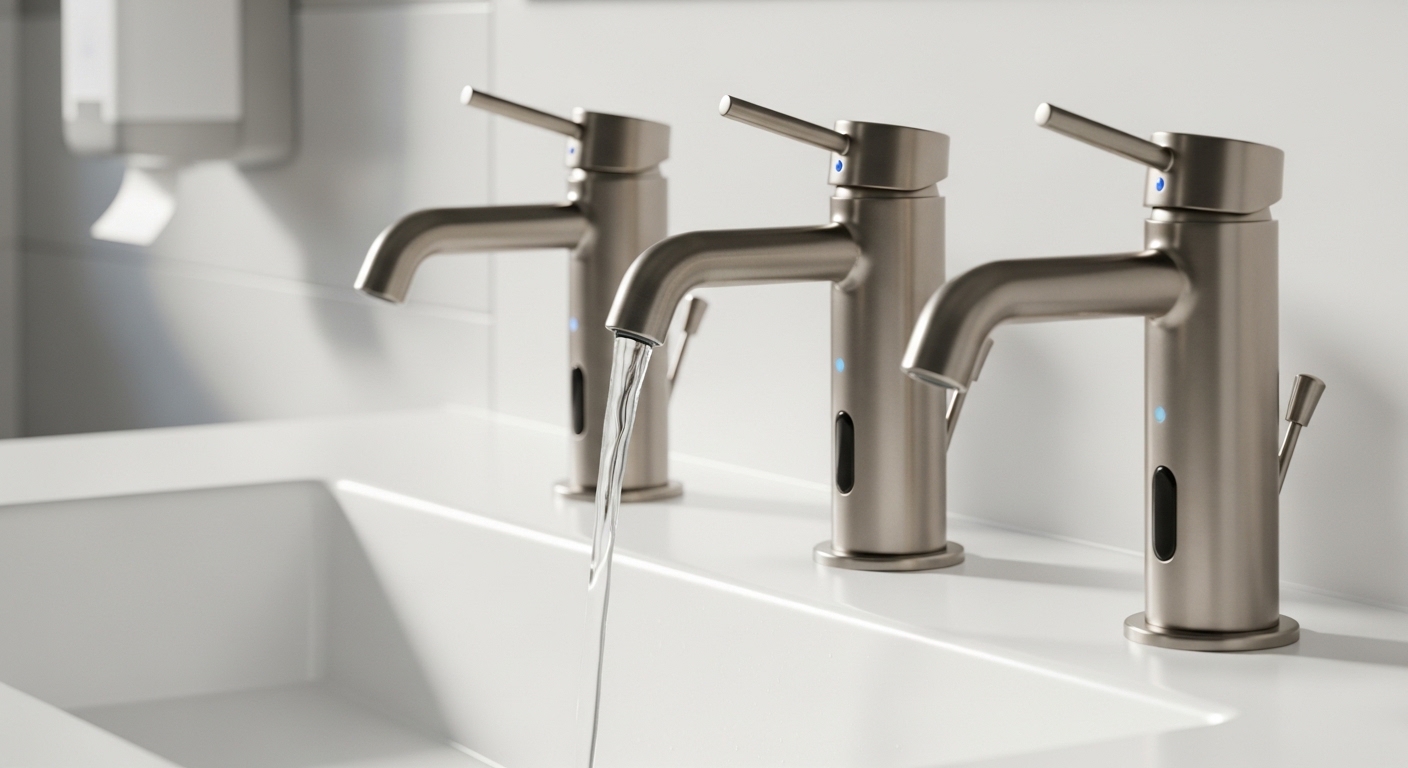
A touchless lavatory faucet is a hands-free bathroom sink faucet that turns water on and off automatically using an infrared sensor — no handle to push, twist, or grab. In a commercial restroom (office, restaurant, clinic, school, retail), that translates into three things facility managers actually care about: lower water bills, fewer germs spread across the room, and a lot less hardware to repair because there’s no handle for people to yank on. Below, we’ll answer the real questions buyers ask before they spec these by the dozen — power options, flow rates, sensor reliability, what “commercial-grade” really means, and how much you should expect to spend.
This guide is written for the person signing the purchase order, not the casual DIYer. If you’re outfitting a single home powder room, the priorities shift a bit, and our latest bathroom faucets buying guide covers that scenario in more depth.
What exactly is a touchless lavatory faucet, and how does the sensor work?
A touchless lavatory faucet uses an active infrared (IR) sensor to detect your hands and open a solenoid valve that releases water. Wave your hands under the spout, the beam reflects back, the valve opens; pull your hands away, the beam clears, and the valve shuts within a second. There’s no mechanical handle in the water path at all.
Here’s the chain of parts, in plain terms:
- IR emitter + receiver — usually in the spout tip or base. It sends out an invisible beam and watches for the reflection off your hands.
- Solenoid valve — an electrically operated on/off valve. This is the part that physically starts and stops the water.
- Control module — the little brain that reads the sensor, runs the timing logic, and tells the solenoid what to do.
- Power source — batteries, an AC adapter (hardwired/plug-in), or in some models a self-generating hydropower turbine.
- Mixing valve or thermostatic control — sets the water temperature, since there’s no handle to adjust hot/cold on the fly.
The single most common point of confusion: temperature. With no handle, you set the temperature behind the scenes — at an under-sink mixing valve, at a thermostatic mixing valve (TMV), or simply by feeding the faucet tempered water. Most commercial installs run a single tempered supply (around 95–105°F) for safety and code compliance.
Is a touchless lavatory faucet actually worth it for a commercial restroom?
Yes — in any restroom with real foot traffic, a touchless lavatory faucet pays for itself faster than almost any other fixture upgrade. The savings come from three places at once: water, labor, and hygiene.
Water. A manual faucet left running while someone soaps up can dump 1.5–2.2 gallons per minute. A commercial touchless faucet caps flow at 0.5 GPM and runs only while hands are present — typically 5–10 seconds per use. In a restroom with a few hundred uses a day, that’s tens of thousands of gallons saved per year.
Labor and maintenance. No handle means no loose, dripping, or vandalized handle to fix. The most common bathroom-faucet service call — a wobbly or worn handle — simply doesn’t exist here. (If you’ve ever dealt with that on a residential Delta, you know the drill; our guide on why a faucet handle goes loose and how to fix it shows exactly the headache you’re designing out.)
Hygiene. The faucet is one of the most-touched surfaces in a public restroom, and people touch it right after using the toilet and before they’ve finished washing. Removing that touch point is the entire point in clinics, food service, and schools.
Here’s a realistic payback sketch for a moderately busy restroom:
| Factor | Manual 2.2 GPM faucet | Touchless 0.5 GPM faucet |
|---|---|---|
| Water per handwash | ~0.5–0.7 gal (tap runs while soaping) | ~0.08–0.12 gal (runs only on hands) |
| Uses per day (busy restroom) | 300 | 300 |
| Est. annual water use | ~55,000–75,000 gal | ~9,000–13,000 gal |
| Handle service calls/yr | 2–4 typical | 0 (no handle) |
| Battery/sensor service | None | 1 battery swap or none (if hardwired) |
| Typical unit cost | $60–$150 | $120–$400 |
The higher upfront cost is real, but in a high-traffic setting the water savings alone usually erase it inside 1–3 years, before you even count avoided labor.
Battery, hardwired, or hydropower — which power option should I pick?
Pick hardwired (AC) for the busiest, most critical restrooms; pick battery for easy retrofits; pick hydropower only when you want zero batteries and zero wiring and can accept the price. The “right” answer is mostly about how many uses per day the faucet sees and whether you can run a wire.
| Power type | Best for | Pros | Watch-outs |
|---|---|---|---|
| Battery (4×AA or 6V lithium) | Retrofits, low-to-medium traffic | No electrician, fast install, works in a power outage | Battery swaps every 1–3 yrs; track them or you get dead faucets |
| Hardwired AC adapter | High-traffic, new construction | Never changes batteries, most consistent sensor performance | Needs an outlet or junction box under the sink; dies in an outage unless battery-backed |
| Hydropower (turbine) | Sustainability-focused, hard-to-wire sites | No batteries, no wiring, self-charging from water flow | Higher cost; needs minimum water pressure; fewer models |
A practical middle path many buyers love: a hardwired faucet with battery backup. It runs on AC day to day but keeps working through a power outage. For a clinic or 24-hour facility, that redundancy is worth the small premium.
What flow rate and finish should I spec — and does the finish survive hard water?
For commercial lavatories, spec a 0.5 GPM laminar or aerated stream and a solid-brass faucet body in a brushed/satin finish such as brushed nickel or matte black. The 0.5 GPM rate meets most water-efficiency and green-building requirements (it’s a common LEED and CALGreen threshold), and brushed finishes hide water spots and fingerprints far better than polished chrome in a high-use room.
On flow: a laminar stream gives you a clear, non-splashing column of water and is preferred in healthcare because it doesn’t aerosolize the way an aerated stream can. A standard aerated stream feels softer and fuller and is fine for offices and retail. Both can hit 0.5 GPM.
On finish and durability, the real enemy in many regions is hard water — mineral scale that clouds the finish, clogs the aerator, and can gum up a sensor’s clean operation over time. Finish material matters more than color here. We break down which materials shrug off scale in our deep-dive on the best bathroom faucet material for hard water; the short version is that solid brass with a quality PVD finish outlasts cheaper zinc-alloy bodies with electroplated coatings.
- Brushed nickel / satin: best all-around for commercial — hides spots, very durable, neutral look.
- Matte black: on-trend and hides fingerprints, but shows dried mineral residue more in very hard water; wipe-downs help.
- Polished chrome: cheapest and easy to sanitize, but every droplet and fingerprint shows.
- PVD finishes: physical vapor deposition bonds the color to the metal — far more scratch- and corrosion-resistant than standard plating, worth paying for in a public restroom.
If you’re outfitting a wider 8-inch widespread vanity rather than a single-hole sink, the hands-free options and sizing differ a bit — our widespread touchless faucet buyer’s guide covers that exact layout.
How do I install a touchless lavatory faucet, and can my maintenance team do it?
Yes — a competent maintenance tech can install most deck-mounted touchless lavatory faucets in 30–60 minutes per fixture, no specialty license required for battery models. Hardwired units may need an electrician to add an outlet or junction box, but the plumbing side is standard. Here’s the typical sequence:
- Shut off the supplies and disconnect the old faucet. Clear the deck holes and clean the mounting surface.
- Drop in the new faucet body and secure it from below with the mounting nut. Make sure the sensor window faces straight down/out, unobstructed.
- Connect the solenoid valve and control box to the supply lines. Most commercial units want a single tempered supply — set that temperature at your mixing valve.
- Power it up — install batteries or connect the AC adapter. The sensor usually self-calibrates to the sink basin within a minute.
- Set the range and timing. Adjust the sensor distance so it triggers at hand height but not from the far basin wall, and set the auto-shutoff timeout.
- Test for leaks and false triggers. Run several cycles, check fittings, and confirm it doesn’t run on its own from a reflective backsplash.
Two install tips that prevent 90% of callbacks: (1) keep the sensor away from shiny, reflective basin bottoms or mirrors that can cause “ghost” activations, and (2) get the temperature right at the mixing valve before you walk away, since users can’t adjust it themselves.
Touchless vs. push-button (metering) vs. manual — which is right for which restroom?
Touchless wins for hygiene and water savings; metering (push-button) faucets win on lowest upfront cost and zero electronics; manual faucets only make sense in private or very low-traffic settings. Match the technology to the room’s traffic and risk level.
| Type | Hygiene | Water savings | Upfront cost | Best fit |
|---|---|---|---|---|
| Touchless (sensor) | Best — no contact | Best | Higher | Clinics, food service, airports, schools, busy offices |
| Metering / push-button | Good — brief touch | Bon | Low | Parks, rest stops, budget high-traffic where electronics are risky |
| Manual handle | Poor — full contact | Depends on user | Lowest | Private offices, single-occupant restrooms |
Metering faucets — the kind you press and they run for a fixed few seconds — are the honest budget alternative to touchless. They have no batteries or sensors to fail, which is why you still see them in vandal-prone public spaces. But they still require a touch, and many people press them several times, eroding the water savings. For most modern commercial projects, touchless is the spec to beat.
How reliable are the sensors, and what maintenance do they really need?
Modern commercial touchless faucets are highly reliable — quality units are tested for hundreds of thousands of activation cycles — but they need two simple things: occasional battery changes (on battery models) and a clean sensor window. Most “broken sensor” complaints trace back to a dead battery, a dirty or scaled-over sensor lens, or false triggers from a reflective surface, not an actual failure.
A light maintenance routine keeps them running:
- Wipe the sensor window during normal cleaning so soap film and hard-water scale don’t blind it.
- Clean or replace the aerator periodically — scale buildup here weakens the stream just like on any faucet.
- Track battery age across the facility; swap on a schedule instead of waiting for dead faucets.
- Avoid harsh abrasive cleaners on the finish and sensor; they scratch PVD and acrylic windows.
One important note: avoid mounting these where mirrors, polished metal, or shiny basins sit directly in the sensor’s path, since reflections cause phantom run cycles that look like a “stuck” faucet. Proper range adjustment at install (step 5 above) fixes the vast majority of these.
FAQ
How much does a commercial touchless lavatory faucet cost in 2026?
Expect roughly $120–$400 per faucet for a reputable solid-brass commercial unit, with most quality picks landing in the $180–$300 range. Budget battery models start lower; hydropower and integrated thermostatic models run higher. Don’t forget to budget for a mixing valve if your supply isn’t already tempered.
Do touchless faucets work during a power outage?
Battery-powered models keep working in an outage because they don’t rely on building power. Hardwired (AC) models stop unless they have battery backup — which is why hardwired-with-backup is a popular choice for clinics and 24-hour facilities. Pure hydropower units also keep running since they generate power from the water flow itself.
Can I adjust the water temperature on a touchless lavatory faucet?
Not at the faucet — there’s no handle. You set the temperature behind the scenes using an under-sink mixing valve or a thermostatic mixing valve, or by feeding the faucet a single tempered supply line. For commercial restrooms, most installers run one tempered supply around 95–105°F for safety and code compliance.
Are touchless faucets ADA compliant?
Most are well-suited to ADA requirements because hands-free operation needs no tight grasping, pinching, or twisting of the wrist. Always confirm the specific model’s spout height, reach, and mounting meet your local accessibility codes, since compliance depends on the full lavatory installation, not just the faucet.
What certifications should a commercial touchless lavatory faucet have?
Look for ASME A112.18.1/CSA B125.1 (faucet performance), NSF/ANSI 61 and 372 (drinking-water safety and lead-free), and a flow rate that meets your local water-efficiency code (commonly 0.5 GPM for public lavatories). WaterSense labeling and a solid manufacturer warranty are good additional signals of a commercial-grade fixture.
How long do the batteries last?
In typical commercial use, a quality battery model runs 1–3 years per set, depending on traffic and whether it uses AA alkaline or a 6V lithium pack. High-traffic restrooms land at the shorter end. If frequent battery swaps aren’t acceptable, go hardwired or hydropower instead.
The bottom line
For any commercial restroom with real traffic, a solid-brass, sensor-operated, 0.5 GPM touchless lavatory faucet is one of the highest-ROI fixtures you can spec. Choose hardwired-with-backup for the busiest rooms, battery for easy retrofits, and a brushed PVD finish if your water is hard. Set the temperature correctly at install, keep the sensor clean, and the faucet largely takes care of itself — saving water, cutting touch points, and removing the handle that usually generates your service calls in the first place.
About the author & avitashome: This guide was written by the avitashome fixtures team, drawing on years of helping homeowners, contractors, and facility managers select and install faucets across thousands of orders. At avitashome (www.avitashome.com) we test the fixtures we sell against ASME A112.18.1 and NSF/ANSI 61 performance and lead-free standards, and we back our faucets with a manufacturer warranty so you’re covered well after installation. We write to inform first and sell second — if a metering or manual faucet is the smarter call for your space, we’ll say so.