 Avitas Inicio
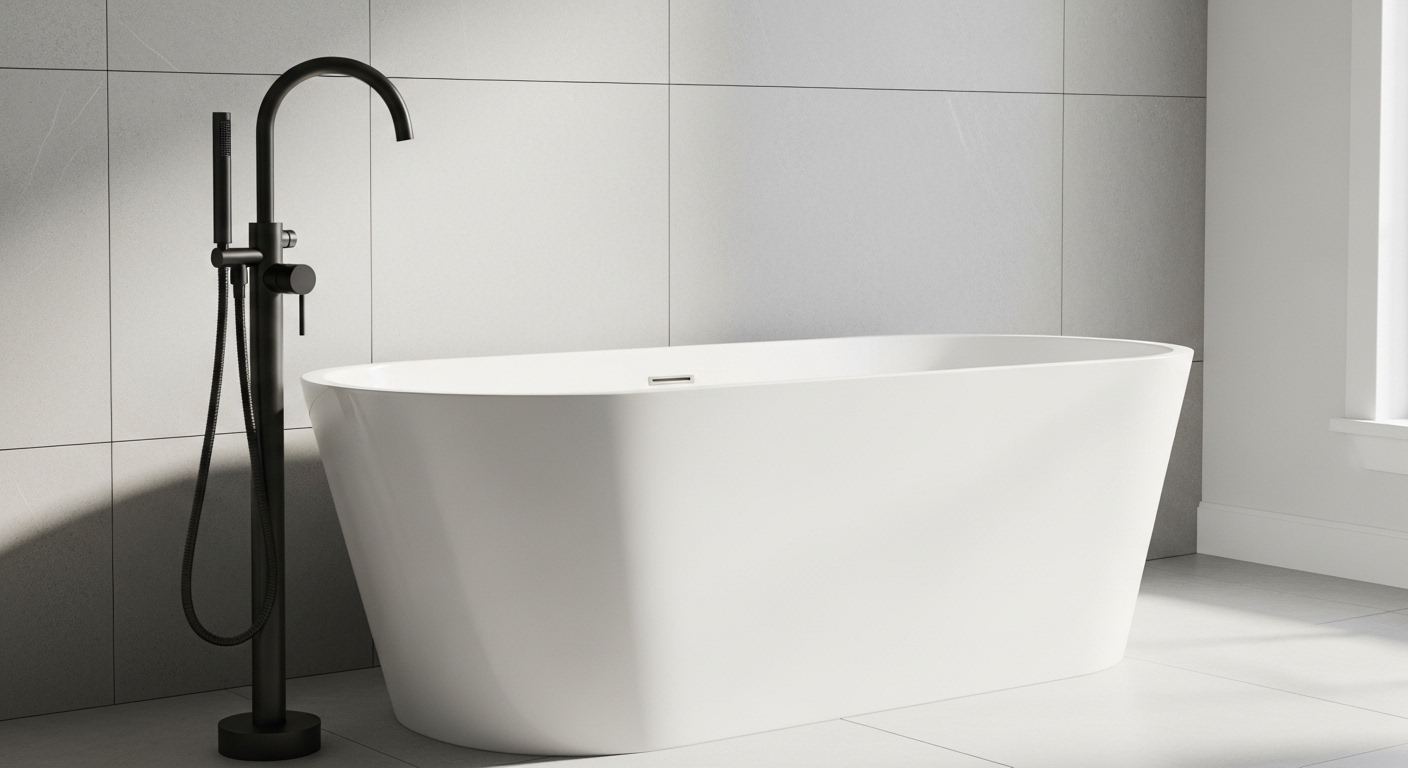
A matte black tub faucet is one of the fastest ways to make an ordinary bathtub look like it came out of a design magazine — but only if you pick the right finish quality and the right mount for your tub. The color is easy to fall in love with; the hard part is knowing which body material, valve, and installation style actually fit your bathroom so you’re not returning a heavy fixture two weeks later. This guide walks through exactly that, in plain language, with the specs and price ranges that matter.
At avitashome, we sell and stress-test bath fixtures across every finish, and matte black is now our single most-requested tub faucet color. So let’s answer the real questions people ask before buying one.
Is a matte black tub faucet actually worth it, or is it just a trend?
It’s worth it, and it has outgrown “trend” status. Matte black has been a top-three bathroom finish for roughly eight years running, which is longer than most hardware fads survive. The practical reasons hold up: matte black hides water spots, toothpaste splatter, and hard-water film far better than polished chrome, and it reads as a deliberate design choice rather than a builder-grade default.
The honest tradeoffs are worth knowing too. A matte (non-reflective) surface can show dust and dried soap scum as a faint dull film — you wipe it with a damp microfiber cloth, not a spray cleaner. And because black is a statement color, you want your other bathroom metals to either match it or intentionally contrast it, not clash. If your towel bar, drain, and shower trim are all bright chrome, a lone black faucet can look accidental instead of designed.
- Great fit if: you have a modern, transitional, industrial, or Scandinavian bathroom; light or neutral tile; and you’re willing to coordinate the drain and hardware.
- Think twice if: you have a traditional brass-and-marble bathroom, or you’re staging a home to sell fast in a conservative market where neutral chrome is the safe default.
What’s the difference between a matte black tub filler, a wall-mount, and a deck-mount faucet?
The difference is where the faucet attaches — and that decision is dictated by your tub, not your taste. You cannot mix these up; a deck-mount faucet will not work on a freestanding tub with no deck. Here’s the quick decoder:
| Type | Where it mounts | Best for | Typical price (matte black) |
|---|---|---|---|
| Freestanding floor-mount (tub filler) | Rises from the floor next to the tub | Standalone soaking tubs with no deck | $250–$700 |
| Wall-mount | Plumbing comes through the wall behind the tub | Alcove/drop-in tubs, minimalist looks | $150–$450 |
| Deck-mount (tub-side) | Sits on the flat rim/deck of the tub | Drop-in and undermount tubs with a wide deck | $180–$500 |
| Roman tub (widespread deck) | Three or more holes drilled in the deck | Larger built-in tubs, spa look | $200–$600 |
The most common mistake is buying a gorgeous freestanding tub filler for a tub that’s pushed against a wall — the filler is designed to be seen from all sides and needs floor plumbing roughed in. If your plumbing already comes out of the wall, you want a wall-mount or a matching wall-mount tub spout. If you’re unsure what your existing spout even connects to, our guide on tub spout connection types shows exactly how to identify slip-fit versus threaded connections before you order anything.
Is matte black hard to keep clean, and does the finish wear off?
No — matte black is easier to keep clean day to day than chrome, and a quality finish will not wear off if you buy the right kind. The two things that determine longevity are the base material and how the color is applied.
Cheap matte black faucets are often zinc alloy with a sprayed paint or thin powder coat. Those chip at the spout edges and around the handles within a year or two, especially where a ring or a dropped bottle can nick them. The good ones use a solid brass body with either a PVD (physical vapor deposition) coating or a properly baked powder-coat finish. PVD in particular bonds the color into the metal at a molecular level and is rated to resist scratching, tarnishing, and UV fading for the life of the faucet.
For cleaning, the rule is boringly simple:
- Wipe with a damp microfiber cloth after showers to stop hard-water film from building up.
- For stuck-on spots, use a drop of dish soap and water — never an abrasive pad, bleach, or acidic descaler on the finish itself.
- Dry it after cleaning so you don’t leave a dull mineral haze.
If you live somewhere with genuinely hard water, the finish quality matters even more, because minerals attack weak coatings first. It’s worth reading our breakdown of the best bathroom faucet material for hard water before you buy — it explains why solid brass under a matte finish outlasts alloy in mineral-heavy homes.
What should I look for so I don’t buy a cheap one that chips?
Buy on four specs, in this order: body material, finish type, valve/cartridge quality, and flow rate. Everything else is styling. Here’s what each one means in practice.
- Body material: Solid brass is the gold standard — heavy, corrosion-resistant, and it holds a matte finish well. If a tub filler feels suspiciously light for its size, it’s likely zinc or thin alloy. Real brass tub fillers are noticeably heavy (often 8–15 lbs).
- Finish type: Look for “PVD matte black” or a stated powder-coat. Avoid anything just labeled “black coated” with no detail.
- Valve/cartridge: A ceramic-disc cartridge is what gives you smooth, drip-free control for years. Brass or ceramic cartridges from established makers are ideal; rubber-washer valves drip sooner.
- Flow rate: A tub filler should move water fast — look for 6+ GPM (gallons per minute) so a deep soaking tub fills in a reasonable time. A trickle-flow filler on a 70-gallon tub is a daily annoyance.
Also confirm the faucet is certified to NSF/ANSI 61 and 372 (safe drinking-water contact and low-lead compliance) and that it carries a real warranty. Reputable matte black tub fillers come with a limited lifetime warranty on the finish and function — a one-year warranty is a quiet signal the maker doesn’t trust the coating.
Does a matte black tub faucet have to match the shower, drain, and other fixtures?
It doesn’t have to match perfectly, but the metals in a bathroom should look intentional. The cleanest look is an all-matte-black package: tub faucet, shower trim, drain, towel bars, and toilet flush lever in the same finish. That’s the easiest way to guarantee it looks designed.
That said, a controlled two-metal mix is very much on-trend and can look more expensive than a single finish. The trick is to pick one metal as dominant and one as accent — for example, matte black tub and shower fixtures with brushed gold or brushed nickel cabinet hardware and lighting. What you want to avoid is three or more random finishes with no logic.
One detail people forget: the tub drain and overflow trim. A bright chrome drain in a matte black setup instantly cheapens the whole look. Most drain kits come in matching matte black, so order them together. If you’re mixing black with a warmer metal instead, our look at whether a polished nickel faucet and shower combination works can help you decide which contrast reads as intentional versus accidental.
How hard is it to install a matte black tub faucet myself?
It ranges from a 30-minute swap to a job you should hand to a plumber, depending entirely on the mount type. A deck-mount or wall-mount spout replacement on existing plumbing is genuinely DIY-friendly. A freestanding floor-mount tub filler usually is not, because it needs floor plumbing roughed in and secured to a mounting bracket under the subfloor.
Here’s the realistic difficulty scale:
| Install type | DIY difficulty | Time | Special tools/needs |
|---|---|---|---|
| Slip-fit tub spout swap | Easy | 15–30 min | Allen wrench, plumber’s tape |
| Threaded tub spout swap | Easy–moderate | 20–40 min | Plumber’s tape, rag |
| Deck-mount on existing holes | Moderate | 1–2 hrs | Basin wrench, access under deck |
| Wall-mount (new rough-in) | Hard | Half day+ | Open wall, valve soldering/PEX |
| Freestanding floor-mount | Hard — hire a pro | Half day+ | Floor rough-in, mounting bracket |
If you’re just replacing an old chrome spout with a matte black one on the same wall connection, the single most important step is identifying whether your existing spout is slip-fit (slides onto a copper stub and locks with a set screw) or threaded (screws onto a pipe nipple). Get that wrong and the new spout won’t seat. When you swap, wrap the threads in fresh plumber’s tape and don’t overtighten — matte black finishes can scuff if you clamp channel-lock pliers directly on the spout. Use a rag as a buffer.
One more real-world tip: if there’s an ugly gap between your new spout and the wall tile, don’t leave it — moisture gets behind it. A small bathtub faucet gap filler closes it cleanly, and many come in matte black to match.
Matte black vs. other popular tub faucet finishes: quick comparison
If you’re still deciding, here’s how matte black stacks up against the other finishes people cross-shop for a tub faucet.
| Finish | Hides water spots? | Style vibe | Cleaning effort | Resale-safe? |
|---|---|---|---|---|
| Matte black | Excellent | Modern, bold, industrial | Low (damp wipe) | Moderate–high |
| Chrome | Poor | Classic, neutral | High (spots show) | Very high |
| Brushed nickel | Bien | Warm, transitional | Low | Very high |
| Brushed gold/champagne bronze | Bien | Warm, luxe | Low | Moderate |
| Matte black + industrial styling | Excellent | Loft, utilitarian | Low | Moderate |
If the industrial look is what pulled you toward black in the first place, that aesthetic carries beautifully into the kitchen too — the same design logic behind a matte black industrial kitchen faucet (exposed-spring styling, heavy solid-brass body) applies to bath fixtures, so you can carry one coherent look through the whole home.
What’s the right budget for a matte black tub faucet in 2026?
Plan on $180–$300 for a solid, well-finished wall or deck-mount faucet, and $250–$600 for a quality freestanding floor-mount tub filler with a handheld sprayer. Below about $150 for a floor-mount filler, you’re almost certainly getting zinc alloy with a sprayed finish that will chip. Above $600, you’re mostly paying for a designer brand name rather than better function.
Where the money genuinely buys you something:
- $180–$300: solid brass body, ceramic cartridge, PVD or good powder-coat black, lifetime finish warranty. This is the sweet spot for most bathrooms.
- $300–$600: heavier brass, smoother handle action, matching handheld sprayer and hose, more mounting hardware included, sometimes a nicer drain kit bundled in.
- $600+: premium designer engineering and brand cachet — worth it if you want a specific look, not required for durability.
Spend the money on the finish and the cartridge, not the box it comes in. A $220 solid-brass PVD matte black filler will outlast a $130 alloy one many times over, which makes the “cheaper” option the expensive one within a couple of years.
FAQ
Do matte black tub faucets scratch easily?
A quality PVD or baked powder-coat finish on a solid-brass body resists scratching very well — PVD is one of the hardest finishes available. Cheap sprayed-paint faucets on zinc bodies scratch and chip easily, which is why body material and finish type matter far more than the color itself.
Will a matte black faucet show hard-water stains?
Less than chrome, but you’ll still see a faint dull mineral film if you never wipe it down and your water is hard. A quick damp-microfiber wipe after use prevents buildup. Avoid acidic descalers and abrasive pads directly on the finish, since those are what actually dull a matte surface over time.
Can I put a matte black tub filler on any bathtub?
No — the mount has to match the tub. Freestanding floor-mount fillers need floor plumbing and suit standalone tubs; deck-mount versions need a flat tub rim with drilled holes; wall-mount versions need plumbing through the wall. Always confirm your tub’s mounting type and rough-in before ordering.
Does matte black hurt home resale value?
Not meaningfully in modern markets — matte black has been a mainstream design choice for years and reads as current, not risky. In very traditional markets, neutral chrome or brushed nickel is still the safest resale bet, but a well-coordinated matte black bathroom generally helps a home feel updated rather than dated.
What’s the difference between matte black and “oil-rubbed bronze”?
Matte black is a flat, true-black, uniform finish. Oil-rubbed bronze is a dark brown-black with warm undertones and often intentional highlights on raised edges. Matte black looks modern and graphic; oil-rubbed bronze looks traditional and rustic. They don’t mix well in the same room, so pick one direction.
How long should a good matte black tub faucet last?
A solid-brass, PVD-finished tub faucet with a ceramic cartridge should last 15–20+ years with basic care, and most carry a limited lifetime finish warranty to back that up. Budget alloy models with sprayed finishes often start chipping or dripping within 1–3 years.
The bottom line
A matte black tub faucet is a genuinely good buy in 2026 — durable, spot-hiding, and stylish — as long as you buy a solid-brass body with a real PVD or powder-coat finish, match the mount to your tub, and coordinate your drain and shower trim. Get those three things right and you’ll have a fixture that anchors the whole bathroom and still looks sharp two decades from now.
Author note: This guide was written by the avitashome fixtures team, drawing on hands-on testing of tub fillers across finishes, mounts, and price tiers. avitashome specializes in faucets and bath fixtures, and we evaluate every model we recommend against real-world criteria — body material, NSF/ANSI 61 & 372 certification, cartridge quality, flow rate, and finish warranty — not just looks. Always verify a product’s specific certifications and warranty terms on its listing before purchase.