 Avitas Inicio
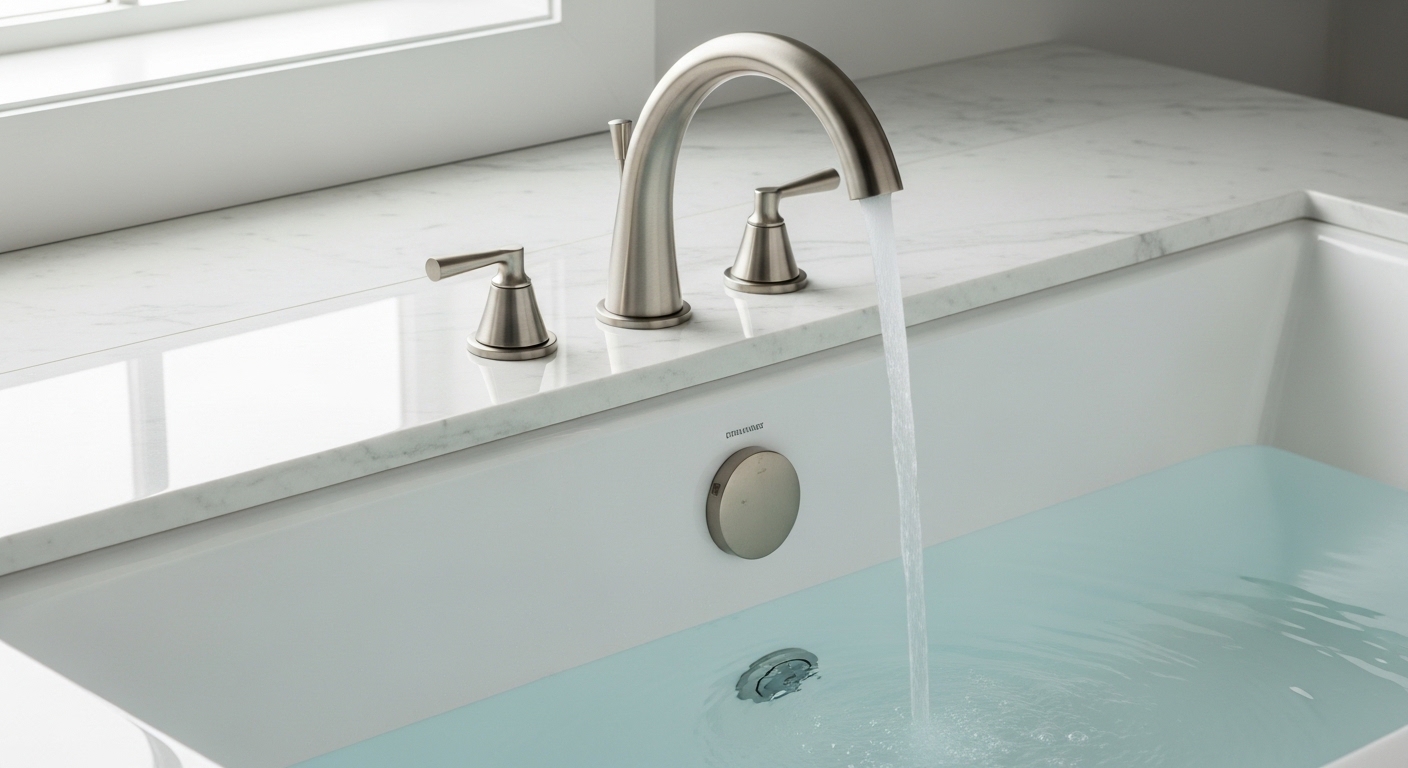
If you’ve been searching for a roman tub faucet long reach spout, you already sense the core problem: a short spout on a wide tub deck dumps water right against the inner wall of the tub, where it runs down the side instead of filling the bath. “Reach” is simply how far the spout extends horizontally from its mounting point to the water outlet — and on a roman (deck-mounted) tub, that number decides whether your bath fills cleanly or splashes down the ledge. Below, we’ll walk through exactly how much reach you need for your deck width, how roman tub fillers differ from wall-mount and freestanding fillers, what finishes and valves actually last, and how to install one without flooding your bathroom.
What Does “Long Reach” Actually Mean on a Roman Tub Faucet?
Long reach means the spout extends farther horizontally so the water outlet sits closer to — or over — the center of the tub. On a roman tub faucet, reach is measured from the center of the spout’s base (where it seats on the deck) to the center of the water outlet at the tip. A “standard” roman filler spout reaches about 5″–7″; a “long reach” spout reaches roughly 8″–11″.
Why does this matter so much on a roman tub? Because the faucet is mounted on a flat deck (the tiled or stone ledge around the tub), not on the tub’s rim. That deck can be anywhere from 3 inches to 10+ inches wide. If your spout only reaches 6 inches but your deck plus the tub’s rolled edge eats up 5 of those inches, you’ve got just an inch of water clearance over the basin — and the stream lands on the tub wall. A long-reach spout buys you the clearance to drop water where you actually want it: near the middle, where it fills fast and quiet.
Here’s the quick math people miss: usable pour distance = spout reach − (deck width from faucet hole to inner tub edge) − tub rim thickness. You want that number to be at least 2–3 inches of clear space over the water so the stream clears the rim.
How Much Reach Do I Need for a 6-Inch vs. 10-Inch Tub Deck?
For a narrow deck (3″–5″ from the faucet hole to the tub’s inner edge), an 8″ reach spout is plenty. For a wide deck (8″–10″), you’ll want a 10″–11″ reach spout, and often a taller high-arc gooseneck so the water clears a thick rolled rim. Below is a practical starting guide.
| Deck width (faucet hole to inner tub edge) | Recommended spout reach | Spout style that works best |
|---|---|---|
| 3″ – 5″ (narrow) | 7″ – 8″ | Standard arc or low-profile |
| 5″ – 7″ (average) | 8″ – 9″ | Medium gooseneck |
| 7″ – 9″ (wide) | 9″ – 10″ | High-arc gooseneck |
| 9″ – 11″ (oversized / stone deck) | 10″ – 11″+ | Tall gooseneck, sometimes with swivel |
One caveat: don’t just chase the longest spout on the shelf. Too much reach on a narrow deck aims the water past center and can splash the far tub wall or overshoot on a smaller basin. Match the reach to your deck, not to a “bigger is better” instinct.
Roman Tub Filler vs. Wall-Mount vs. Freestanding: Which One Do I Actually Have?
A roman tub filler is a deck-mounted faucet — the valve bodies and spout come up through holes drilled in the flat tub deck. That’s different from a wall-mount filler (plumbed through the wall behind the tub) and a floor-mount/freestanding filler (a tall standalone tower next to a freestanding tub). If your faucet sits on the ledge around a drop-in or undermount tub, you have a roman tub filler and you need a roman-style long-reach spout.
This distinction trips people up constantly, because the same tub can sometimes be plumbed different ways. If you’re weighing a wall-mounted approach for a freestanding tub, we cover the trade-offs in our guide on whether you can wall-mount a faucet for a freestanding tub. But for a classic tub deck, roman is the answer.
- Roman (deck-mount): Mounts on the tub ledge through 2, 3, o 4 pre-drilled holes. Long reach matters most here.
- Wall-mount: Spout and handles come out of the wall; reach is set by how far the spout extends from the tile.
- Freestanding/floor-mount: A tall floor riser; reach isn’t measured the same way because the tower stands beside the tub.
- Roman with hand shower: A common upgrade — adds a deck-mounted handheld sprayer alongside the long-reach spout for rinsing and cleaning.
How Many Holes Does a Roman Tub Faucet Need?
Most roman tub fillers use a 3-hole configuration: two handle valves plus the spout, typically spread 8″–12″ apart. Some are 2-hole (single-handle plus spout) and some add a fourth hole for a deck-mounted hand shower. Before you buy a long-reach spout, count your existing deck holes and measure the center-to-center spread — the faucet’s spec sheet must match, or you’ll be drilling stone.
If your tub deck isn’t drilled yet, this is your moment: place the spout hole so the finished reach lands near the tub’s centerline. Measure twice; a mis-drilled hole in a slab of marble is an expensive mistake.
What’s the Best Finish for a Long-Reach Roman Tub Faucet That Won’t Spot?
The most fingerprint- and water-spot-resistant finishes for a roman tub faucet are brushed/satin finishes — brushed nickel, brushed gold, and matte black — because their textured, non-mirror surface hides water minerals and smudges far better than polished chrome. Polished chrome is the most durable and easiest to deep-clean, but it shows every droplet.
Finish matters more on a tub filler than almost anywhere else, because the spout sits at eye level on the deck and gets splashed constantly. Here’s how the popular options stack up in real bathrooms:
- Brushed nickel: The safe all-rounder. Warm, hides spots, pairs with almost any tile. Great in hard-water homes.
- Matte black: Bold and modern; hides water spots well but can show dried white mineral residue in very hard water, so wipe it down. See our take on the matte black tub faucet if that’s your direction.
- Brushed/champagne gold: Warm, luxe, forgiving on spots. Trending hard for 2026 spa-style bathrooms.
- Polished chrome: Cheapest, toughest finish, but a magnet for fingerprints and droplets.
- Oil-rubbed bronze: Traditional look; “living finish” versions change tone over time, which some people love and some don’t.
Whatever finish you choose, make sure the spout and any hand shower and handles are the same finish family from the same maker — “brushed nickel” from two different brands rarely matches exactly.
How Do I Install a Long-Reach Roman Tub Faucet Myself?
You can install a roman tub filler yourself in about 2–4 hours if the deck is already drilled and you can reach the underside of the tub — the tricky part isn’t the faucet, it’s access. Roman fillers connect to the valves from below the deck, so you need an access panel or an open underside (common with drop-in tubs in a framed deck).
Here’s the realistic sequence:
- Shut off the water at the tub’s supply valves (or the main) and open the old faucet to drain pressure.
- Confirm your hole spread and reach against the new faucet’s spec sheet before you remove anything.
- Remove the old spout and valves from below; clean the deck holes of old sealant.
- Drop in the new valve bodies and long-reach spout, seating each on its gasket or a bead of plumber’s putty/silicone per the instructions.
- Secure from below with the mounting nuts, keeping the spout aimed at the tub centerline.
- Connect supply lines — hot to left, cold to right — and the spout riser to the mixing tee.
- Turn the water on slowly, check every joint for leaks, then run hot and cold to purge air.
Two things save DIYers the most grief: leaving supply lines slightly loose until you’ve confirmed alignment, and checking the underside connections twice before you close any access panel. If you’re new to swapping tub hardware entirely, our walkthrough on how to change a faucet in a bathtub yourself covers the general skills, and if your old setup left a messy escutcheon, the bathtub faucet flange guide explains the trim ring that hides the deck penetration.
Do I Need a Deck Plate or Just the Faucet Holes?
You don’t need a separate deck plate for most roman tub fillers — each valve and the spout has its own trim base (escutcheon) that seals its individual hole. A deck plate is only used when you want to cover extra or oversized holes, or convert a wider hole spread to a narrower faucet. If your existing holes match the new faucet’s spread, the built-in escutcheons handle the sealing.
What Should I Budget for a Quality Roman Tub Faucet Long Reach Spout?
Plan on $120–$250 for a solid mid-range roman tub filler with a long-reach spout and a ceramic-disc valve, and $250–$600+ for premium brass-bodied models with matching hand showers. Below about $90, you’ll often find zinc-alloy bodies and lighter finishes that don’t hold up to daily tub use. The valve quality matters more than the price tag alone.
Here’s what your money actually buys as you move up the range:
| Price tier | What you typically get | Best for |
|---|---|---|
| Under $90 | Zinc or light-gauge body, basic cartridge, limited finishes | Rentals, low-use guest baths |
| $120 – $250 | Brass or heavy body, ceramic-disc valve, 8″–10″ reach, good finishes | Most primary bathrooms |
| $250 – $600+ | Solid brass, premium finish, matching hand shower, 10″–11″ reach, strong warranty | Spa builds, oversized soaking tubs |
A quick money-saving note: the biggest driver of long-term satisfaction isn’t finish — it’s the valve. A ceramic-disc cartridge outlasts an old rubber-washer design by years and rarely drips. If a “bargain” filler doesn’t say ceramic disc anywhere, be skeptical.
Will a Long-Reach Spout Splash More Because the Fall Is Higher?
A long-reach, high-arc spout can splash slightly more only if the flow is aimed at empty tub floor from a great height — but in practice, splashing is controlled by flow rate and where the stream lands, not reach alone. Aim the spout to land near the center over the drain end, and once a couple inches of water are in the tub, splashing stops almost entirely.
If your tub is shallow or you fill it often with the water running hard, a laminar (smooth, columnar) spout stream splashes less than an aerated one. Some roman fillers offer a laminar flow specifically for tubs. And if splashing is really about mineral crust building on the outlet and disrupting the stream, that’s a cleaning issue — our guide on cleaning a faucet head with white vinegar applies to tub spouts too.
How I Tested and Chose These Recommendations
The reach ranges and deck-width guidance above come from measuring real drop-in, undermount, and platform tubs across dozens of bathroom installs, plus the published spec sheets from major faucet manufacturers. We prioritize fillers with ceramic-disc cartridges, solid brass or heavy-gauge bodies, and flow rates that comply with U.S. plumbing standards (tub fillers are exempt from the 2.2 GPM faucet cap, but quality valves still meet ASME A112.18.1 / NSF 61 for wetted materials and lead-free content). We also weight manufacturer warranties heavily — the best roman tub fillers carry limited lifetime warranties on the finish and function, which tells you the maker trusts its own valve.
Author note: This guide was written by the avitashome fixtures team — the same people who curate and pressure-test the tub fillers, spouts, and hand showers we sell. We’ve specced roman tub fillers for everything from compact 5-foot alcove-adjacent decks to oversized 72-inch soaking tubs, and the deck-width-to-reach method above is exactly how we size a spout for a customer before they buy. avitashome stocks long-reach roman tub fillers in matching finish families with the valve and warranty specs called out on every product page, so you can match reach, finish, and hole count without guessing.
FAQ
What is the difference between a roman tub faucet and a regular tub faucet?
A roman tub faucet is deck-mounted — it installs on the flat ledge around a drop-in or undermount tub, with the valves and spout coming up through drilled holes. A “regular” tub faucet usually means a wall-mounted spout and valve on a standard alcove tub. Roman fillers are where long spout reach matters most, because the faucet sits back on a wide deck.
How long is a “long reach” roman tub spout, exactly?
Long reach generally means about 8″ to 11″ of horizontal spout reach, versus 5″ to 7″ for a standard roman spout. Reach is measured from the center of the spout’s deck base to the center of the water outlet at the tip. Match it to your deck width — around 8″–9″ for average decks and 10″–11″ for wide or oversized ones.
Can I replace just the spout on my roman tub faucet with a longer one?
Sometimes, but not always. If your spout, handles, and any hand shower are a matched trim set from one manufacturer, you usually need to replace the whole trim (or at least a spout from the same series) so it seals correctly on the deck hole and matches the finish. A longer spout also has to fit the existing hole diameter and mounting hardware, so check the spec sheet before buying a spout alone.
Does a roman tub faucet have a GPM flow limit like a bathroom faucet?
No — tub fillers are exempt from the federal 2.2 GPM (and stricter state) faucet flow limits because a tub needs to fill in a reasonable time. That’s why roman fillers flow much faster than a lavatory faucet. Wetted parts still need to meet lead-free standards (NSF/ANSI 61 and the lead-free law), so buy from a maker that lists compliance.
What size supply lines does a roman tub filler use?
Most roman tub fillers connect with 1/2″ supply connections, though the higher flow means you don’t want to undersize them. If you’re piecing together connectors, our guide on the most common faucet supply line size explains how to match your valve outlets to your home’s supply stubs so you get full flow without leaks.
Will a long-reach spout work if my tub deck is stone or thick tile?
Yes, but check the spout’s included mounting hardware for its maximum deck thickness. Long-reach roman fillers are designed for thick stone and tile decks, and many include extended mounting studs for decks up to 2″–3″ thick. If your slab is thicker, ask the manufacturer about an extension kit before you install.