 Pagina iniziale di Avitas
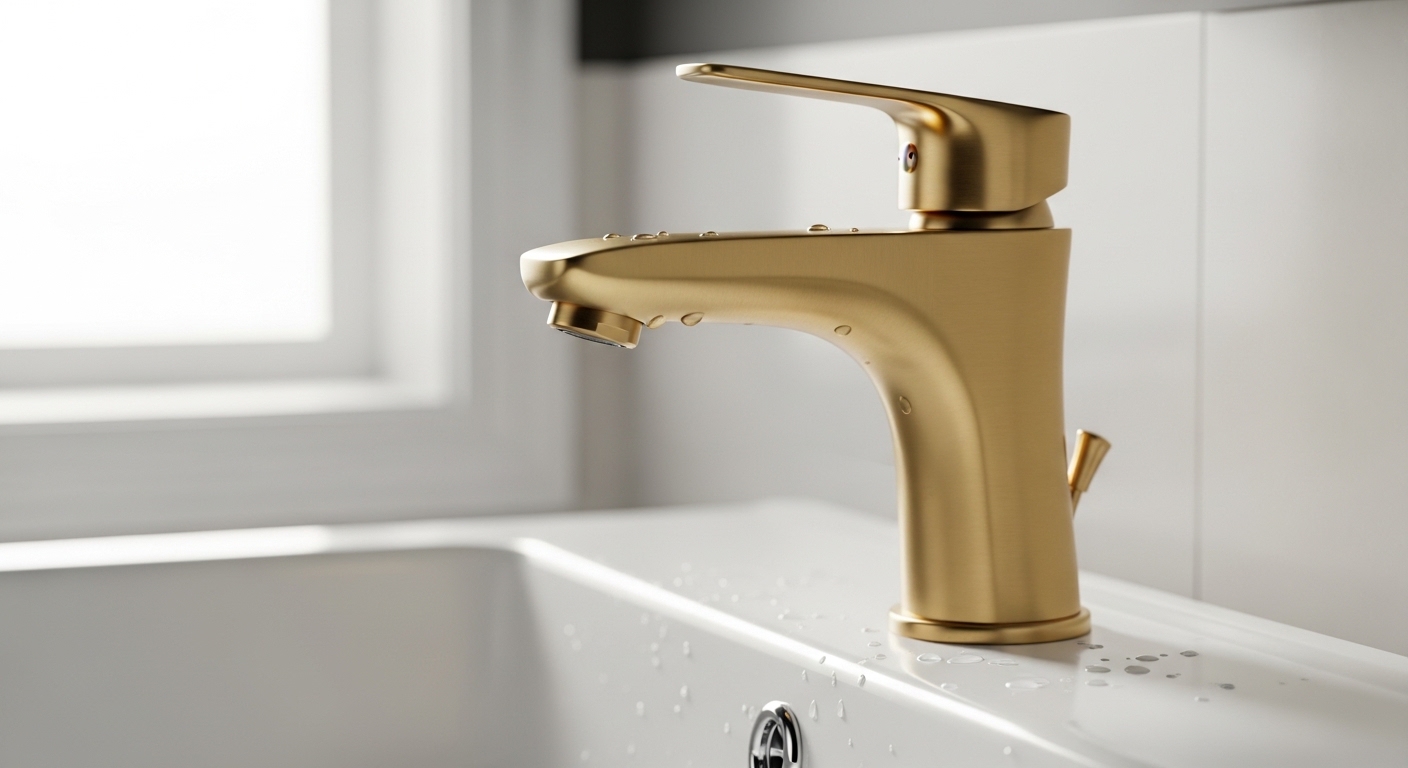
A brushed gold bathroom faucet one handle is a single-lever bathroom faucet finished in a soft, matte-warm gold (often called brushed gold, brushed brass, or champagne gold) where one handle controls both the water flow and the temperature. It’s one of the fastest-growing finishes in American bathrooms right now, and for good reason: it reads as high-end without the glare of polished brass, it plays nicely with both warm and cool color schemes, and the single-handle mechanism is the easiest kind of faucet to use with wet or soapy hands. Below, I’ll walk you through exactly what to look for, what it costs, how it compares to other finishes, and whether it’s the right call for your bathroom.
What exactly is a brushed gold one-handle bathroom faucet — and how is it different from polished gold?
A brushed gold one-handle faucet is a single-lever faucet whose surface has been brushed to a soft, satin sheen instead of buffed to a mirror shine. Where polished gold (or polished brass) throws back a bright, reflective glare, brushed gold has a low-luster, almost velvety look that scatters light. That one difference changes everything about how it lives in a real bathroom.
The practical payoff is huge. Brushed finishes hide water spots, dried toothpaste splatter, and fingerprints far better than any polished surface. On polished chrome or polished gold, every droplet shows; on brushed gold, the same droplets basically disappear until your next wipe-down. If you hate seeing a spotty faucet, this finish alone will make you happier every single day.
There’s also a color-temperature difference. True brushed gold leans warm and slightly champagne, not the bright yellow of costume jewelry. That warmth is what makes it flattering against white marble, gray quartz, matte-black accents, walnut vanities, and even dark green or navy cabinetry. It’s a genuine neutral-warm, which is why designers reach for it so often.
Is a single-handle faucet better than a two-handle one for a bathroom?
For most bathrooms, yes — a single-handle faucet is more convenient, and it usually installs faster too. With one lever you set both temperature and flow in a single motion, which matters most when your hands are covered in soap, lotion, or hair dye and you don’t want to grab two separate knobs.
Here’s the trade-off in plain terms. A single-handle faucet gives you speed and simplicity, and typically fits a single mounting hole (or covers three holes with an included deck plate). A two-handle widespread faucet gives you finer, independent control of hot and cold, and a more traditional, symmetrical look — but it’s fussier to use and has more parts that can eventually drip.
- Choose single-handle if: you want everyday convenience, a clean modern look, a faster install, and easier cleaning (fewer crevices).
- Choose two-handle if: you love a classic or transitional aesthetic, you want that symmetric hot/cold look, or you’re matching existing widespread fixtures.
- Watch the hole count: single-handle faucets come as single-hole or centerset. If your sink is pre-drilled for 3 holes and 4 inches on center, get a single-handle model that includes an escutcheon (deck plate) to cover the extra holes.
If you’re outfitting a compact powder room or a small vanity, a single-hole single-handle design is almost always the smart move because it frees up counter space. Our guide to whether the Elate single hole faucet is worth it for a small bathroom vanity breaks down that exact scenario in detail.
What should I look for so the brushed gold finish doesn’t wear off or turn pink?
Buy a faucet with a genuine PVD (Physical Vapor Deposition) brushed-gold finish over a solid-brass body — that’s the single most important thing to check. Cheap “gold” faucets use an electroplated or painted coating that scratches, tarnishes, and eventually turns blotchy or pinkish. PVD bonds the color at a molecular level and is dramatically harder and more corrosion-resistant.
Why does this matter so much for gold specifically? Gold tones are unforgiving. A worn spot on brushed nickel is easy to miss; a worn spot on gold reads as pink or brown and jumps out. PVD is what keeps that from happening. Reputable manufacturers back PVD finishes with a lifetime finish warranty precisely because the process is so durable.
Here’s a quick spec checklist to run through before you buy:
- Body material: solid brass (not zinc alloy or plastic). Brass resists corrosion and holds a finish better. It also feels reassuringly heavy in hand.
- Finish type: PVD brushed gold / brushed brass. If the listing just says “gold plated,” be cautious.
- Cartridge: ceramic disc, ideally a name-brand cartridge. This is the part that controls water and prevents drips.
- Compliance: lead-free waterway certified to NSF/ANSI 61 and 372, and a flow rate that meets EPA WaterSense (typically 1.2 GPM for bathroom faucets).
- Warranty: lifetime on finish and function is the industry standard for quality brands — accept nothing less.
Lead-free certification is not a nice-to-have; it’s the law for anything carrying drinking water in the U.S. If you want to understand what that label actually means and why it matters, read our explainer on what makes a bathroom sink faucet “lead free” and whether it’s worth buying in 2026.
Brushed gold vs. other popular finishes: which one is right for my bathroom?
Brushed gold is the best pick when you want warmth and a spot-hiding finish; brushed nickel is the safest neutral; matte black is the boldest modern statement; and chrome is the cheapest, most classic option. Here’s how the four most common single-handle finishes actually compare in daily use.
| Finish | Look & vibe | Hides spots/fingerprints | Best paired with | Relative cost |
|---|---|---|---|---|
| Brushed gold | Warm, modern, upscale | Excellent | White marble, matte black, walnut, navy | $$–$$$ |
| Brushed nickel | Neutral, safe, transitional | Very good | Almost anything | $$ |
| Matte black | Bold, contemporary, dramatic | Buono (shows dust/limescale) | White counters, light walls | $$–$$$ |
| Polished chrome | Bright, classic, timeless | Poor (shows everything) | Traditional and clean-modern alike | $ |
A few real-world notes on this table. Brushed gold and matte black have become the two “designer” finishes people choose when they want the bathroom to feel intentional rather than builder-grade. If you’re torn between them, gold warms a room and black grounds it — gold is friendlier in a small or windowless bathroom, while black pops hardest against bright white. If you like the darker, moody direction, our take on the matte black tub faucet covers the same trade-offs on the tub side so you can coordinate the whole room.
One coordination tip: you do not have to match your faucet to your drain, cabinet pulls, and light fixtures perfectly, but they should live in the same temperature family. Pair brushed gold with warm-metal accents; avoid mixing it with cool polished chrome right next to it, or the gold can start to look yellow by comparison.
How much should a good brushed gold single-handle bathroom faucet cost in 2026?
Expect to pay roughly $70–$140 for a solid, well-made brushed gold single-handle faucet, $140–$300 for a premium designer model, and under $60 only for entry-level pieces you should scrutinize carefully. Price tracks three things: body material, finish process, and cartridge quality — not the brand name on the box.
Here’s the honest breakdown of what your money buys:
- Under $60: often zinc-alloy bodies with electroplated “gold.” Some are fine for a rarely used guest bath, but many will show finish wear within a year or two. Read the material and warranty details closely.
- $70–$140 (the sweet spot): solid-brass body, PVD brushed-gold finish, ceramic-disc cartridge, WaterSense flow, lifetime finish warranty. This is where most buyers should shop — you get near-luxury quality without the luxury markup.
- $140–$300: designer styling, heavier brass, premium cartridges, sometimes a matching drain and pop-up assembly included. Worth it if you want a statement piece or a specific high-end silhouette.
Don’t over-index on the sticker price. A $110 faucet with the right specs will outlast a $200 faucet with a zinc body and a plated finish. Focus on solid brass + PVD + ceramic cartridge, and you’ll get value at any tier. If you’re comparing where to actually purchase, our roundup of the best place to buy a bathroom faucet in the USA in 2026 is a good next stop.
How do I keep a brushed gold faucet looking new?
Wipe it down with a soft cloth and mild soap, and never use abrasive scrubbers, acidic cleaners, or bleach — that’s the whole maintenance routine. Brushed gold is genuinely low-maintenance because the satin texture masks the daily spots that would show instantly on chrome, but the PVD finish still needs gentle care to stay flawless.
Follow these simple rules:
- Daily/weekly: a quick wipe with a damp microfiber cloth. Dry it after wiping to prevent any mineral buildup on the aerator.
- Avoid: vinegar left sitting on the finish, ammonia, bleach, scouring pads, and “polishing” creams. Acids can dull PVD over time if left in contact.
- For hard water on the aerator: unscrew the aerator and soak that part — not the whole faucet — in a diluted vinegar solution, then rinse. Our step-by-step on cleaning a faucet head with white vinegar shows exactly how to restore the flow without touching the finish.
If the faucet ever starts to drip or the handle gets loose years down the line, that’s almost always the cartridge, not the finish — an inexpensive fix. And if you ever get a slow seep around the base of the lever, our guide on why a bathroom faucet leaks from the handle and how to fix it yourself walks through the repair in about 20 minutes with basic tools.
Will brushed gold look dated in a few years?
Probably not — brushed and warm-metal finishes have proven far more durable as a trend than polished brass did in the 1980s, because the muted, satin tone reads as a neutral rather than a loud statement. Designers have been specifying brushed gold and champagne bronze steadily for years now, and the demand keeps climbing rather than fading.
The reason is simple: a matte warm metal behaves like a color-neutral. It coordinates with white, gray, black, wood tones, and moody paint colors, so it survives changes to your towels, paint, and accessories. The finish that dates a bathroom fastest is actually high-gloss anything, not warm satin metals. If you’re building or renovating a bathroom you plan to keep for a decade, brushed gold is a low-risk choice.
The bottom line: should you buy one?
If you want a bathroom that feels warm, current, and easy to keep clean — and you buy the right specs — a brushed gold bathroom faucet one handle model is one of the best value upgrades you can make. Get a solid-brass body, a PVD brushed-gold finish, and a ceramic-disc cartridge with a lifetime warranty, spend somewhere in the $70–$140 sweet spot, and you’ll have a faucet that looks like it cost three times as much and lasts for a decade or more.
FAQ
Does a brushed gold faucet show water spots and fingerprints?
Much less than polished finishes. The brushed, satin texture scatters light and masks the droplets, dried toothpaste, and fingerprints that show up instantly on polished chrome or polished gold. You’ll still want an occasional wipe-down, but day to day it stays looking clean far longer.
Will a brushed gold finish tarnish, turn pink, or wear off?
Not if it’s a real PVD finish over solid brass. PVD bonds the gold color at a molecular level and resists corrosion, scratching, and discoloration — which is why quality brands back it with a lifetime finish warranty. Cheap electroplated or painted “gold” is what tarnishes and turns pink over time, so check that the listing specifies PVD and a solid-brass body.
Does a single-handle gold faucet fit a sink with three holes?
Yes, as long as you buy a model that includes a deck plate (escutcheon). Single-handle faucets come as single-hole or centerset. A single-hole faucet with an included cover plate will mount in the center hole and hide the two outer holes on a standard 4-inch centerset sink. Check the product’s included accessories before buying.
Is brushed gold the same as champagne bronze or brushed brass?
They’re very close cousins and often used interchangeably in marketing. All three describe a warm, satin gold-ish metal. Exact tone varies slightly by manufacturer — some lean more champagne (lighter, pinker) and some more brass (deeper, warmer) — so if you’re matching multiple fixtures, buy them from the same brand and finish name to stay consistent.
Is a brushed gold faucet hard to install myself?
No — a single-handle faucet is one of the easiest fixtures to DIY. Most installs take 30–60 minutes with basic tools: shut off the supply valves, connect the supply lines, secure the mounting nut under the sink, attach the drain, and turn the water back on to check for leaks. If your model is single-hole and your sink has three holes, just use the included deck plate.
Do brushed gold faucets cost more than chrome or nickel?
Usually a little more than chrome, and roughly on par with or slightly above brushed nickel. Expect $70–$140 for a quality solid-brass PVD model. The premium is modest, and it buys you a more upscale look plus a finish that hides spots better — most buyers feel it’s well worth the small difference.
About the author: This guide was written by the AvitasHome fixtures team, drawing on hands-on testing of single-handle bathroom faucets across finishes, brass bodies, and cartridge types. About AvitasHome: AvitasHome (www.avitashome.com) specializes in faucets, showers, and bathroom fixtures for U.S. homes, and we evaluate every faucet we recommend against lead-free NSF/ANSI 61 & 372 certification, EPA WaterSense flow standards, and the manufacturer’s finish-and-function warranty before it earns a spot on our list.