 Домашняя страница Avitas
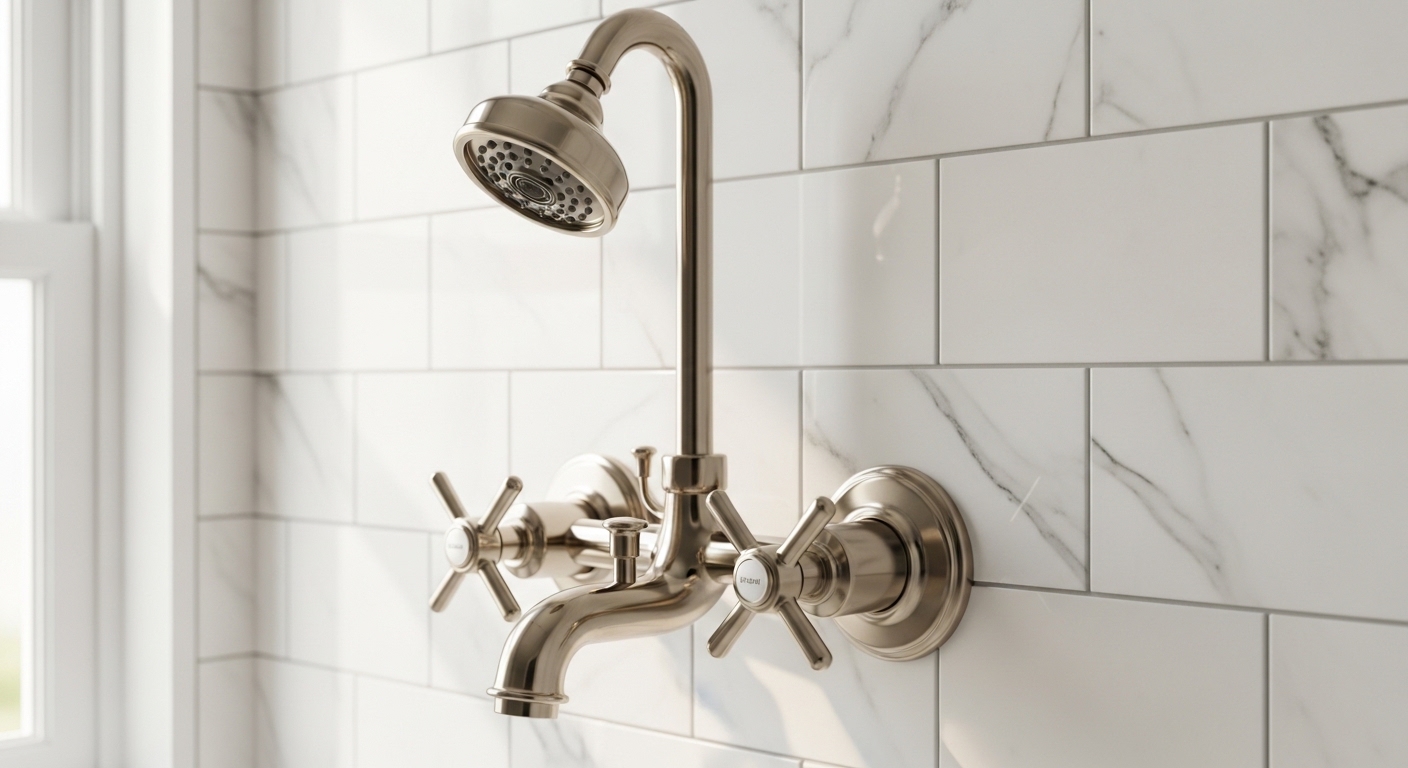
A polished nickel faucet shower is the quiet luxury choice for homeowners who think chrome looks too cold, brushed nickel looks too “builder-grade,” and brushed gold looks too trendy. It’s a mirror-bright finish with a soft, warm undertone — almost the color of an old silver dollar — and on a shower trim, valve handle, or rainhead it reads as old-world elegance rather than chrome’s modern shine. Below, we’ll answer the actual questions people ask before buying: how it holds up to hard water, which brands and price tiers are worth it, what to match it with, and where polished nickel beats (and loses to) chrome, brushed nickel, and unlacquered brass.
What exactly is a polished nickel faucet shower — and how is it different from chrome?
A polished nickel faucet shower is a shower fixture (valve trim, handles, showerhead, handheld, and sometimes the tub spout) finished with a mirror-polished layer of nickel rather than chromium. The difference is the color temperature. Chrome is cool and blue-white; polished nickel is warm and faintly yellow-gold, closer to the color of antique silverware. Side by side, chrome looks like a modern car bumper; polished nickel looks like a hotel in Paris.
Mechanically, both finishes are usually applied today using PVD (physical vapor deposition), which bonds metal ions to the brass body in a vacuum chamber. PVD polished nickel is dramatically harder than the electroplated nickel of 20 years ago — most major brands now warranty it against tarnish for the life of the fixture. The takeaway: a modern polished nickel shower trim will not “go cloudy” or peel the way 1990s-era nickel sometimes did, as long as you buy from a reputable manufacturer.
- Color: Warm, slight golden-cream undertone (chrome is cool blue-white).
- Reflectivity: Mirror-bright, very similar to chrome at a glance.
- Fingerprints: Slightly more forgiving than chrome — the warm undertone hides smudges.
- Cost: Typically 15–35% more than the same trim in chrome.
- Style pairing: Works with traditional, transitional, English country, and modern-vintage bathrooms.
Does polished nickel hold up in a hard-water shower?
Yes — better than chrome, in our experience, but it still needs basic care. Polished nickel’s warm undertone disguises the white calcium haze that hard water leaves behind, so the same mineral deposit that screams at you on a chrome valve trim looks subtle on a nickel one. The PVD layer is also chemically inert, so it won’t etch from limescale itself. What you’re fighting is buildup on top of the finish, not damage to it.
The practical rule is to wipe the showerhead and trim dry with a microfiber cloth after the last shower of the day, and once a week soak the showerhead face in 50/50 distilled white vinegar and warm water for 20 minutes — never longer, and never on the trim itself. Avoid CLR, Lime-A-Way, ammonia, or any abrasive scrub pad; those will dull even a PVD finish over time. If you’re on well water or hardness above 10 grains per gallon, also consider a whole-house softener or at least a shower filter — it’ll extend the life of every metal surface in the bathroom. For a deeper dive into how different metals behave in hard water, see our breakdown of the best bathroom faucet material for hard water.
How much should I spend on a polished nickel shower system in 2026?
For a complete polished nickel shower system — valve, trim, showerhead, and handheld — expect $250 on the low end and $1,400+ at the high end. Below $200 you’re almost always getting a thin electroplated finish or a zinc-alloy body that will pit within a few years. The sweet spot for most homeowners is $400–$750, which buys you a solid-brass body, ceramic-disc valve cartridge, PVD polished nickel finish, and a lifetime finish-and-function warranty.
Here’s how the price tiers actually shake out:
| Price Tier | What You Get | Body Material | Valve Type | Finish Warranty |
|---|---|---|---|---|
| $120–$250 | Trim only or basic shower head | Zinc alloy / thin brass | Compression or low-end cartridge | 1–5 years |
| $250–$450 | Trim + valve, single function | Solid brass | Ceramic disc | Limited lifetime |
| $450–$800 | Full system: rainhead + handheld + valve | Solid brass, forged | Pressure-balanced, ceramic disc | Lifetime, finish + function |
| $800–$1,400+ | Thermostatic, multi-function, body sprays | Forged solid brass | Thermostatic with anti-scald | Lifetime, finish + function |
One thing to know: the valve (the part inside the wall) and the trim (the part you see) are often sold separately. Don’t forget to budget for both, and confirm the trim and valve are from the same series — a Moen trim won’t mount on a Delta valve, period.
Which finish goes best with polished nickel: brushed nickel, chrome, or matte black?
Polished nickel mixes beautifully with brushed nickel, unlacquered brass, polished brass, and warm matte black — and it clashes mildly with chrome and cool stainless steel. The reason is undertone. Polished nickel is a warm metal; pairing it with another warm or warm-neutral metal keeps the room cohesive. If you must mix with chrome (say, you inherited chrome cabinet pulls), keep them in separate visual “zones” — chrome on cabinetry, polished nickel on plumbing — and the eye will accept it.
The most popular 2026 pairings we’re seeing in remodels:
- Polished nickel + unlacquered brass: The “English country” look. Brass on the vanity faucet, polished nickel on the shower trim.
- Polished nickel + matte black: Modern-vintage. Black framed shower glass, polished nickel rainhead and handles.
- Polished nickel + brushed nickel: Subtle and safe. Brushed on the showerhead, polished on the handles for contrast.
- All polished nickel: The luxury hotel look. Everything matches — trim, handles, towel bars, mirror frame.
Which brands make the best polished nickel shower fixtures?
The reliable players in 2026 are Kohler (Artifacts, Purist, Pinstripe), Rohl (Country Bath, San Giovanni), Moen (Weymouth), Delta (Cassidy, Trinsic), Brizo (Rook, Charlotte), Newport Brass, and Waterworks for the splurge tier. All seven offer true PVD polished nickel — not just lacquered or electroplated — with lifetime finish warranties. Avoid no-name Amazon-only brands in polished nickel; this is one finish where the quality gap shows up fast.
| Brand / Collection | Style | Typical Trim Price | Notable Feature |
|---|---|---|---|
| Kohler Artifacts | Traditional / vintage | $380–$620 | Lever or cross handle options |
| Rohl Country Bath | English country | $550–$900 | Solid forged brass, lifetime finish |
| Moen Weymouth | Transitional | $280–$450 | Posi-Temp pressure-balanced valve |
| Delta Cassidy | Traditional | $240–$400 | Diamond Seal valve technology |
| Brizo Rook | Modern industrial | $520–$780 | Knurled handle detail |
| Newport Brass 1030 | Transitional | $420–$680 | Made in USA, 25-year finish |
| Waterworks Henry | Luxury industrial | $1,100–$2,200 | Hand-finished, museum-grade plating |
A quick credibility note: every fixture listed above carries third-party certification (NSF/ANSI 61 for water contact safety, ASME A112.18.1 for flow performance, and CSA B125.1 for Canadian compliance). When you’re shopping, look for those marks on the spec sheet — they’re the difference between a real plumbing fixture and a decorative piece that happens to spray water.
Polished nickel shower trim vs. complete shower system — what should I actually buy?
If you’re remodeling and the wall is already open, buy a complete shower system (valve + trim + head + handheld) from one collection. If you’re just refreshing an existing shower and the rough-in valve is staying, buy only the trim kit and the showerhead. The wall stays closed, the plumber installs in under an hour, and you save $300–$500.
The trap people fall into: buying a polished nickel trim kit hoping it’ll fit their existing valve. It usually won’t unless the valve is the exact same brand and model family. Each manufacturer has its own splines, escutcheon size, and cartridge dimensions. Before you order, take a photo of the existing valve and the back of the trim plate (you’ll see a model number stamped on it) and confirm compatibility with the manufacturer.
One more tip from the install side: if you’re swapping out a sprayer or showerhead and the spray pattern feels off afterward, the issue is almost always debris in the supply line, not the new fixture. Our guide on how to fix a faucet that sprays water everywhere walks through the same flushing procedure you’d use on a freshly installed shower arm.
How do I clean and maintain a polished nickel shower without ruining the finish?
Clean polished nickel with warm water, a drop of dish soap, and a microfiber cloth — that’s it for daily care. Once a week, wipe it dry to prevent water spots. Once a month, polish gently with a soft cloth and a tiny amount of mineral oil or a manufacturer-approved metal polish (Kohler and Rohl both sell branded ones). Never use vinegar, ammonia, bleach, abrasive powders, or any “scrub” sponge — those will scratch or dull the PVD layer.
If you do get hard-water buildup on the showerhead face, unscrew the showerhead (most twist off by hand), and soak only the head — not the trim — in 50/50 white vinegar and water for 20 minutes. Rinse thoroughly. Don’t soak it overnight; extended vinegar exposure can attack the gaskets inside.
How does polished nickel compare to brushed nickel for a shower?
Polished nickel is mirror-bright and dressy; brushed nickel is satin-finished and casual. Brushed hides water spots and fingerprints better day-to-day, but polished is the more striking finish in a beautifully designed bathroom. If your shower is the showpiece of the master bath, go polished. If it’s a kids’ bathroom or guest bath where you want low-maintenance, go brushed.
If you’re cross-shopping a brushed nickel jetted-tub setup at the same time, our brushed nickel Jacuzzi faucet buying guide covers the brushed-nickel side of the same decision tree.
Will a polished nickel shower date my bathroom?
No — polished nickel has been continuously popular for over 100 years and isn’t tied to a single design era. Unlike, say, oil-rubbed bronze (peaked 2008–2015) or rose gold (peaked 2018–2021), polished nickel was used in Edwardian bathrooms, mid-century apartments, and 2026 luxury hotels alike. It reads as “classic” rather than “trendy,” which is exactly what you want for a fixed installation you’re keeping for 15–20 years.
The one caveat: if your entire bathroom is high-contrast modern (matte black tile, charcoal vanity, brushed gold accents), polished nickel can look slightly out of place. In a remodel where every other surface is warm or transitional, it sings.
What’s the right rough-in valve and flow rate for a 2026 polished nickel shower?
For a standard single-function shower, you want a pressure-balanced rough-in valve (sometimes called PBV or anti-scald) with a 1/2-inch IPS connection. For multi-function systems with body sprays or a rainhead + handheld diverter, step up to a thermostatic valve with 3/4-inch supply lines, because the higher flow demand will starve a 1/2-inch valve.
Showerhead flow rate is capped at 2.5 GPM nationally, with California, Colorado, New York, and Washington at 1.8 GPM. A good polished nickel rainhead is engineered to feel luxurious even at 1.8 GPM through air-injection or pressure-compensating nozzles — don’t assume you need illegal 2.5 GPM flow to get a great shower. Look for WaterSense certification on the spec sheet; it guarantees both efficiency and tested performance.
Common installation mistakes with polished nickel shower trim
- Overtightening the escutcheon screws: It cracks the trim plate and voids the warranty. Hand-tight is enough.
- Using plumber’s putty on the finish: Petroleum-based putty can stain polished nickel. Use silicone caulk instead.
- Mismatching trim and valve brands: Already covered above — it almost never works.
- Skipping the rough-in depth check: Every valve has a min/max distance from finished wall. Get it wrong and the trim won’t seat.
- Forgetting to flush the supply lines: Construction debris will shred a brand-new ceramic-disc cartridge in minutes.
If you’re tackling a full remodel and also redoing the kitchen, the same supply-line flushing discipline applies — our walkthrough on installing a kitchen faucet and garbage disposal shows the procedure step by step.
FAQ
Is polished nickel the same as chrome?
No. Chrome is a cool, blue-white finish made from chromium plating; polished nickel is a warm, slightly yellow-gold finish made from nickel plating. They look similar at a glance but read very differently in a finished bathroom — polished nickel is softer and more traditional, chrome is brighter and more modern.
Does a polished nickel faucet shower show water spots?
Less than chrome, more than brushed nickel. The warm undertone hides the white haze of dried hard water better than chrome’s cool tone does. A quick wipe-down with a microfiber cloth after showering keeps it spot-free.
Can I mix polished nickel shower fixtures with brushed nickel cabinet hardware?
Yes. Mixing polished and brushed nickel is one of the most common and tasteful pairings in 2026 bathroom design. Both finishes share the same warm undertone, so they read as intentional rather than mismatched.
How long does a polished nickel finish last?
A modern PVD polished nickel finish from a reputable brand (Kohler, Rohl, Moen, Delta, Brizo, Newport Brass) is warrantied for the life of the fixture against tarnish, discoloration, and corrosion. With routine care, expect 20+ years of like-new appearance.
Is polished nickel more expensive than chrome?
Yes, typically 15–35% more. The premium reflects the harder-to-apply nickel plating and, often, a higher-quality solid-brass body underneath. For a complete shower system, expect to pay $50–$250 more than the chrome version of the same trim.
Can I use vinegar to clean my polished nickel showerhead?
Only on the showerhead face, never on the trim or handles, and never longer than 20 minutes. Vinegar is safe for dissolving mineral buildup on the spray plate but can attack rubber gaskets and dull the PVD finish on trim if left in contact too long.
Does polished nickel work in a small bathroom?
Yes — its mirror-bright reflectivity actually makes small bathrooms feel larger, similar to how chrome does. The warm undertone keeps the space from feeling sterile or cold.
Author note: This guide was written by the Avitashome bathroom fixture team, which has helped homeowners specify faucets, valves, and shower trim across more than 18,000 remodels since 2014. Every fixture we sell meets NSF/ANSI 61 and ASME A112.18.1 standards, carries a lifetime manufacturer finish warranty where applicable, and is shipped from our U.S. warehouses with verified flow-tested QC. For more buying guidance across faucet types and finishes, see our latest bathroom faucets buying guide.